Sleeping under a curved glass ceiling while snow falls outside sounds like a dream, but most travelers hesitate at one practical question: can a tent really stay warm when temperatures drop below freezing? That doubt keeps a lot of people from booking dome glamping in winter, and honestly, the hesitation is reasonable. Some domes are genuinely winter-ready; others are summer tents that shut down in the cold months.
This guide walks through what actually separates the two. We explain how four-season domes are built, what heating systems feel like overnight, and how snow affects access to remote sites. You will also find a practical packing list, realistic price ranges and booking timelines, and a checklist for spotting listings that are truly winter-proof rather than just well-photographed. By the end, you will know exactly what to expect from a night in the snow, from the first crackle of the wood stove to the cold floor by the door in the morning.
How Dome Glamping in Winter Actually Works
A winter-ready geodesic dome is a different animal from the lightweight festival-style tent most people picture. Proper four-season builds use insulated covers and thermal liners that trap heat inside, while the frame itself is reinforced to carry real weight. Well-built winter domes are rated for snow loads of roughly 30 cm or more, so a steady overnight snowfall is something the structure is designed to handle, not an emergency.
The design detail that sells most travelers on the experience is the window. A transparent or panoramic window section is standard on these domes, which means you can watch snowflakes drift down and see the night sky without leaving your bed. On clear evenings, that curved pane above you becomes the entire show.
Not every dome is a winter dome
Here is the catch: not all domes are four-season structures. Many operators run summer-only tents, which are typically closed from November to March because their thin fabric and basic frames cannot cope with snow or deep cold. If a listing goes quiet for the winter months, that is usually your answer.
When browsing, look for explicit language about winter use, insulation and snow ratings rather than assuming a dome that looks sturdy in photos will perform the same in January. The difference between a true four-season build and a fair-weather tent shows up the moment temperatures drop.
Heating Systems and What They Feel Like Indoors
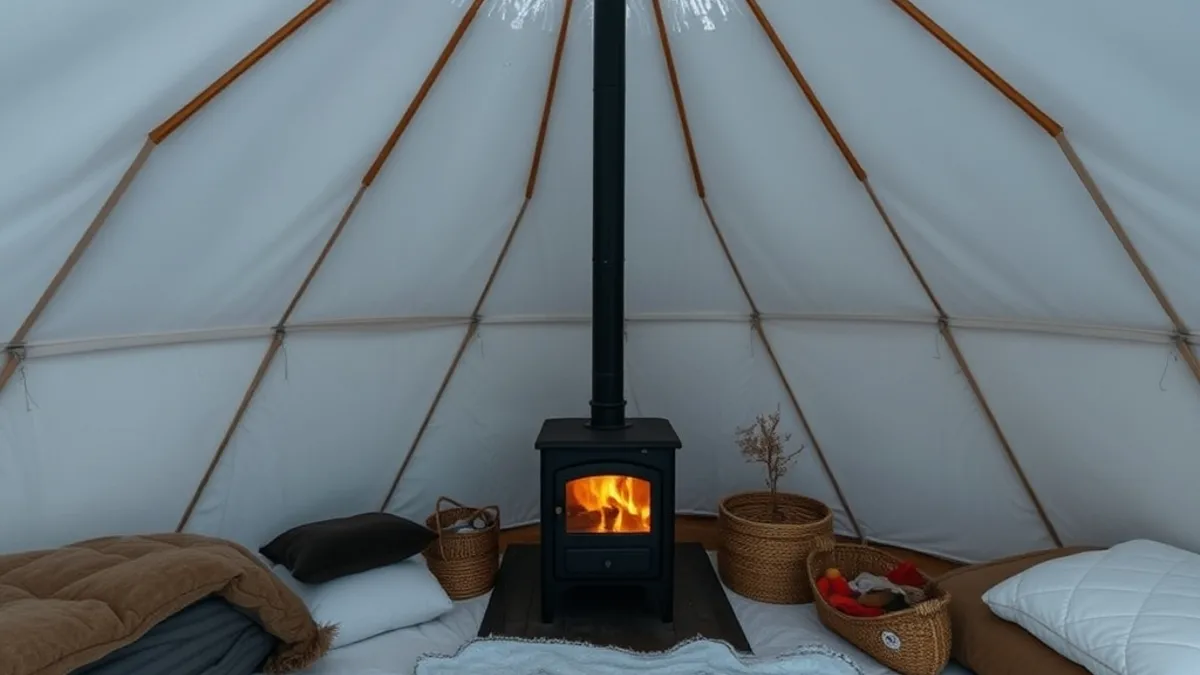
Heat in a winter dome usually comes from one of three sources: a wood stove, underfloor heating, or a diesel or gas heater. Many operators combine two of these in a single dome, for example a wood stove for atmosphere with a backup heater that kicks in overnight. Most winter domes rely on one of these systems, so it is worth knowing what each feels like before you book.
Wood stoves: warm but hands-on
A well-fed wood stove keeps interiors around 18-22°C (64-72°F), which feels genuinely cozy when there is a meter of snow outside. The trade-off is that heat drops quickly overnight unless the stove is reloaded. If you sleep through the night without waking, expect a noticeably cooler dome by morning, especially far from the stove itself. Some hosts pre-stack firewood beside the stove so you can feed it without going outside; others leave a pile near the entrance.
Underfloor heating and backup heaters
Underfloor heating gives steadier warmth and solves the cold-floor problem that wood-stove domes often have, but it usually comes at the higher end of the $150-400 per night range. Diesel and gas heaters are less romantic but dependable, and they are often what keeps the dome comfortable while you are out for the day. If you run cold at night, ask the host which system runs unattended and whether a thermostat keeps it on while you sleep.
Snow, Access and Getting There
Getting to a snowbound dome is often the trickiest part of the trip, not the stay itself. Heavy snowfall can leave the final stretch of access road passable only with 4WD, and some hosts ask guests to park lower down and walk the last few hundred meters, pulling luggage on sleds the site provides. It sounds rustic, and it is, so it helps to know the arrangement before you arrive rather than discovering it in a snowstorm.
Remote winter dome sites, such as those in Nordic and mountain regions, also have to contend with short days. In deep winter, usable daylight can be just a handful of hours, so plan your arrival well before dark. Finding an unmarked track or a dome in the trees at night with falling snow is nobody’s idea of a smooth check-in. For a sense of how remote these setups can be, this piece on remote hideaways near Khuvsgul for open-sky stillness gives a good feel for what far-flung winter sites are like.
Before booking a multi-day stay, ask two direct questions: is snow clearing included, and how often does it happen? A road that is cleared on arrival day but not again can leave you snowed in, which some guests love and others regret.
- Ask about arrival logistics in writing. Confirm whether the host meets you, sends GPS pins for the final track, or expects you to follow marked poles, since signage under snow is often minimal or buried.
- Check what happens to your car. Some sites require you to leave vehicles at a winter parking area, so ask how far the walk is and whether luggage sleds or host transport are available.
- Find out the resupply situation. If the nearest shop or restaurant is a drive away on snow-cleared roads, ask whether meals, groceries or firewood deliveries can be arranged during your stay.
What to Pack for a Winter Dome Stay
Packing for a winter dome stay is different from a summer glamping trip, mostly because of the temperature swings you’ll encounter between the heated interior and the outdoors. Even a dome with excellent heating will have cold zones near the entrance, where the floor loses warmth every time the door opens. That first barefoot step onto the platform in the morning is a memorable one, and not in a good way, unless you’ve planned for it. Packing with a little strategy makes those moments a non-issue rather than a daily shock.
Lighting and power deserve more thought than you might expect. Remote dome sites are often deliberately low-light to preserve the night sky, so paths between your dome and the bathroom or parking area can be genuinely dark. And because many sites sit off the grid or rely on limited generators, power cuts do happen, even if only briefly. A little redundancy in your bag goes a long way when the nearest outlet is hours away.
Here’s what to have in your bag:
- Insulated slippers or wool socks: Keep a pair right by the bed so you’re never crossing a cold floor barefoot, especially at night when temperatures inside drop a few degrees.
- A headlamp: Unlike a phone flashlight, it leaves both hands free for carrying hot drinks, firewood or your wash bag along an unlit path.
- A power bank: Useful for keeping phones and cameras charged if the site’s electricity is limited or cuts out, and essential if you’re relying on your phone for navigation on arrival.
- Thermal base layers: You’ll want them for outdoor hot tubs and stargazing breaks, which can mean stepping out of a warm dome into air of -10°C or colder, then back in again.
Booking Windows, Prices and Minimum Stays
Winter dome stays have moved well beyond a niche curiosity, and the most desirable sites now sell out their best dates months in advance. For peak periods, the rule of thumb is simple: reserve Christmas, New Year and February half-term dates 3-6 months ahead. Book later than that and you’ll usually be choosing from the leftovers, often the less insulated domes or the least convenient locations.
What you’ll pay
Prices vary widely by location and what’s included, so compare like for like. Basic domes with a shared bathroom sit at the lower end of the market, while glass-ceiling domes and those with private hot tubs command the top of the range. Some sites also add a winter surcharge to cover extra heating and snow clearing, so check what the quoted rate actually includes before booking. Ask whether firewood, bedding upgrades and hot tub use are part of the deal or billed separately, because these extras add up quickly over a multi-night stay.
Minimum stays and the January trick
Many winter sites enforce 2-night minimums on weekends, which rules out spontaneous one-night trips during the busiest periods. If your schedule allows it, January midweek dates are the easiest to get, often with better availability and quieter sites. You sacrifice the festive atmosphere, but you gain a calmer experience and, frequently, a lower rate. Check current availability and prices directly with operators, since they vary by site and season.
How to Spot a Genuinely Winter-Proof Dome
Not every dome listed online is built for winter, and a true four-season structure is a very different thing from a summer tent with a portable heater bolted inside. The gap shows up fast once temperatures drop well below freezing. The good news is that genuinely winter-proof domes tend to advertise it clearly, with technical details front and center. Vague, cozy-sounding descriptions with no specifics are a warning sign worth taking seriously.
Reviews are your best tool here, but be selective. A glowing review from July tells you little about how the dome performs in January. Focus on the most recent winter-season reviews and read them specifically for how the structure and heating held up in real conditions, since a dome that felt magical in mild weather can be a different story during a cold snap.
When comparing listings, look for these specifics:
- A stated four-season rating: Reputable operators mention insulated liners and a named heating system, such as a wood stove or underfloor heating, rather than relying on the word “cozy” to do all the work.
- Winter review details on condensation and stoves: Condensation dripping from the ceiling overnight and stoves that die out after a few hours are the two most common complaints, so search reviews for those exact topics.
- Snow access mentioned by recent guests: Comments on whether roads were cleared and how easy arrival was in heavy snowfall tell you more than any listing description can.
- Where the bathroom and kitchen are: An en-suite dome and a dome with facilities in a separate shared building are very different experiences in winter, especially when that walk involves snow, ice and darkness, so confirm this before booking.
The Winter Dome Experience, Summed Up
So, can you actually sleep warm under a glass dome while the snow falls outside? Yes, as long as the dome is a genuine four-season build with a reinforced frame, an insulated liner and a heating system that works through the night. The worry about freezing in a tent is fair, but a well-built winter dome holds a comfortable 18-22°C indoors even when it is far below zero outside.
The reward is exactly what draws people in: snow-covered views from bed, a crackling wood stove and starlit ceilings. The trade-offs are real too — cold floors near the entrance, short winter days and higher peak-season prices. Book 3-6 months ahead for popular dates and pack for sub-zero evenings, and the stay tends to live up to the photos. If you have tried a winter dome stay, share how it went in the comments.