Plenty of villas call themselves eco while offering little more than a recycling bin in the kitchen. That leaves travelers in an awkward spot: you want to book somewhere that genuinely treads lightly, but the green claims on listing pages rarely come with proof. The word eco is unregulated in hospitality, so a villa with low-flow showerheads can market itself right alongside one that runs entirely on sunshine and rainwater.
This guide cuts through the noise. We break down what eco villas actually mean in 2025, what a serious solar setup looks like on the roof, and how rainwater, greywater and recycling systems separate real infrastructure from window dressing. We also cover the materials and food sourcing that matter beyond utilities, share practical ways to spot greenwashing before you book, and highlight destinations where sustainable stays genuinely thrive. By the end, you’ll know exactly which questions to ask a host and which numbers to look for in a listing.
What Eco Villas Actually Mean in 2025
The word “eco” carries no legal definition in hospitality. A villa can slap it on a listing after installing low-flow showerheads, while another uses it to describe a fully off-grid build with solar power, rainwater harvesting and composting toilets. Both are allowed to make the same claim, which is exactly why travelers need to read listings more carefully than they read a menu.
A credible eco villa addresses the big four together: energy, water, waste and construction materials. A property that generates its own solar power but ships in pallets of bottled water is solving one problem while creating another. The strongest operations treat sustainability as a system, not a single token feature to photograph for the listing.
Numbers beat adjectives
The fastest way to judge a villa is to look for measurable data. Serious operators publish figures like annual energy generation in kilowatt-hours or liters of water saved per guest stay. If a listing describes itself as “deeply committed to the planet” without a single number attached, that commitment is doing less work than the adjectives suggest.
Third-party certifications also do real filtering here. Green Globe and EarthCheck audit properties against defined standards, which separates verified operations from marketing language. A certification name in a listing is worth far more than any self-declared eco label, so treat it as one of your first checkpoints when comparing options.
Solar Power: What to Look For on the Roof
Solar is the headline feature of most eco villas, but the details on the roof tell you whether it’s a genuine power source or a decorative gesture. A serious setup pairs a panel array in the 5-10 kW range with battery storage of 10-20 kWh. The panels handle daytime demand; the batteries are what keep the lights on after dark. A villa with panels but no meaningful storage goes dark or falls back on other sources the moment the sun sets, which is when most guests actually use electricity.
In sunny climates, an array of that size typically covers 60-90% of a villa’s daytime electricity. Ask the host whether the property is grid-tied with solar backup or fully off-grid. Fully off-grid villas are rarer and usually pricier, because they need enough generation and storage to run everything without a safety net.
The cheap features that reveal priorities
Solar water heaters and solar pool heating are among the cheapest green features to install. If a villa has invested in them, it signals genuine commitment; if it hasn’t, that absence is a red flag that corners are being cut elsewhere too. A “solar-powered” villa heating its pool with gas deserves a second look.
Well-run villas also manage when energy gets used, not just where it comes from. Peak solar output runs roughly 10am-3pm, so good operations schedule laundry and pool pumping to those hours rather than drawing on batteries at night. It’s a small operational detail, but asking about it tells you whether the villa is actively managed or just wearing a green label.
Water Systems: Rainwater, Greywater and Recycling
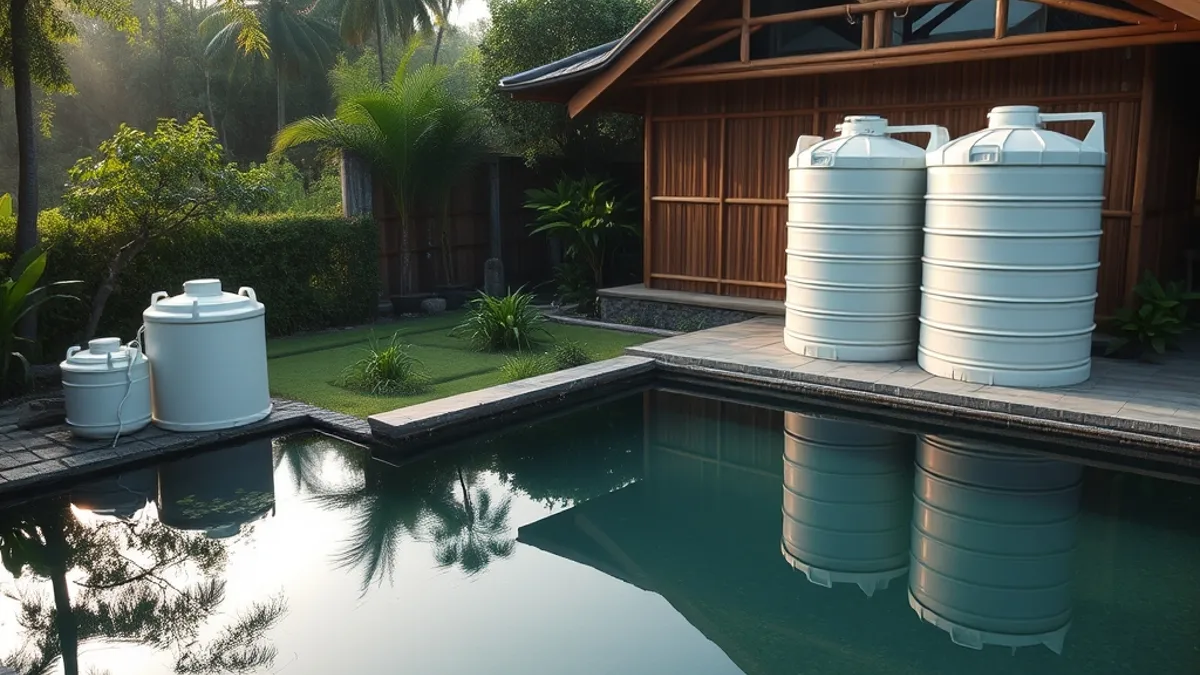
Water is where eco villas truly earn the label, because water systems are expensive to fake. In wet climates, a well-designed rainwater harvesting system with adequate tank storage can cover 40-70% of a villa’s annual water needs. The key phrase is adequate storage: catching rain is easy, but without enough tank capacity the water simply overflows during a storm and runs out during a dry spell.
Greywater systems take the next step by reusing water from showers and sinks to irrigate gardens. Done properly, this cuts fresh water use by 30-50% per guest stay, which matters enormously in regions where every liter counts.
What to check in the water story
Beyond the headline systems, a few details reveal how complete a villa’s water design really is:
- Blackwater treatment. Constructed wetlands or composting toilets that handle toilet waste on-site signal a genuinely closed-loop design, rather than one that recycles the easy water and forgets the rest.
- Fixture choices. Low-flow showerheads and dual-flush toilets reduce demand at the source, making every other system in the chain work less hard.
- Landscaping. Native, drought-tolerant planting needs far less irrigation than imported lawns and ornamentals, which matters most in dry regions where water is the binding constraint.
- Storage maintenance. Tanks and reed beds that are cleaned and inspected regularly work as designed; neglected ones can breed mosquitoes or affect water pressure, both of which show up in guest reviews.
In dry destinations, these details matter more than any solar panel. A villa that harvests rain, reuses greywater and treats its own waste is running a real water budget, and that’s the kind of operation worth booking.
Beyond Utilities: Materials, Waste and Food Sourcing
The villa itself is a big part of its footprint, long before the lights come on. Materials with high embodied carbon, like imported concrete and steel shipped across oceans, undo a lot of good done by rooftop panels. A genuinely green build leans on locally sourced timber, bamboo and stone, or reclaims materials from older structures. Ask where the walls and floors came from; a good host will enjoy answering.
Waste is the other half of the story. Look for villas that compost food scraps, offer plastic-free toiletries in refillable dispensers, and run an on-site recycling system. These details show the property manages its waste rather than quietly trucking it to a landfill and hoping nobody asks.
Food, gardens and the bottled water test
A kitchen garden on site, or a menu built around local produce, shortens the supply chain and usually tastes better. Meals built on whatever is grown nearby tend to change with the seasons, which is exactly what you want at a villa that takes its surroundings seriously.
One warning sign deserves special attention: bulk deliveries of plastic bottled water. It contradicts everything else an eco villa claims to be. Filtered refill stations, ideally with glass bottles in every room, are the standard among properties that truly walk the talk. If the fridge is stacked with single-use bottles, treat it as a clue that other green claims may be thinner than they look.
How to Spot Greenwashing Before You Book
Booking a genuinely sustainable villa means doing a little detective work, since anyone can slap a green label on a listing. The burden of proof falls on you as the booker, but the good news is that separating real eco villas from marketing language takes little effort if you know where to look. The steps below take maybe fifteen minutes and will filter out most of the pretenders.
- Scan the listing for numbers, not adjectives. Specifics like kilowatt figures for the solar array, tank sizes for rainwater storage, or the names of certifications such as Green Globe or EarthCheck carry real weight. Vague words like “conscious” or “earth-friendly” carry none, because anyone can use them.
- Message the host with two pointed questions. Ask what share of the villa’s energy comes from solar, and what happens to the greywater from showers and sinks. A host running a real system answers within a day and with specifics. Evasive or generic replies tell you what you need to know.
- Mine recent reviews for operational clues. Look for mentions of power outages, weak water pressure, or mosquitoes breeding near untreated water storage. These reveal whether the systems actually work day to day, not just in the photos.
- Sanity-check the price. A true off-grid eco villa typically costs 10-30% more than a conventional equivalent in the same area, because batteries, tanks and treatment systems cost real money. A suspiciously cheap “eco” stay rarely is one.
Timing matters more than most travelers realize. If a host claims to run on solar, ask how they handle the hours outside the 10am-3pm peak, and whether heavy tasks like laundry and pool pumping are scheduled to match the sun. The answer reveals whether someone actually manages the system or simply installed panels for the listing photos.
None of this requires expertise, just a willingness to ask. Hosts with genuine infrastructure are usually proud of it and happy to talk numbers, tank sizes and kilowatts included. The ones who deflect, or who answer every question with a paragraph about their love of nature, are giving you your answer before you ever arrive. Trust the specifics, and you will rarely be disappointed.
Where Eco Villas Thrive: Destinations Doing It Well
Certain destinations make it far easier to build and run a credible eco villa, because nature hands them the right raw materials. Strong sun, reliable rain and remote locations each push owners toward systems that actually work, rather than token gestures.
Islands, wellness hubs and forest retreats
Tropical islands with strong sun and heavy rainfall are natural fits for combined solar and rainwater systems. Fiji’s Yasawa chain is a good example, where well-designed bungalows can harvest rain during wet months and lean on panels the rest of the year. If this appeals to you, our guide to Yasawa bungalows and secluded Pacific beauty goes deeper on what to expect.
Wellness-focused regions have gone further still. Nosara, on Costa Rica’s Pacific coast, has built a whole ecosystem of certified sustainable stays, so you can compare several genuine options within a few kilometers. In cooler climates, forest and mountain retreats often lead on biomass heating and construction from local timber, with the Black Forest in Germany a long-standing example of both.
Where solar is a necessity, not a slogan
Remote destinations with weak or unreliable grids, from Zanzibar’s coast to the Maldives, deserve special mention. There, solar plus battery storage is a practical necessity rather than a marketing line, and properties that do it well have often refined their systems over years of real operation. If a genuine off-grid experience is your priority, these remote stretches of coastline are often where the most serious infrastructure lives.
The Bottom Line on Choosing an Eco Villa
With all that covered, the pattern behind a genuinely green villa should now be easy to see. Real eco stays treat energy, water, waste and building materials as one connected system, and they back their claims with numbers a host can actually verify. When a listing or owner answers your questions with specifics instead of adjectives, you have probably found one of the good ones.
That vagueness is exactly what this guide set out to fix, because a recycling bin alone tells you nothing about how a property is run. The premium you sometimes pay for a truly self-sufficient villa tends to reflect real infrastructure, not marketing, so treat suspiciously cheap “eco” rates with healthy skepticism. Use the checks from the sections above before you book, and the word “eco” starts meaning something again. If this helped you plan a greener stay, leave a comment or share the article.