Every traveler knows the small moment of doubt: you’re heading out for the day, passport and spare cash in hand, and you pause at the door wondering if everything you leave behind is actually safe. Should you lock your valuables in the room safe, or hand them over to the front desk and trust the hotel’s system? It’s one of the most common security questions in travel, and the answer matters more than most people realize.
The truth is that hotel safe deposit boxes and in-room safes work very differently, and each has real strengths and real weaknesses. In this guide, we’ll walk through how each option actually works, compare their security head to head, look at what hotels will and won’t compensate you for, and share a simple splitting strategy plus a quick check-in routine. By the end, you’ll know exactly what to store where on your next stay.
How Hotel Safe Deposit Boxes Work
A hotel safe deposit box is a small locked metal box kept behind the front desk or inside a separate locked vault area at the hotel. You don’t get open access to the vault itself; instead, a staff member accompanies you whenever you want to deposit or retrieve something. Your key, plus the presence of an employee, is what opens the box. This dual control is the foundation of the whole system: no single person, including you or a rogue staff member, can get into your box alone.
The paper trail behind every visit
Each trip to the box is a formal transaction. You’ll typically be asked for photo ID and a signature before anything comes out or goes in, which creates a written record of every single deposit and withdrawal. That paper trail matters enormously if anything ever goes missing, because there’s a documented account of who accessed the box and when. It also acts as a natural deterrent, since anyone tampering with the system leaves evidence behind.
Cost and availability
In most hotels the service is free, or requires only a small refundable deposit, rarely over $20. The main trade-off is timing: the boxes sit behind the reception desk, so they’re only reachable during staffed reception hours, roughly 6 am to 11 pm at many properties. If you return from a late dinner at midnight and want your passport back for an early-morning flight, the front desk may simply not be staffed to help you. Check the exact hours with your hotel when you deposit anything, and plan around them.
How In-Room Safes Work
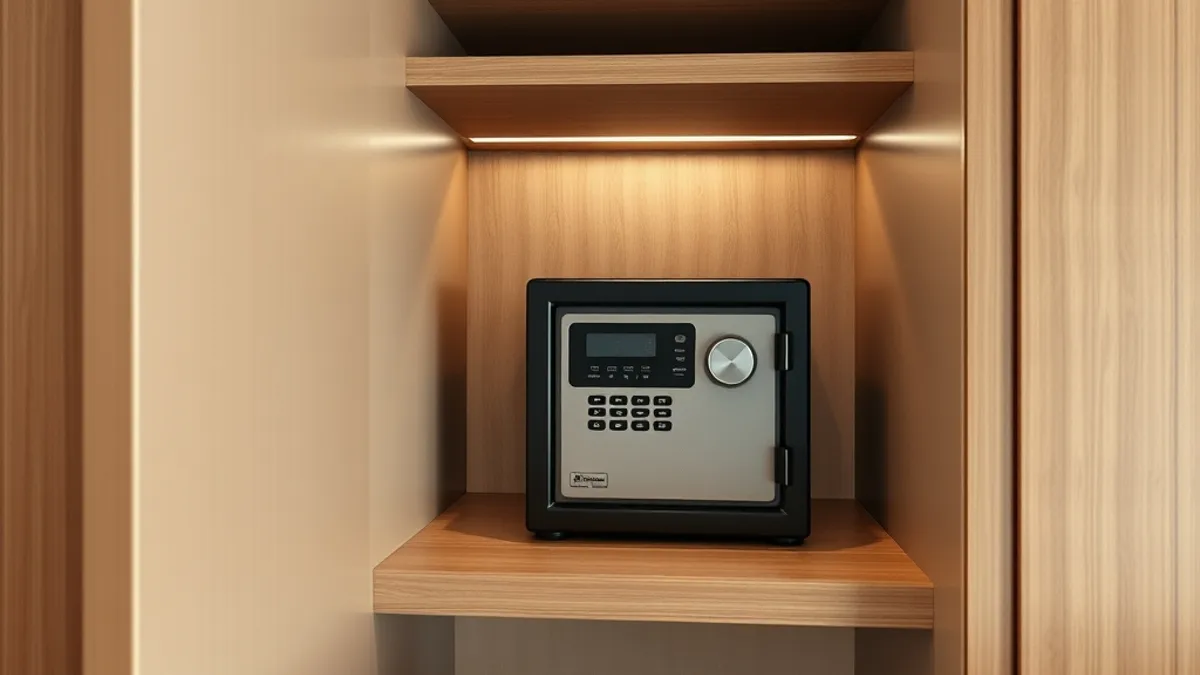
The in-room safe is the small steel box you’ll find bolted inside a closet or wardrobe in most hotel rooms. When you check in, you program it with a personal code, usually 4-6 digits, that only you know. From that moment, the safe opens for that code alone, and you can come and go as you please without ever speaking to a member of staff.
Reset the code first, always
Here’s the step many guests skip: reset the code the moment you arrive. Default factory codes and common override combinations for popular safe models are widely known and easy to find online, which means an unreset safe may offer almost no protection at all. Choose a code that isn’t your birthday or your room number, lock the safe, and test that it opens with your new code before you put anything inside.
What actually fits inside
These safes are sized for flat, valuable items rather than bulk. A typical in-room safe holds laptops up to roughly 15-17 inches, along with passports, wallets, cameras and phones. Larger bags usually don’t fit, so a full daypack or a purse stuffed with everything you own will need another solution. Pack a slim pouch with the items you intend to lock away, and keep the bag itself out of sight in a wardrobe or under the bed as a secondary measure.
Round-the-clock access
The big advantage is availability. The safe is in your room 24 hours a day, with no staff interaction and no reception hours to work around. If you land on a late flight and check in at midnight, or you leave for an airport transfer before dawn, you can still retrieve your documents and electronics without waiting for the front desk to open. For many travelers, that convenience alone is why the room safe becomes their default choice.
Security Comparison: Hotel Safe Deposit Boxes vs In-Room Safes
When you put the two options side by side, the differences come down to environment and construction. A front-desk deposit box lives in a staffed, alarmed area of the hotel, usually within sight of reception cameras and employees. Attacking it means getting past a controlled access point, and any tampering happens in one of the most watched spaces in the building. A closet-mounted room safe, by contrast, sits inside a room that housekeeping, maintenance and any number of visitors may enter during your stay.
How much resistance does a room safe offer?
In-room safes are rated against opportunistic theft, not a determined professional attack. Most models will resist only a few minutes of tampering before giving way, which is enough to deter a thief who wants a quick, quiet grab, but not much more. They’re also relatively light units bolted into furniture, and their electronic locks are their soft spot. If someone has time, tools and privacy, the rating offers limited protection.
The master code problem
The bigger structural weakness is that room safes carry master or override codes held by hotel staff. These exist for legitimate reasons, such as guests who lock themselves out or forget their code, but they mean the safe’s security ultimately depends on how carefully the hotel controls and rotates those codes. It’s a known weak point in the industry, and one that travelers should be aware of rather than assume away.
Deposit boxes avoid this entirely through dual-key control: the box needs your key plus staff presence to open, so no master code exists to bypass your lock. Combined with the signed, ID-checked paper trail on every access, the front-desk system is simply harder to attack and harder to abuse. That said, the room safe still beats leaving valuables loose in the room, and its constant availability keeps it genuinely useful. The smart move is understanding what each option is actually built to withstand, then matching your valuables to the right one.
Liability and What Hotels Actually Cover
Here is the part most travelers never read until it is too late: the fine print about what a hotel will actually pay you if something disappears. In most properties, liability for stored valuables is capped at roughly $500 to $1,500 unless the hotel issues a signed receipt for the items. That cap applies whether your camera was worth $300 or $3,000, so assuming full reimbursement is a mistake.
The signed receipt is the key detail. When you hand items to the front desk and receive a documented receipt listing them, the hotel has formally accepted custody, and a claim is far more likely to be honored. An item that vanishes from an in-room safe sits in a gray zone: you have no proof of what was inside, no staff signature, and no paper trail, which makes any claim an uphill negotiation.
Items left loose in the room
Worst of all is the laptop charging on the desk or the jewelry on the bathroom counter. Items left loose in the room, outside either the deposit box or the room safe, are usually excluded from compensation entirely. Housekeeping staff, other guests with access during servicing, and simple forgetfulness all become your problem. If a hotel refuses to pay for something that was never secured, it is generally within its rights to do so.
The practical takeaway is simple: if you want a realistic chance of being compensated, use the front desk and ask for a receipt. Everything else is convenience, not protection.
What to Store Where
Once you understand the liability picture, deciding what goes where becomes much easier. Think of the front-desk deposit box as your vault for things you cannot afford to lose, and the in-room safe as your everyday locker for things you need regularly. The two options are complements, not competitors.
Use the deposit box for your passport, spare cash, spare cards and any jewelry you will not need during the day. These are precisely the items that are hardest to replace and easiest to forget on a nightstand. Because the box requires photo ID and a signature at every withdrawal, you will think twice before retrieving something, which is exactly the discipline you want for irreplaceables.
The in-room safe handles the opposite category: items you may need at odd hours, when reception is closed or you simply do not want to walk down to the lobby in your robe.
- Passport in the box, a photocopy or digital copy in the safe: you keep the original under maximum protection while still having proof of identity for unexpected situations.
- Spare cards and cash in the box, one card and small bills in the safe: if a card is skimmed or your wallet disappears during the day, you have a fallback waiting at the hotel.
- Laptop and camera in the room safe, memory cards or a backup drive in the box: the devices themselves are replaceable, but your photos and files may not be.
- Jewelry you will not wear today in the box: anything left for an evening event or a special dinner has no business sitting in a closet-mounted safe all day.
This split means no single failure wipes you out. If the room safe is defeated, your passport and spare funds are still behind the front desk. If the box is somehow compromised, your working devices and daily wallet are untouched. And on excursions, carry only the day’s needs so the bulk of your valuables never leaves the property at all.
Practical Checks Before You Trust Either Option
Neither storage option protects you if it is broken, misconfigured or misunderstood, so spend a few minutes at check-in verifying both before anything valuable is at stake. These quick checks catch the most common failure points while the solution is still as simple as asking for a different room or a different box.
- Test the room safe immediately. Lock it and unlock it once with your own code before you put anything inside. If it jams, beeps oddly or refuses your code, you want to discover that now, not at midnight with your passport inside.
- Set a code only you know. Choose something the hotel has never used and previous guests could not have left behind, and avoid obvious combinations like your birth year or 1234. If the keypad acts up while you set it, ask the front desk to check the unit or swap rooms.
- Quiz the front desk about deposit boxes. Ask three specific questions: whether the service is free, whether a signed receipt is issued for deposits, and which reception hours apply. A box you cannot reach outside staffed hours is a different tool than one available around the clock.
- Document your electronics before locking them away. Photograph serial numbers of your laptop, camera and phone, and keep a separate digital copy of your passport in cloud storage or email. If anything is lost or stolen, this evidence speeds up both police reports and insurance claims.
Ten minutes of preparation buys you a working safe, a paper trail and documented valuables, and it costs you nothing but a short conversation at the desk. Skipping it saves no time at all if something goes wrong later, so make this routine part of every check-in, whether you are staying one night or two weeks. If a hotel balks at basic questions about its safes or boxes, treat that as useful information about how the property handles security in general.
The Bottom Line for Your Next Stay
So which is safer: your passport, cash and electronics locked in the room or handed to the front desk? On pure security and liability, the deposit box wins. It sits in a staffed, alarmed area, requires photo ID and a signature for every visit, and a signed receipt makes any claim far easier to honor. The in-room safe wins on convenience, with 24/7 access and no staff interaction, which matters for late arrivals and early departures.
The strongest setup combines both: irreplaceables like your passport and spare cards at the desk, daily items like your laptop and wallet in the room. And before you trust either one, spend two minutes at check-in testing the safe, resetting the code and asking the front desk about receipts and hours. That small routine removes most of the risk. If this helped you pack smarter, leave a comment or share the article.