You book a resort because of one perfect pool photo, then arrive to find the property actually has three: a shallow family pool packed with floats, a quiet adults-only section behind a gate, and an infinity edge facing the sunset. Each type attracts a different crowd and sets a completely different tone for your days.
Resort pools shape far more than where you swim. They decide how noisy your afternoons are, who lounges beside you, and how much of your trip you actually spend at the water. This guide breaks down family pools, adults-only pools and infinity pools, explains how climate changes pool design by destination, and helps you match the right pool to your trip before you book a single room.
Why resort pools shape your whole stay
The pool you end up next to determines noise levels, who your neighbors are, and how much of the day you spend poolside. A family pool means splashing and music from mid-morning onward. An adults-only pool means hushed conversations and long stretches of reading. An infinity pool means everyone is angled toward the view, cameras out at golden hour. Pick the wrong one and you may spend your whole stay walking to the other end of the resort.
One resort, several very different pools
Many large resorts operate two or three pools at once, often on opposite sides of the property. That means choosing a room near the right pool matters more than choosing the resort itself. A sea-view room that looks idyllic in photos can sit directly above the family pool’s splash zone, while a garden room two buildings over might back onto the quiet pool you actually wanted.
Why listings rarely make this clear
Pool photos in listings almost never label which pool is which. A wide shot might show the infinity edge, the kids’ pool and the swim-up bar in one frame, leaving you to guess which one your room faces. Guests often arrive surprised to discover the “tranquil pool” from the brochure is the one with the poolside DJ. Before booking, study the resort map, read recent reviews that mention specific pools by location, and ask the property directly which pool your chosen room overlooks.
Family pools: space, shallows and splash zones
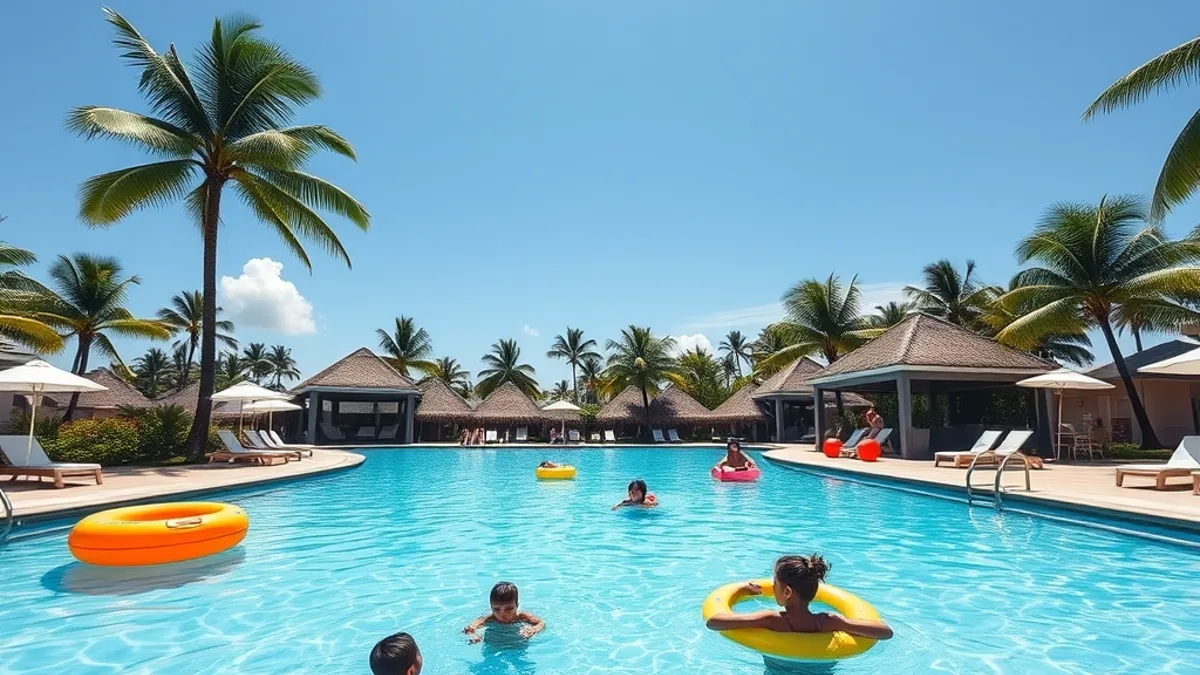
Family pools are built for volume and safety. Expect main depths of 0.9-1.4 m, deep enough for older kids to swim but shallow enough for confident supervision, plus a separate children’s zone under 0.6 m with slides, fountains or splash features. The layout is deliberate: parents can stand in the main pool while toddlers play within arm’s reach. Wide steps and gradual entries are common too, which makes getting in and out with small children far less stressful than at a standard resort pool.
The trade-off is competition for space. Loungers go early, and the shade around a family pool is claimed long before the 10:00-15:00 peak window. Arriving at noon with towels hoping for a front-row spot rarely works in high season. A realistic plan is to settle in before breakfast, claim your base, and treat midday as the time for lunch, naps or the kids’ club rather than fighting for space at the water’s edge.
What to plan before you arrive
- Book a cabana early: in high season, cabanas at popular family pools are often reserved 2-4 weeks ahead, so contact the resort when you book the room rather than after you land.
- Check the children’s zone details: some resorts run heated toddler pools with shade sails, while others rely on umbrellas that fill by mid-morning, so ask which applies.
- Look for a kids’ club nearby: a pool beside a supervised kids’ club lets parents alternate swim time with actual rest, instead of standing in the water all day.
Family pools work best at beach resorts designed around children, and island properties in Malaysia are a strong example, combining calm shallows with kids’ clubs and family suites. If your trip falls in the December to March high season, expect the busiest water and the tightest lounger competition, and plan your mornings accordingly. For a closer look at that style of stay, see this guide to family-friendly luxury resorts in Malaysia.
Adults-only pools: quiet by design
Adults-only pools exist to remove the noise, not to add features. Access is usually limited to guests aged 16 or 18 and over, and resorts enforce it seriously with wristbands, keyed gates or staffed entrances. That single rule changes the atmosphere more than any design choice: no splashing, no float toys, no poolside games.
Why the water feels different too
The design reinforces the calm. Adults-only pools run deeper, typically around 1.4-1.5 m, so they suit actual swimming rather than wading. Add a swim-up bar and fewer loungers spaced further apart, and you get calmer acoustics and a slower pace. People linger over drinks instead of cycling through quick dips, and the soundscape stays at conversation level all day.
Check the map before you book the room
Here is the detail that catches guests out: these pools are usually positioned away from the main building, deliberately, to protect the quiet. That means a “pool view” room near the adults-only section can be a long walk from restaurants, the lobby and the beach. Check the resort map before booking a room nearby and decide whether the short walk to the main facilities is a fair price for stepping out your door into silence. If the resort offers several room categories, ask specifically which buildings face the adults-only pool rather than the family pool, since the two are rarely adjacent.
Infinity pools: the view is the point
An infinity pool is less about swimming and more about where the water ends. The vanishing edge is engineered so the surface appears to merge with the sea or the horizon, which means the pool’s location on a cliff or shoreline matters far more than its size. A modest infinity pool perched above the water will beat a huge one set inland every time.
Most infinity pools sit 1.2-1.5 m deep and are rarely heated, so they suit warm months. In Mediterranean climates that means roughly May to October; in the tropics, they work year-round. If you are chasing that cliff-edge feeling, resorts built for sea-cliff leisure and slow golden afternoons show how much the setting itself adds to the swim.
Timing your swim
Sunset hours are the busiest photo window, and lounger space can tighten quickly as guests gather with phones and cameras. Early mornings offer the same view with empty water, softer light and often a cooler breeze. If your priority is the shot, arrive at golden hour; if it is the swim, go at sunrise and enjoy the horizon to yourself.
Climate and pool design: what changes by destination
Pool design changes dramatically once you leave the beach. The right pool type in the Alps is not the right pool type in Bali, and knowing the difference before you book saves disappointment on arrival.
Mountains and cooler climates
Cooler mountain destinations like Switzerland rely on heated indoor and outdoor thermal pools rather than infinity edges. The emphasis falls on warmth, wellness and contrast — a steaming outdoor pool with snow around it delivers the memorable moment, not a vanishing edge. Properties built around this idea, such as mountain wellness resorts focused on fresh-air restoration, make the heated pool the centerpiece of the stay rather than an afterthought.
Tropics and arid regions
Tropical resorts in Southeast Asia run outdoor pools year-round, but shade becomes the deciding factor between pools. Midday sun is intense, so a pool lined with palms, umbrellas or overhangs gets far more usable hours than a fully exposed one, even if the latter looks better in photos.
Desert and arid destinations favour shaded courtyards and indoor pools to escape midday heat. There the pool is often a cool retreat rather than a sunbathing stage, so check how much shade coverage each pool offers before choosing a room.
How to match the right pool to your trip
The best pool for your trip depends less on the resort’s star rating and more on who is traveling and what you want from your poolside hours. Two resorts can look identical in photos and deliver completely different stays, simply because one has the right pool for your group and the other does not. Before you pay a deposit, work through a short checklist matched to your travel style. It takes ten minutes and prevents the most common booking regret: arriving at a lovely resort and realising the pool never suits you.
- Traveling with children: Prioritize family pools with shallow zones, since dedicated children’s areas under 0.6 m make a real difference to both safety and your own relaxation. Book a pool-facing room early for high season, when the rooms closest to the family pool sell out first.
- Couples and quiet seekers: Filter for adults-only sections rather than assuming a “relaxed” pool means quiet. Confirm the minimum age before paying a premium, because the threshold and the enforcement method vary between resorts.
- View hunters: Choose infinity pools in shoulder months, May-June or October, for warm water without peak crowds. You get the same horizon and far more space at the rail for photos.
Whichever profile fits you, remember that the pool you choose shapes your whole stay. A few minutes of checking pool types, depths and room locations before booking will pay off every single day you are there.
Choosing between family, adults-only and infinity pools
The difference between arriving at the right pool and the wrong one comes down to what you prioritize before booking. Family pools win on space and shallow zones, adults-only pools win on calm, and infinity pools win on views — but depth, age rules and heating vary by type, so the pool you picture from the photos may not be the one steps from your room.
Remember that the 10:00-15:00 window is the busiest at every pool, and booking the right room location 2-4 weeks ahead matters as much as picking the resort itself. Match the pool to your trip, not just the destination, and the whole stay falls into place. If this helped you choose, leave a comment or share the article with a fellow traveler.