If you have ever searched for ski accommodation, you have seen the phrase everywhere: ski-in ski-out. It appears in titles, descriptions and photo captions, yet few listings explain what it actually guarantees. Does the piste really pass the door? Can you ski back at the end of the day? And is the price gap between these properties and everything else justified for your trip?
This guide breaks down ski-in ski-out lodging in plain terms. We start with what the phrase genuinely means and how marketers stretch it, then look at why the premium exists and how large it typically is. From there, we cover when slope-side access pays off, when a short walk is the smarter choice, and how to time your booking for the weeks you want. We also share how to spot genuinely slope-side properties in listings, compare the logic with other mountain stays, and wrap up with a simple takeaway for planning your next ski trip.
What Ski-In Ski-Out Lodging Actually Means
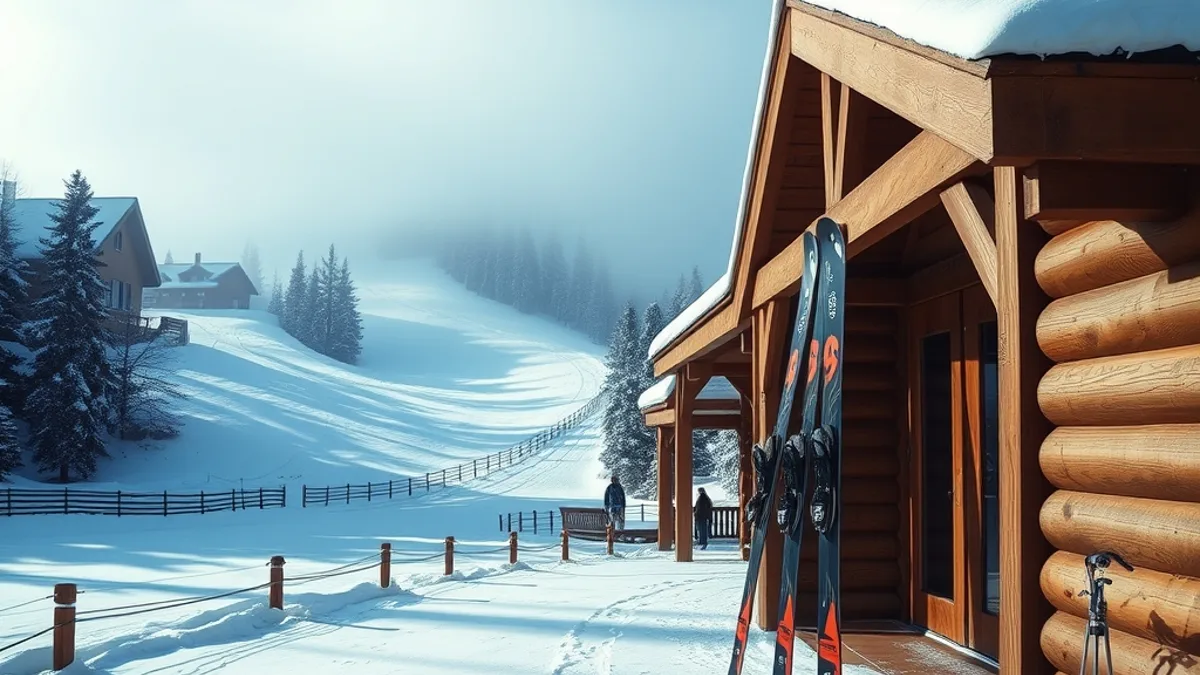
True ski-in ski-out lodging has a simple test: the piste runs to the property door, and the return route is skiable without walking. You should be able to click into your skis outside the entrance, glide down to the lift system, and at day’s end ski back to the building and step out of your skis at the door. The “boots-free” part matters more than people expect. Many properties sit near a slope but end the day with a walk in stiff ski boots, skis over the shoulder, across a road or a icy car park. That is not ski-out; that is a carry.
How marketers stretch the phrase
Listings use a whole family of loosely related terms. “Slope-side” usually means the building touches the piste, but not always that you can ski back to it. “Ski-in only” often means you can arrive from the mountain but must walk or take a shuttle to the lifts in the morning. “Steps from the lifts” can describe anything from a genuine two-minute stroll to a ten-minute trek with gear. None of these phrases is regulated, so treat them as marketing language until you verify the details.
How to verify before you book
The most reliable check is the stated distance to the nearest lift. As a rule of thumb, anything over 200 m means you are looking at a walk-in property, not true ski-in ski-out. Look at the resort’s piste map, find the building, and trace both the morning route to the lift and the evening route home. If the description names the run that passes the door and describes a skiable return, that is a good sign. If it only mentions a “ski bus” or a “short walk”, adjust your expectations accordingly.
Why the Premium Exists: What You Are Really Paying For
Slope-side properties typically cost 30-60% more than comparable accommodation 500-1,000 m from the lifts. That is a significant gap, and it helps to understand exactly what you are buying before deciding whether it fits your trip. You are not paying for more space or better facilities; identical apartments often sit on either side of the price divide. You are paying for position.
Scarcity drives the price
Genuinely slope-side plots are rare in most resorts. Buildings can only touch a piste where the terrain and planning rules allow it, and in many established resorts that land was developed decades ago. Every year, a fixed and limited pool of these properties competes for demand from skiers who prioritize access above all else. Scarcity of that kind keeps the premium stable, and in peak weeks it can push prices even higher. A property 800 m away may offer the same square meters, the same view and a newer kitchen, yet still rent for far less simply because it sits a shuttle ride from the action.
What the convenience is actually worth
The practical value shows up in your daily routine. For an intermediate skier, staying on the slope typically saves roughly 30-60 minutes a day of booting up, walking to shuttles, queuing and sorting lockers. Multiply that across a week and you recover several extra hours of actual skiing, or of resting your legs. There is also the midday bonus: slope-side guests can duck inside for lunch, a bathroom stop or a forgotten glove without ending their ski day. Whether that convenience justifies a 30-60% premium depends on how many nights you stay and how much those recovered minutes matter to your group.
When It Is Worth It — and When It Is Not
The honest answer is that ski-in ski-out lodging is worth it for some trips and a poor use of budget for others. The deciding factors are who is in your group, how long you stay and how much daily friction you are willing to trade for a lower price. Families with young children and all the gear that comes with them benefit most from slope-side access, because the morning routine alone can otherwise eat a big chunk of the day before anyone reaches a lift. First-time skiers also gain, since everything from lessons to lunch is steps away when energy and confidence run low.
When the premium pays off
Length of stay matters as much as who is traveling. On stays of 5-7 nights, the daily time savings compound into a genuinely better holiday, which makes the premium easier to justify. The same logic applies in less obvious situations:
- Short ski days. If your group skis a few hours at a time, walking to the lifts twice a day can cost more time than you spend on the snow, so door-to-slope access changes the shape of the whole day.
- Injuries or fatigue in the group. A tired or injured skier who can reach the lodge under their own power, without a long walk in boots, has a far easier end to the day.
- Non-skiers in the party. Slope-side living lets them watch the runs from the terrace, meet the group for lunch and enjoy the mountain atmosphere without depending on shuttles.
When a walk is the smarter choice
On a 2-3 night, city-break style trip, it is harder to amortise the premium: you pay for a week’s worth of convenience across only a handful of days. Car-based travelers should also think twice, since they can often park close to lifts and accommodation slightly farther out, making the slope-side advantage smaller. And for budget-focused trips, a walk of just a few hundred meters can shave a substantial share off your lodging cost — money that might fund an extra night, better gear rental or more days on the mountain instead.
Booking Timing and Season Strategy
Timing is the single biggest lever on price for slope-side lodging. The same apartment can cost dramatically more in February half-term than in early December, and the best true ski-in ski-out units in any resort are limited in number — there are only so many buildings a piste actually reaches. Plan around the calendar and you can often get the same door-to-slope convenience for a noticeably softer rate, or at least avoid paying top rates for a leftover unit.
- Lock in peak weeks early. Christmas, New Year and February half-term are when slope-side inventory sells out first, because families with children and gear compete for the same handful of units. For these weeks, book 6-12 months ahead; waiting until autumn usually means choosing between leftovers and paying top rates.
- Use shoulder dates for flexibility. Early December and April departures typically need only 3-6 months of lead time, and prices soften as operators try to fill beds. You trade some snow certainty for savings and easier availability, which suits flexible travelers without school-age children.
- Know the season’s shape. In most alpine destinations the season runs from late November or early December through mid-to-late April. Snow reliability drops at the edges of that window, which matters most for slope-side access: a run that reaches your door in January may be thin or closed in early December.
- Match your dates to the property’s altitude. If you are set on a late-season trip, favor higher, snow-sure return runs so the ski-out actually works in April, not just in midwinter. Ask the operator directly how the return route holds up late in the season rather than relying on listing photos taken in February.
Booked well, the premium you pay for location shrinks considerably. A slope-side unit in early December or late-season April can cost little more than a walk-in option in peak weeks, with far quieter pistes as a bonus. If your dates are fixed to school holidays, start looking as soon as the season ends the year before: shortlist the units you want, confirm which piste they sit on, and be ready to commit when operators release availability. A little calendar discipline is often the difference between a true ski-out door and a compromise with a shuttle stop outside.
How to Spot Genuinely Slope-Side Properties in Listings
Listings exaggerate. Marketing language like “ski-in ski-out” is used loosely across booking platforms, and the gap between the title and the reality can be several hundred meters of walking in ski boots. Learning to read listings critically saves you from paying a slope-side premium for a shuttle-ride property.
Start with the red flags. Phrases like “ski bus stops outside” or “5 minutes to the lift” are polite admissions that the slope does not reach the building. If the title says ski-in ski-out but the map pin sits far from any piste, trust the map. As a rule of thumb, verify the actual distance to the nearest lift: anything over 200 m is not true ski-in ski-out.
- A named piste or lift next to the building. Genuine listings usually name the run or lift that touches the property, for example a return trail ending at a specific slope. Vague wording like “close to the skiing” is a warning sign.
- A skiable return route described in detail. Look for a description of exactly how you ski home, including whether the final stretch is a groomed trail, a cat track or a short flat section that requires skating or walking.
- The slope visible in photos. If the winter photos show pistes running to the terrace or the base of the building, that is strong evidence. Photos shot only from the balcony facing away from the mountain deserve suspicion.
- The altitude of the return run. Cross-check how snow-sure the home-run is. A ski-out that depends on a low, south-facing trail works in January but can fail in late season, so confirm the return route holds snow through your travel dates.
When in doubt, email the property manager before booking and ask one direct question: can you ski from the lifts to the door and ski back out from the building on a typical winter day? A confident, specific answer is worth more than any headline.
Mountain Stays Beyond the Slopes: Comparing the Lodging Logic
Slope-side lodging is really a lesson in what you are paying for when you book any mountain stay: location, not square meters. Two apartments of identical size in the same resort can differ in price by a wide margin, and the difference is almost entirely about how much time and friction the location removes from your day. The same logic applies far beyond ski resorts.
Proximity versus views
Ski resorts trade in convenience: the closer you are to the lifts, the more you pay, because every minute saved is a minute on the mountain. Highland and mountain retreats trade in views and quiet instead. There, the premium often buys sunrise light, an unobstructed horizon or silence, rather than shorter walks. A stay like the kind described in Almaty mountain homes with big-sky quiet and scenic light shows how a location’s value can come from scenery and atmosphere rather than access to infrastructure.
One test for any destination
Wherever you book, apply the same simple calculation. Estimate the time and effort the location saves you each day — minutes of walking, shuttles, packing and unpacking — and weigh that against the nightly premium over a comparable property farther out. If you would use the convenience daily, as skiers do over a week of riding, the premium is usually justified. If the benefit is occasional or purely visual, decide honestly how much that view is worth to you per night. Location pricing is not a trick; it is just a price on your time, and it is yours to accept or decline.
The Takeaway for Your Next Ski Trip
Ski-in ski-out lodging means exactly one thing: the piste runs to your door and you can ski back to it at the end of the day. That convenience typically comes at a 30-60% premium over comparable stays a short walk or shuttle ride from the lifts, so the question is whether the hours saved are worth the extra cost for your trip.
For families with young children and heavy gear, and for stays of 5-7 nights in peak season booked 6-12 months ahead, the premium usually pays for itself in saved logistics alone. For short 2-3 night trips or travelers watching their budget, a walk of a few hundred meters can deliver nearly the same skiing at a much lower price. Have you stayed slope-side, or do you prefer to save the money? Share your experience in the comments or pass this article along to someone planning a ski trip.