Many villa listings advertise a gym or wellness room, but the photos often hide worn machines, missing weights and spaces that are too small to train in. Villa gyms and wellness rooms can mean anything from a fully equipped home gym to a spare room with a single yoga mat, and the difference only becomes clear after you have already paid and unpacked your sneakers.
This guide walks you through what separates a genuine fitness space from a marketing label. You will learn why listings vary so much, what equipment a real villa gym should contain, and which questions about space, ventilation and climate to ask before booking. We also cover wellness rooms, from massage tables to saunas and therapist access, plus the exact questions to send your host and when a villa gym actually justifies paying more. By the end, you will know how to verify the facilities before you commit, not after.
Why villa gyms and wellness rooms vary so much between listings
The word “gym” covers an enormous range in villa listings. On one end sits a fully equipped home gym with a dumbbell rack, bench and cardio machine; on the other, a stretching corner with one yoga mat leaning against the wall. Both can appear under the same label, and the listing title will not tell you which one you are getting.
The reason for this inconsistency is simple: private villa gyms are bought and maintained by individual owners, not by hotel chains with service contracts and equipment budgets. One owner might invest in quality machines and replace them regularly, while another picks up a used treadmill that has been sitting in a garage for years. Quality depends entirely on that person’s investment and habits.
Wellness rooms have the same problem
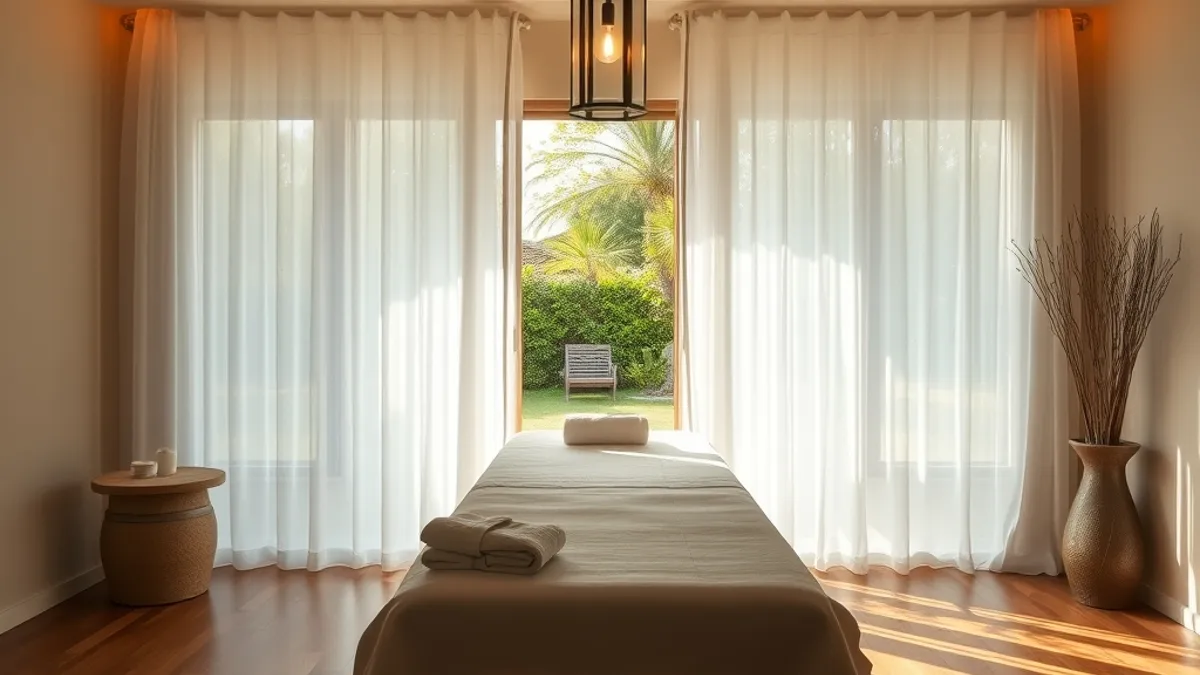
The range is just as wide for wellness rooms. A genuine one is a dedicated massage space with a professional table, proper lighting and sound insulation. A disappointing one is a spare bedroom with a folded mattress pulled out when guests ask. Both get photographed and listed as a spa.
Photos make this harder to spot, not easier. Most listing images are shot with wide-angle lenses and cropped carefully, which makes small rooms look far larger than they actually are. A room that appears spacious in photos can be too cramped for a full range of motion once you stand in it. That is why verification questions matter more than pictures, as the rest of this article explains.
Equipment quality checklist: what a real villa gym contains
Equipment quality is where villa gyms reveal their true character. A serious setup starts with a dumbbell rack containing a paired set, ideally going up to 20-30 kg per dumbbell, so you can progress in weight rather than stopping at whatever two mismatched hand weights the owner happened to own. Pairs matter: training with uneven weights throws off your form and limits what you can do.
A working cardio machine is the second pillar. Ask the host for the brand and model of the treadmill or elliptical, and whether it has been serviced within the last 3-6 months. In humid climates especially, belts and motors degrade quickly without maintenance, so a machine that worked two years ago may not work today.
- Adjustable bench: lets you do presses, rows and step-ups at different angles; a fixed flat bench covers far fewer exercises.
- Resistance bands: lightweight, versatile and a good sign the owner thinks about training variety, not just filling a corner.
- Pull-up bar: securely mounted, not a doorway model that wobbles; check whether the ceiling height allows full hangs.
- Yoga mats: at least two, clean and non-slip, so stretching and floor work are actually possible.
Cable machines or a squat rack are premium additions. Their absence is completely normal in a private villa, but their presence signals a genuinely serious home gym and an owner who trains themselves. Finally, learn to spot neglect: rust on plates, frayed cables and cracked treadmill belts are the clearest signs that the equipment has been ignored. If you see any of these in photos, assume the rest of the setup has been treated the same way.
Space, ventilation and climate questions to verify before booking
Even great equipment is useless in a room you cannot train in. A functional private villa gym typically needs at least 15-20 square meters of floor space. Ask the host for the room’s exact dimensions and, just as important, the ceiling height. Low ceilings block overhead presses, jump rope and anything done on a pull-up bar, and no photo will show you the distance from the top of the treadmill to the ceiling.
Climate is the dealbreaker in the tropics
In tropical destinations, confirm the space has air conditioning or strong ventilation, ideally cooling to 18-22°C. Humidity does two things at once: it makes your workouts miserable and sticky, and it quietly ruins equipment by rusting plates and warping treadmill belts. A gym without airflow in a hot climate is a gym you will use once. This is one reason wellness-focused destinations such as Nosara in Costa Rica put real thought into how their fitness and spa spaces are built and ventilated.
Shared spaces and how to see the truth
Ask whether the gym shares space with a garage, storage room or bedroom. Shared rooms often mean the equipment gets moved around, blocked by stored items or simply unavailable when you want it. A treadmill buried behind surfboards is not a gym.
Finally, request a short video walkthrough of the fitness space rather than relying on still photos. A phone video shows the real room size, the condition of the machines and whether anything is crammed or missing. Most hosts can record one in two minutes, and how they respond to the request tells you a lot before you book.
Wellness rooms: massage tables, spa setups and therapist access
The phrase “wellness room” means wildly different things from one villa to the next, and the gap becomes obvious the moment you look past the photos. A genuine wellness room has a proper massage table with adjustable height, dimmable lighting for atmosphere, and enough sound insulation that a treatment feels private rather than like a bed pushed into a quiet corner. If the listing shows a folded mattress on the floor of a spare bedroom, you are not booking a spa space.
Therapist access is the second question to settle. Some villas keep an in-villa therapist on call, and those typically need 24-48 hours of notice to arrange a session. Others expect you to book an external therapist who travels to the property, which means you handle the scheduling, payment and vetting yourself. Neither option is wrong, but you should know which one applies before you arrive, especially if a massage is a core part of why you booked.
Then look at what surrounds the massage table. The extras below are what separate a real spa room from a furnished afterthought:
- Sauna or steam shower: confirm which one is present, because a “steam room” description sometimes refers to a regular shower with poor ventilation rather than an actual steam enclosure.
- Cold plunge: if listed, ask whether it is temperature-controlled or simply an unheated tub, since the experience differs enormously.
- Location of these facilities: a sauna may sit inside the wellness room or on the other side of the property, which matters if you plan to use it early morning or late at night.
- Consumables: towels, massage oils and robes should be provided and refreshed; many villa spa rooms look complete in photos but arrive as empty shells with no supplies at all.
Ask the host to confirm each of these in writing. A short video of the wellness room, showing the table, lighting and any sauna or steam setup, will tell you more than a dozen staged photos.
Questions to send the host and when to ask them
The timing of your questions matters as much as the questions themselves. Send your equipment and space queries 2-4 weeks before arrival, when the owner still has time to fix a broken treadmill, replace a missing dumbbell or arrange a service visit before you show up. Ask too late and you will only get apologies at check-in. Booking platforms also move slowly, so building in this buffer gives a slow-responding host room to sort things out without stress.
- Request dated photos of the gym and wellness room. Specify that they should be taken within the last month, not the listing photos from years earlier, and ask the host to include equipment close-ups as well as the whole room.
- Ask for the service history of cardio machines. A recent service date tells you the owner actually maintains the equipment, especially in humid destinations where machines deteriorate quickly.
- Confirm the dumbbells are complete pairs. A rack missing its heavier weights or one half of a pair is common in home gyms, and it changes which exercises you can actually do.
- Ask about the room itself. Request the dimensions, ceiling height and whether the space is shared with storage or a garage, since that affects whether the equipment is usable at all.
How a host responds is information in itself. A host who sends fresh photos, service dates and straight answers is telling you the facilities are real and that they take guest training seriously. A host who answers vaguely, sends old listing shots or refuses to provide photos is giving you the strongest available signal that the advertised gym will disappoint. Weigh that signal heavily before you commit, especially if daily workouts are a core reason you chose a villa over a hotel. It is far easier to switch properties before booking than to negotiate a refund after arrival.
When a villa gym justifies paying more
Villas with verified, well-equipped gyms commonly price 15-30% above comparable properties without fitness facilities. That premium is real money, so the question is not whether the gym is nice but whether it fits how you actually travel and train. Paying it for a space you will use twice is a poor trade; paying it for a daily training habit can be entirely reasonable.
When the premium makes sense
The 15-30% premium earns its keep on stays of a week or longer, where a few missed sessions add up and consistency matters. It also makes sense when you train daily and the alternative is a hotel gym that requires a drive across town, turning a 45-minute workout into a two-hour errand. In both cases, the gym is not a bonus feature but part of the reason you booked.
When it does not
For short stays of two or three nights, a nearby gym day pass often costs far less than the villa premium, and you lose nothing except the walk to the door. Run that comparison before you pay extra for a gym you may use once. Destination matters too: in a remote area with no commercial gym nearby, a villa gym is worth far more than the same room in a city where gyms sit on every corner. In remote destinations, the premium often buys you the only realistic way to train at all, which changes the math completely.
Verifying your villa gym before you commit
The word “gym” in a villa listing tells you almost nothing. What matters is equipment completeness, a room of roughly 15-20 square meters, and climate control that keeps the space usable in heat and humidity. For wellness rooms, check that there is a real massage table, therapist access with 24-48 hours notice, and a working sauna or steam facility rather than an empty spare bedroom.
Do the verification before you commit: ask hosts for recent photos and service dates 2-4 weeks before arrival, and expect a 15-30% premium for genuinely equipped villas. Vague answers and old listing photos are the clearest warning signs that the advertised facilities will not match reality. If you have been burned by a villa gym that looked nothing like the photos, share your experience in the comments or pass this article along to a fellow traveler.