A villa stay with kids offers space, privacy, and room to breathe — but it also hands you a set of risks most hotel rooms never have. Private pools without fences, open staircases, balconies with wide railings, and gardens that run straight to a road or lagoon can turn a dream week into a constant supervision job. The fix is not more vigilance on arrival; it is vetting the property before you book.
This guide walks through what a safe villa stay with kids actually requires, how to vet the pool and the stair layout, which safety asks to send the host, when to book, and how to set the villa up on day one. Get these steps right and the villa becomes the relaxed family base you were picturing — not a week spent counting heads by the water.
What a Safe Villa Stay With Kids Actually Requires
A villa stay with kids comes down to three risk zones, and every booking decision should be filtered through them. First is the pool, which in most villas is private, unsupervised, and completely open. Second are vertical drops: staircases, mezzanine landings, and balconies that a curious toddler treats as a climbing frame. Third are unfenced boundaries — many villas sit directly beside roads, cliffs, canals, or open water with nothing but a hedge in between.
The core difference from a hotel is responsibility. A hotel pool usually has lifeguards, depth markings, and a regulated barrier around it. A private villa pool has none of that. There is no one watching the water, no gate that closes itself, and no one checking whether the cover was put back on. The safety burden sits entirely on parents, which means you need to know exactly what you are walking into before the deposit is paid.
Selection filter, not a follow-up request
This is why safety works as a filter during selection, not a request to make after you have paid. If a host cannot confirm a pool barrier, or the only bedrooms are upstairs above a spiral staircase, that property is simply the wrong one for your family — no amount of asking after booking will change the layout. Treat the pool, the stairs, and the boundaries as questions you ask before you commit, alongside price and availability. Villas that already cater to families will answer quickly and with photos; the ones that go quiet are telling you something.
Vetting the Pool Before You Book
The pool is the single biggest risk in most villas, and it is also the easiest thing to rule out before you book — if you ask the right questions. Start by asking the host directly whether there is a fence, a self-closing gate, or a rigid pool cover, and whether any of those can be locked when adults are not supervising. A soft solar blanket does not count; a child can slip under one in seconds and it will not support their weight.
Next, ask for the depth and the shape. Many private pools run 1.5-2.5 m deep with no gradual entry at all — you step off the edge into water over an adult’s head. If there is no shallow ledge or kids’ section, a toddler has no safe zone in the water, and even confident young swimmers have nowhere to rest.
- Line of sight from living areas: ask where the pool sits relative to the kitchen, terrace, and bedrooms. A pool visible from where you cook and eat is far easier to supervise than one hidden behind the villa or down a garden path.
- Chemical handling: confirm whether pool heating or cleaning chemicals are stored and handled on-site. Ask when treatment happens and keep kids out of the pool area during those windows, since freshly treated water and open chemical containers are both hazards.
- Access at night: ask whether the pool area is lit and whether the barrier or cover can be secured after dark, when supervision naturally drops and evening swims tempt older kids.
Get the answers in writing. A host who sends photos of the fence and the gate latch is a host you can hold to their word on arrival.
Stairs, Balconies, and Multi-Level Layouts
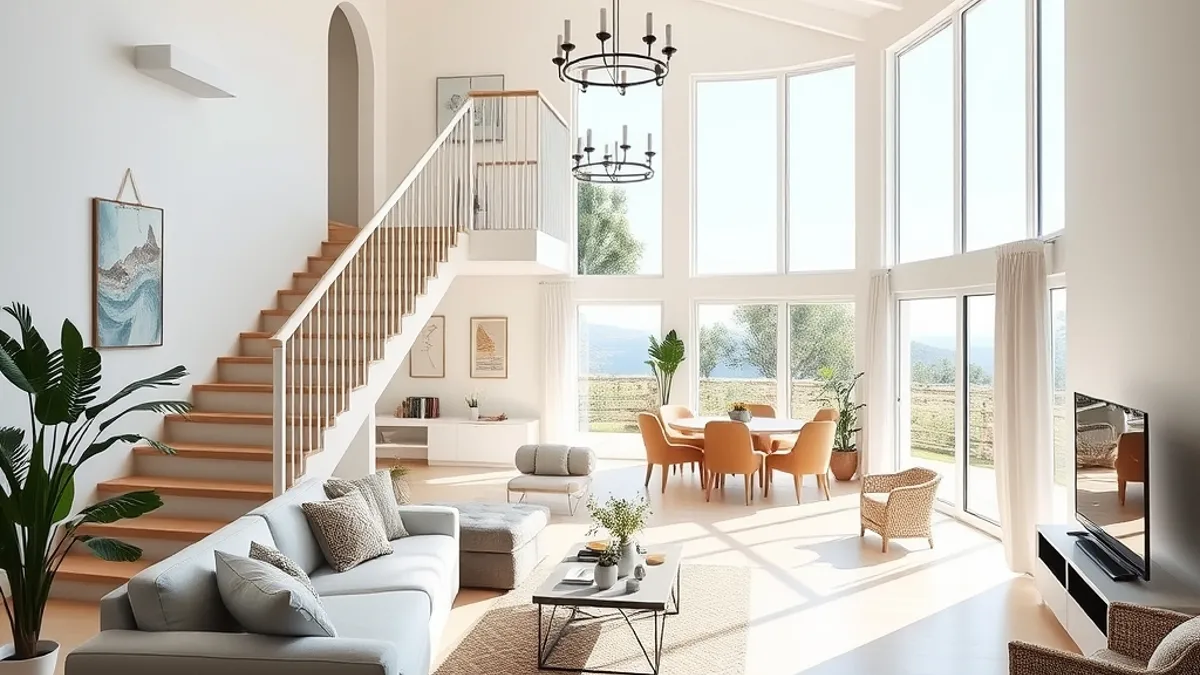
Pools get the attention, but stairs injure more villa guests than most parents expect. Villa architecture loves drama: open-riser stairs with gaps between each tread, steep ladders up to mezzanine bedrooms, and spiral staircases with narrow treads. All three are serious hazards for toddlers, and none of them show up clearly in listing photos. Ask the host for floor plans and photos of every staircase in the villa before you book, not just the main one.
Bedroom placement matters just as much as the stairs themselves. For children under 3, prioritize ground-floor bedrooms so night-time bathroom trips and early-morning wake-ups never involve stairs at all. A toddler navigating a dark staircase half-asleep is the classic villa accident, and it is entirely avoidable with the right room assignment.
- Balcony railings: check the gap between rails — under 10 cm is the safe standard, since anything wider lets a small child squeeze through or get their head stuck. Ask for close-up photos of the railing on every level your kids will use.
- Terrace edges: look for low solid walls rather than climbable horizontal rails. A rail with horizontal bars is effectively a ladder for a two-year-old, while a solid wall gives them nothing to grip.
- Portable barriers: ask whether the host provides stair gates. If not, plan to travel with a foldable one for 1-3 year olds — portable pressure-mounted gates pack in luggage and turn any staircase into a closed zone within minutes.
A villa with one gentle, railed staircase and ground-floor sleeping is worth more to a family with toddlers than a flashier multi-level property with a better view.
The Safety Asks to Send the Host
Once you have chosen a villa, the safety work shifts to communication. A well-organized host is usually happy to prepare the property for young children, but only if you give them enough time and a clear list. One message, sent early and covering everything, works far better than a stream of separate requests during the week before arrival. Hosts juggle multiple bookings, maintenance crews, and local suppliers, so a single detailed note is far easier to act on than a dozen follow-ups.
- Send one consolidated message 4-6 weeks before check-in. List everything in a single email or booking-platform message: pool barrier, stair gate, cot, high chair, outlet covers, and a first-aid kit. Hosts can source or borrow items, but they need lead time, especially in destinations where baby equipment is not stocked locally. Ask for photos of staircases, balconies, and pool access in the same message so you can verify answers rather than rely on descriptions.
- Ask specifically about fencing to the property boundary. Many villas open directly onto roads, cliffs, or lagoons, and a fenced pool means little if a toddler can wander straight out the front gate. Describe your concern plainly and ask whether boundary access can be locked or secured during your stay.
- Request the nearest clinic or hospital name and drive time. In remote villa areas, the answer can be 30-60 minutes. Knowing this in advance helps you pack an appropriate medical kit and decide whether the location suits your children’s ages.
- Get every promise in writing in the booking thread. A verbal assurance on the phone is unenforceable. If the stair gate is missing on arrival, a written confirmation is what gives you standing to demand a fix, a partial refund, or a same-day solution.
Treat this message as a checklist for your own arrival walkthrough as well. When you can compare the villa in front of you against the written list, missing items become obvious in minutes rather than discovered at bedtime with tired children. Keep the thread handy on your phone during the stay, and note anything the host adds or replaces along the way. If something promised never appears, raise it immediately while there is still time to fix it — most hosts would rather solve a problem mid-week than deal with a complaint after checkout.
Booking Timing and Choosing Family-Friendly Villa Types
Timing shapes both price and availability more than almost any other booking decision for a family villa. The best-configured properties — the ones that already have cots, stair gates, and fenced pools — are the first to go, and they rarely reappear at the last minute.
When to book
For school-holiday weeks, plan to book 3-6 months ahead. Family-configured villas sell out first, and by the time you are comparing options a month before departure, you are usually choosing between properties that were never designed with children in mind. Booking early also gives you leverage for the safety asks, since hosts can prepare the villa before your dates are confirmed on their calendar.
Shoulder season and villa type
Shoulder-season months like May-June and September-October typically cut rates roughly 20-40% versus peak weeks, and the practical benefit is just as valuable: fewer guests, quieter surroundings, and much easier supervision around the pool and grounds. If your children are not yet in school, shoulder season is the straightforward choice.
Layout matters as much as timing. Single-level or ground-floor villas remove most stair risk for toddlers under 3, making them the default pick for families with very young children. For families of 4-6 with older kids, villas with 3+ bedrooms typically sleep 6-8, giving children independence and parents genuine separation in the evenings.
Finally, budget with honesty. Expect to pay roughly 20-40% more in peak season for a villa that already has full child-safety features. That premium usually costs less than the stress — and the improvised fixes — of retrofitting a beautiful but unsuitable villa after you arrive.
Setting Up the Villa on Day One
However thorough your pre-booking vetting was, the first hour at the villa sets the tone for the whole stay. Do a 15-minute walkthrough before anyone unpacks: test the pool gate latches yourself, scan railings for loose bolts, and move breakables and cleaning products out of reach. Children will find every weakness faster than you will, so find them first.
Before that first swim, agree on one non-negotiable supervision rule: one designated adult watches the water whenever kids are outside, no exceptions. Rotate the duty between adults so no one gets fatigued, and agree that the designated watcher stays off their phone and within arm’s reach of non-swimmers.
Then establish the house zones with everyone, including the kids:
- Locked doors: decide which exterior doors stay locked and who holds keys, so no child can slip toward the pool or boundary unnoticed.
- Off-limits stairs: mark which staircases children may use and which are closed off, and put the stair gate in place before bedtime, not after the first tumble.
- Flotation devices: keep armbands and swim vests in one fixed spot near the pool, so they are grabbed every single time and never left in a bedroom.
- First-aid kit: confirm where it lives and that both parents can find it in the dark.
Finally, build the pool check into your evening wind-down. Covers and gates get left open after sunset swims, and a pool that was secure at lunch can be wide open by bedtime. A 30-second recheck every night closes that gap.
The Takeaway for Your Next Family Villa
The villa space and privacy families love is real — but so is the supervision load that comes with private pools, open staircases, and layouts that spill toward roads or water. The difference between a relaxing week and a stressful one comes down to when you ask the safety questions. A villa stay with kids works when pool barriers, stair layouts, and boundaries are verified before booking, not discovered on arrival.
Make it practical: send your consolidated safety asks 4-6 weeks ahead, and keep every host promise in the booking thread so it is enforceable if something is missing on arrival. Add smart timing to the mix — shoulder-season dates like May-June or September-October, a single-level layout for toddlers, or a 3+ bedroom villa that sleeps 6-8 — and you get both a lower price and a lower-stress week. Have a villa safety tip that saved your trip? Share it in the comments.