Plenty of listings promise a private court, only for guests to arrive and find cracks running through the surface, a net held up by hope, or a booking sheet full of other guests’ names. Villas with tennis courts are some of the most searched-for holiday rentals, and also among the most disappointing when the reality doesn’t match the photos.
The good news is that most surprises are avoidable with a few pointed questions before you pay a deposit. This guide walks through what to verify: whether the court is truly exclusive to your booking, what shape the surface should be in, what equipment and lighting to expect on site, how to arrange coaching or playing partners, when to book and what a court adds to the price, plus packing tips for your own gear. A final checklist pulls everything together so you can reserve with confidence.
Is the Court Truly Private and Exclusive to Your Booking?
The single most common disappointment with villas that advertise a tennis court is discovering it isn’t actually yours alone. In many estate developments and resort complexes, the “private court” shown in the listing photos is shared among several properties, sometimes a dozen or more. That can mean queuing for court time during the exact weeks you planned to play.
Questions to ask before you commit
Ask the owner or manager directly whether the court is exclusive to your villa or shared with other properties. If it is shared, find out how many villas hold access rights and whether play is organized through booked time slots. A court shared with three other villas and a slot system is workable; one shared with a whole resort is a very different holiday.
Next, clarify the money. Some owners include court use in the rental rate, while estates bill separately by the hour or by the day, and those charges can add up quickly over a two-week stay. Finally, ask about guest limits: in high season, some estates cap court use at 1-2 hours per villa per day. If your group plans serious daily play, that cap could shape your whole trip, so get the answer in writing before you book.
Surface, Condition and Maintenance of the Court
Not all tennis courts play alike, and the surface type changes everything from ball speed to how your legs feel the next morning. Clay slows the ball down and produces long rallies, grass plays fast and low, hard courts offer a predictable middle ground, and artificial turf sits somewhere between hard and grass. Ask which surface you’re getting before you book, especially if anyone in your group has a preference or a knee that complains on hard courts.
Photos in listings are often years old, so request recent images of the court surface, net, lines and fencing. Look closely for cracks, moss or algae growth, faded line markings and sagging nets. A court with worn markings can still be playable, but heavy cracking or a slippery green film usually means the owner has neglected maintenance.
- Clay upkeep: clay courts need daily rolling and watering to stay firm and even, so ask who handles this and whether it happens every day of your stay, not just when staff are on site.
- Hard court lifespan: hard courts need resurfacing roughly every 4-8 years, so a court well past that age will likely play unevenly and have visible wear in the service boxes.
- Rain behavior: clay and grass courts typically close when wet and can stay shut for hours or even a full day after rain, so ask how quickly the court reopens in a damp week.
Finally, ask when the court was last resurfaced. A clear, recent date is a good sign; a vague answer usually isn’t.
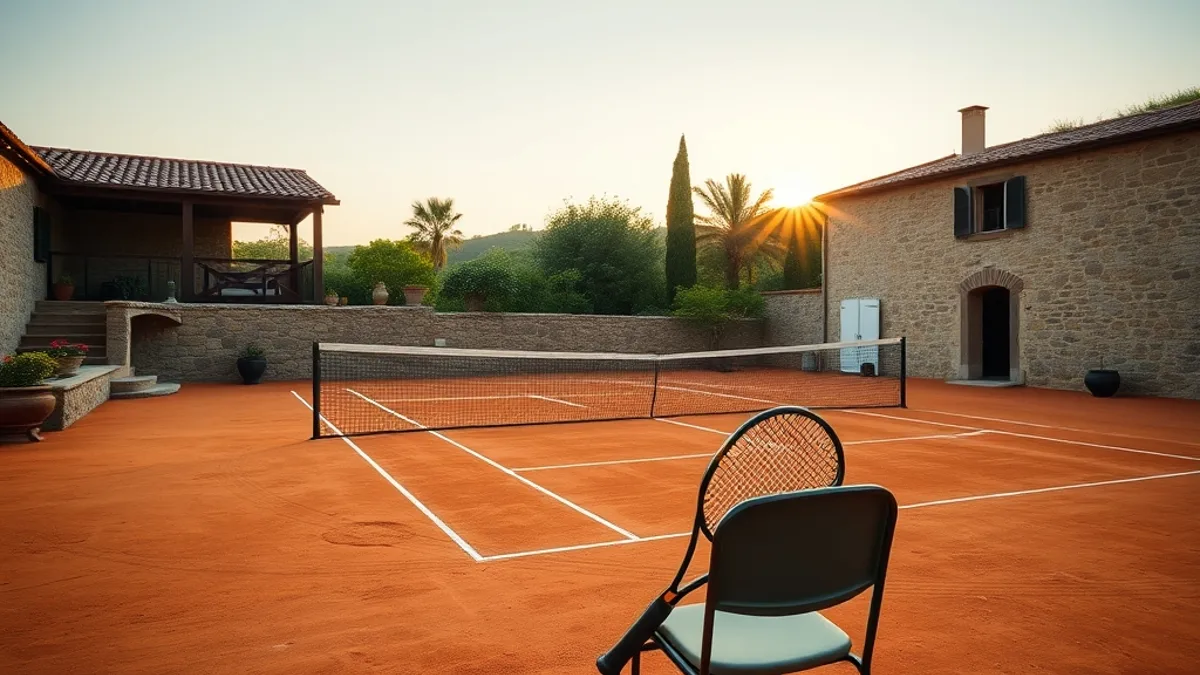
Equipment, Lighting and Playing Conditions On Site
A court is only as useful as what comes with it, so get a full inventory before you arrive. Ask exactly what’s provided: are there rackets for guests, in what condition, and how many? A villa that lists “rackets available” may mean two battered loaners with frayed strings, which is frustrating if four of you want to play doubles. Are balls included, and are they replaced between guest stays or left until they fall apart? Worn, fluffy balls play completely differently and can ruin a rally. Also ask whether grip replacements and basic spares are handled by the property, since small items are easy to forget and awkward to source in rural areas. If the net height can be adjusted, that’s a small bonus for families with children learning the game.
Evening play is a genuine luxury in hot climates, but it depends on floodlights. Ask whether the court has them, what hours they operate, and whether there’s an extra charge for switching them on. Some estates bill lighting by the hour, which turns a relaxed sunset session into a metered expense. Also confirm how bright and even the lighting is, since dim or patchy floodlights make fast balls hard to track after dark.
- Court orientation: a court aligned east-west reduces sun glare during morning and late-afternoon play, so ask which way it faces if you plan to play outside midday hours.
- Run-off space: a standard court measures about 23.8 x 11 m, and roughly 6 m of run-off space around it keeps chasing down drop shots from ending in a fence or a flowerbed.
- Surroundings: ask whether overhanging trees, steep drops or walls sit close to the court edges, since tight surroundings make wide balls genuinely risky to chase.
These details sound minor until you’re playing on a cramped, glare-filled court at noon, or lunging after a wide ball with a stone wall two steps behind the baseline. Ask now, not after arrival, and get the answers in writing so there are no surprises when you unpack your racket.
Coaching, Ball Machines and Playing Partners
A good coach can transform a tennis holiday from casual rallying into genuine improvement, so it pays to ask early. Many villa owners and estate managers have relationships with local pros and can arrange lessons at the property, but this is rarely automatic. Ask directly whether the villa or estate can organize a coach to come to you, and what the typical rates look like. In most resort regions, private coaching generally runs somewhere in the range of $50-120 per hour, depending on the coach’s experience and how remote the property is.
If you like practicing alone, check what solo options exist on site. A ball machine is a fantastic workout tool, but only a minority of villas have one, and some estates keep theirs at a shared tennis center. A plain hitting wall is a simpler alternative and is often available even where machines are not. Either way, confirm before you arrive rather than assuming.
Mixed skill levels in your group?
This is one of the most common situations on tennis holidays, and the fix is usually local. Ask the host whether they can help you find hitting partners, or whether a nearby tennis club offers guest access, social doubles sessions or drop-in play. A club with members at different levels can keep a strong player challenged while beginners join gentler sessions.
Finally, clarify the booking process itself. Some coaches fill their schedules weeks ahead in high season, so pre-booking before arrival may be essential. Others can be arranged on site once you arrive and you know which mornings you want to play. Ask which applies, and if pre-booking is required, lock in your lesson times at the same time you confirm the villa.
When to Book Villas with Tennis Courts and What They Cost
Villas with private tennis courts are a niche product, and the best ones get snapped up early. As a general rule, reserve 3-6 months ahead for high-season weeks. If you are a large group traveling in peak periods, push that to 6-12 months ahead, because properties that combine space for eight or ten guests with a genuinely private court are few and far between.
Be prepared for the price difference, too. A villa with its own court typically costs 20-40% more than a comparable property without one. That premium buys you unlimited access, no walking to a shared club, and the freedom to play at whatever hour suits your group. Whether it is worth it depends on how central tennis is to your holiday: for a group that plays daily, the per-person cost often works out reasonably.
Timing your trip around the tennis
Location matters as much as booking lead time. In Mediterranean villa destinations, the most reliable stretch for outdoor play runs from April through October. Outside those months, rain, cold mornings and shorter days can cut into court time, so check what the shoulder months actually look like at your specific destination.
Shoulder seasons deserve a closer look if your dates are flexible. In April-May and September-October, courts tend to be quieter, coaching is easier to arrange, and villa prices are usually lower than in the July-August crush. Weather is often still very playable in these windows, especially early in the morning and toward evening. Ask the owner or agent about shoulder-season rates and whether any weekly discounts apply. A few targeted questions can shave a meaningful amount off the total while giving you better court access than the peak weeks would.
Bringing Your Own Gear: Rackets, Strings and Packing Tips
Even the best-stocked villa rarely matches the feel of your own racket, so pack it regardless of what the property provides. Loaner rackets at villas tend to be old, loosely strung or simply the wrong weight for your game. Before you fly, check your airline’s policy on rackets, since some carriers count them as oversized baggage or have specific rules about how many you can carry. A quick look at the airline’s sports equipment page will save you a surprise at check-in.
Strings deserve attention before a long trip, not after. Racket strings are generally recommended for restringing roughly every 40-50 playing hours. If you are heading into a two-week holiday of daily play, that can add up fast, so a fresh string job shortly before departure is often the smarter move than waiting until a string snaps mid-trip.
What else belongs in your bag
- Spare overgrips: Sweat, sun and humidity break grips down quickly in warm climates, and a fresh grip changes how secure a racket feels in your hand.
- Extra balls: Villa-provided balls are often soft or pressureless; bring a couple of new cans so rallies stay consistent.
- Surface-matched shoes: Clay and hard courts wear soles differently, and clay-specific outsoles have a herringbone pattern that hard-court shoes lack, so pack the pair suited to the surface you confirmed.
- Sun protection: A cap, sunglasses and high-SPF sunscreen matter when you are playing outdoors for hours, especially at midday.
Finally, ask the owner whether a local pro shop or tennis club nearby can restring rackets or replace gear mid-trip. Not every destination has one within easy reach, and knowing the answer in advance tells you how self-sufficient your gear bag needs to be.
Final Checklist Before You Reserve
A tennis court on a villa listing is not the same as a tennis court you can actually play on. Too many travelers arrive to find cracked surfaces, shared time slots or a net that has not been touched in years. The fix is simple: get court privacy, surface condition, equipment and lighting confirmed in writing before you pay a deposit, and lock in coaching and court access at booking time, especially for high-season stays.
Then plan the trip itself around the game. Match your travel dates to the playing season, budget for the court premium over a standard villa, and pack your own racket, spare strings and shoes suited to the surface so the holiday starts on the right foot. A few questions before booking are all it takes to turn “villa with tennis court” from a photo caption into a reality. If this checklist helped you, leave a comment or share the article with a tennis-loving friend.