You’ve found the perfect villa for your off-season trip, and then you spot the optional extra: villa pool heating, billed as a daily or weekly add-on. Is it a sensible upgrade or money down the drain? The answer depends on where you’re going, when, and how much you actually plan to swim. In the Mediterranean, heating can stretch a pool season that typically runs May–October into April and November, while in tropical spots like Bali and the Maldives it’s rarely needed at all.
This guide walks you through the whole decision. We’ll cover when heating actually matters, what it typically costs as an add-on, and how heat pumps, solar and electric systems compare. You’ll also learn how to book a villa with a heated pool the right way, when the extra cost is genuinely worth paying, and the key questions to ask before you commit. By the end, you’ll know whether to tick that box or skip it.
When Villa Pool Heating Actually Matters
Pool heating only matters when the water would otherwise be too cold to enjoy. Below around 24°C, most swimmers find a pool uncomfortable, and whether your villa’s pool crosses that line depends almost entirely on where you are and how the pool is built.
Where heating is essential
In Mediterranean climates, unheated villa pools typically drop below 24°C from November through April. If you are traveling in winter or early spring, an unheated pool is essentially a decorative pond, so heating is the difference between swimming daily and not swimming at all. This is also why heating extends the comfortable season to April and November on either side of the usual May–October window.
Mountain and inland villas are a second case people often overlook. Even in midsummer, cold nights can pull pool temperatures down by 3–5°C, so a pool that felt fine at noon can be brisk by the next morning. At altitude, heating can be worth it even in the height of summer.
Where heating is usually pointless
In tropical destinations such as Bali, the Maldives or Zanzibar, water stays around 27–30°C year-round. Paying for heating there is money spent on nothing, so skip the add-on entirely.
Two pool types also change the math anywhere you travel. Shaded pools lose warmth through the day rather than gaining it, and small plunge pools lose heat fastest of all because their limited water volume cools quickly overnight. Both benefit from heating even in shoulder season, when a larger sunny pool might still be fine without it.
What Villa Pool Heating Costs
Pool heating is almost never included in the base villa rate. Most owners treat it as an add-on and charge somewhere between $20 and $60 per day, or $150 to $400 per week, depending on the property and the heating system. On a two-week stay, that can quietly add several hundred dollars to your bill, so it pays to understand what you are actually paying for before you agree to it.
The price you are quoted usually reflects the owner’s own running costs. An electric heat pump typically costs $15 to $40 per day to run, depending on the size of the pool and how cold the outdoor air is. Solar systems are different: installation runs roughly $500 to $2,500, but once the panels are on the roof, the heat itself is essentially free. That is why villas with solar heating often include it at no extra charge, while villas relying on heat pumps or electric elements pass the cost on to you.
Before you pay anything, pin down exactly how the fee is structured. The difference between a flat weekly rate and a metered charge can be significant, especially on longer stays.
- Flat weekly rates give you cost certainty: $150 to $400 covers the whole week no matter how hard the heat pump works, which makes budgeting simple.
- Daily charges suit short stays, since you can pay for heating only on the days you actually plan to swim rather than the full week.
- Metered electric heating is billed from an electricity reading, so a cold snap or an inefficient element can push a long stay’s final bill well beyond what a flat rate would have cost.
- Solar-included villas often advertise “heated pool” at no charge, but solar heats slowly, so confirm the system type rather than assuming you are getting a heat pump.
Heating Methods Compared: Heat Pump, Solar and Electric
Most villa pools are heated by an electric heat pump, and for good reason. Heat pumps pull warmth from the surrounding air rather than generating it, which makes them far cheaper to run than other options. They work efficiently as long as the outside air stays above around 10°C, which covers most Mediterranean shoulder-season conditions. The trade-off is patience: a heat pump typically needs 24–48 hours to bring a pool up to a comfortable 26–30°C, so heating needs to be switched on before you arrive, not after.
Solar and electric: the alternatives
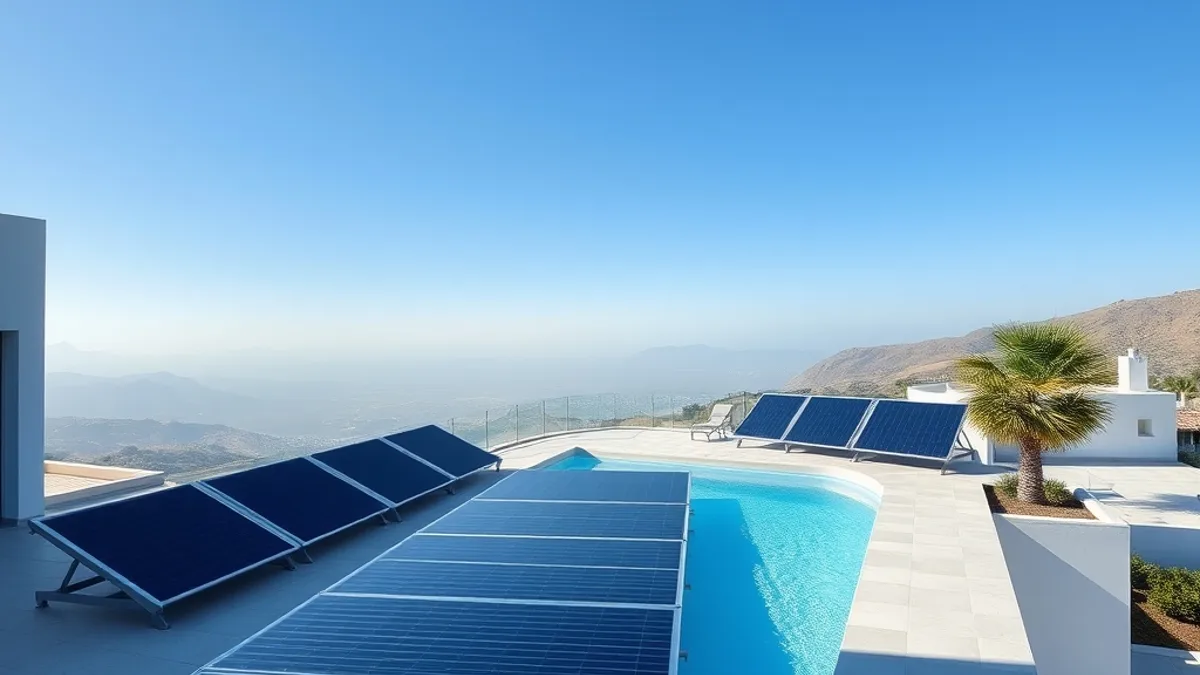
Solar pool heating uses panels, often on a roof, that circulate water through sun-warmed collectors. Installation adds roughly $500–2,500 to a property, but running costs are close to zero, which is why villas with solar systems frequently include heating for free. The catch is that solar depends entirely on sunshine and heats slowly, so it suits long stays in reliably sunny, dry climates. On a cloudy week, or for a three-night break, solar alone may never get the water properly warm.
Direct electric element heaters are the third option. They work like a giant kettle, heating water quickly and regardless of the weather, but the electricity bill is steep. That is why they mostly appear on small plunge pools, where the volume of water is low enough to make the running costs manageable.
Whichever system a villa uses, a pool cover matters more than most guests realize. A cover retains 50–70% of the heat that would otherwise be lost overnight, so a villa that provides one gets dramatically more out of its heat pump, solar panels or electric heater. If a villa offers heating but no cover, ask why before you pay for the add-on.
How to Book a Villa with Heated Pool the Right Way
Pool heating is one of those add-ons that goes wrong when it is arranged too late. The good news is that avoiding a cold pool mostly comes down to asking a few clear questions before you pay anything. Owners and managers deal with dozens of bookings a season, and the ones who get a warm pool are usually the ones who asked early and got answers in writing. Here is the sequence that works.
- Request heating at booking, not on arrival. Heat pumps need 24–48 hours to bring a pool up to a comfortable 26–30°C. If you ask for heating when you walk in the door, your first two days are effectively a cold-pool stay, and you will still pay for the full heating period. A quick message when you book costs nothing and solves the problem.
- Get the pricing in writing. Ask the owner or manager to confirm whether heating is included in the rate, charged per day, or capped at a weekly maximum. A written message also protects you if the price changes between booking and arrival, which happens more often than you would expect in peak season.
- Check the pool’s real temperature for shoulder-season trips. In April, May or October, a villa can advertise a heated pool that still sits below 24°C, which most swimmers find too cold to enjoy. Ask the manager what temperature previous guests actually experienced, or read recent reviews with that specific question in mind.
- Match the heating system to your stay length. If you are staying less than a week, favor villas that advertise heat pumps rather than solar-only systems. Solar panels heat slowly and suit long stays, so a short break may end before the water warms up enough to swim comfortably.
One more detail worth confirming: whether a pool cover is provided. A cover dramatically improves how well any heating system performs, so a villa that includes one is a better bet at the same price. It is also fair to ask when heating was last switched on before your arrival, since a system that has been off for weeks takes longer to recover. A short exchange of messages before you book costs nothing and is the difference between a pool you use every day and one you look at.
When the Extra Cost Is Worth It
Whether pool heating justifies the extra charge depends almost entirely on where you are going and how you travel. The math is simple once you know the destination’s water temperature and your own swimming habits. In the Mediterranean, an unheated pool is typically comfortable from May through October, and heating stretches that window into April and November — exactly the months when villa rates drop and crowds thin out. If you are chasing that kind of value in the shoulder season, heating is usually the cheapest upgrade you can buy.
Families are the other clear case. Children swim daily and feel cold water far more than adults do, so a pool hovering below 24°C can sit unused all week. Paying for heat that keeps the water at 26–30°C turns the pool from decoration into the center of the holiday.
On the flip side, tropical destinations rarely need it at all. In places like Bali and the Maldives, water stays around 27–30°C year-round, so you would be paying to heat a pool that is already warm — money better spent elsewhere, like the overwater stays in the Maldives where the ocean itself does the job.
Timing matters too. If you heat the pool too late, it will not be warm when you arrive, so treat heating as a booking decision rather than an on-site request — a point covered in more detail in the booking section above.
- Short summer stays skip it. On a 2–3 night trip in peak summer, the pool is warm anyway, and heating barely makes a difference before checkout.
- Run the break-even math. If heating adds $200 to a $3,000 week and your family swims every day, it costs under $30 per swim day — less than a round of drinks, for the feature you use most.
- Weight the season, not the price. A modest heating fee in November can be worth more than a free pool in July, because November is when the alternative is no swimming at all.
The pattern is consistent: heating pays for itself when cold water would otherwise stop you from swimming, and it is wasted money when the climate has already done the work.
Questions to Ask Before You Pay for Heating
Before you agree to pay a heating surcharge, spend five minutes asking the owner or manager a few pointed questions. This matters more than most travelers realize, because pool heating is one of the least standardized add-ons in the villa world. Two villas in the same town can charge for the same service in completely different ways, with different equipment and very different results. Good villa owners answer these questions easily and in detail; vague or evasive answers are themselves useful information. Here is what to ask and what a good answer sounds like.
- Is there a guaranteed temperature, and what if the heat pump fails? A confident owner will name a target temperature and explain the fallback — a repair service, a backup heater, or a partial refund. If nobody can tell you what happens on day three of a breakdown, you have found a risk you are being asked to carry.
- How is heating charged? Flat per-day and per-week rates are predictable; a meter reading based on electricity use is not. Metered heating can surprise you on long stays, especially if the heat pump runs around the clock in cool weather, so ask for an estimate of typical consumption before you commit.
- Is a pool cover included, and is the pool shaded? A cover retains a large share of overnight heat loss and makes any system work better. A pool shaded by buildings or trees for part of the day loses heat faster and needs more runtime, which matters most if you are paying by the meter.
- When should heating be switched on, and is start-up extra? Heating should begin well before you arrive, because a cold pool cannot be fixed in an afternoon once you check in. Some owners charge a one-time start-up fee for firing the system early — small, but worth knowing before it appears on your final bill.
Ask these questions in writing, ideally by email or messaging app, and keep the replies. Written answers give you something concrete to refer back to if the pool arrives cold or the bill arrives inflated. If a dispute ever arises over charges or water temperature, that message thread is your best protection, and it costs you nothing to collect it at booking time. A few minutes of asking now can save you both an awkward conversation on arrival and money you did not expect to spend.
The Bottom Line on Heated Villa Pools
So, is paying extra for villa pool heating a waste of money or the difference between a usable pool and a cold one? It depends almost entirely on where and when you travel. In Mediterranean destinations, a pool without heating is generally swimmable from May to October, and heating stretches that window into April and November. With typical charges of $20–60 per day, it clearly pays off in those shoulder and winter seasons.
In tropical destinations like Bali and the Maldives, where water stays 27–30°C year-round, heating is usually an unnecessary expense. Wherever you book, the smartest move is the same: confirm the heating type, the price structure and the start-up time at booking. That single conversation prevents both a cold pool on day one and a surprise bill at checkout. If this helped you decide, leave a comment or share the article with a friend planning an off-season villa trip.