You did everything right. You read the reviews, compared photos, booked a hotel with a strong rating — and still spent the night listening to the elevator ding, a housekeeping cart rumbling past at 6 am, or bass thumping up through your floor from the bar below. The frustrating part is that most of this noise was predictable, and soundproofing in hotels is something you can actually work with, if you know what to look for before you book.
This guide walks you through the whole process: how hotel construction really handles noise, which floors and positions are worth requesting, whether a street or courtyard view is the smarter bet, how to ask for a quiet room the right way, and what review keywords reveal that star ratings hide. We’ll also cover backup tactics for a noisy night and a quick checklist you can use on every future booking. A quiet night’s sleep doesn’t have to depend on luck.
How Soundproofing in Hotels Actually Works
Sound doesn’t respect hotel walls the way most travelers assume. It travels through every surface in your room — windows, doors, shared walls, floors, and even the HVAC ducts that connect rooms to a central system. In practice, windows and doors are almost always the weakest points, because they have to open and close, which means gaps, seals, and thinner materials than a solid wall.
Old buildings vs new builds
Older hotels often have a hidden advantage: solid masonry walls that block sound remarkably well. The catch is their windows, which are frequently original single-pane units that let street noise pour straight in. You may barely hear your neighbor but hear every bus and siren outside.
Newer hotels often flip that equation. Modern builds frequently use double glazing that handles traffic noise nicely, but interior walls may be lightweight stud construction. In those hotels, the street stays outside while your neighbor’s TV, phone calls, and late-night conversations come through loud and clear.
Doors deserve special attention. Many hotel room doors have hollow cores and a visible gap at the bottom, which leaks hallway conversation, luggage wheels, and the unmistakable rattle of housekeeping carts. If you can see daylight under your door, you can hear the corridor too.
Choosing the Right Floor and Position
Where your room sits in the building matters as much as how it’s built. Street noise — traffic, deliveries, people leaving bars — fades with height, so requesting a room above the 5th floor typically cuts a significant amount of it. The trade-off with height is footsteps: guests walking around in the room above you. The top floor eliminates that problem entirely, which is why it’s often the quietest position in the whole hotel.
Lower floors have their place, but rooms on floors 1-3 sit closest to the noise sources: the entrance, the loading dock where deliveries arrive before sunrise, and whatever nightlife zone the hotel happens to border. If you’re booking a low-rise property, ask specifically what surrounds those floors.
Beyond the floor itself, think about what’s inside the corridor. Elevator lobbies, ice machines, and housekeeping closets generate constant traffic and mechanical hum, so aim to be at least 2-3 rooms away from each of them. A few positions to consider:
- Top floor rooms: no one walks above you, and you also get the height advantage against street noise — the only position that blocks both at once.
- Corner rooms: they share walls with just one neighboring room instead of two, cutting your exposure to adjacent noise roughly in half.
- End-of-corridor rooms: fewer guests walk past your door, and you’re naturally farther from elevator banks and stairwell doors that slam.
- Rooms opposite the elevator bank rather than beside it: the distance of several doors dampens the ding and the chatter of waiting guests.
None of these positions costs extra at most properties — they’re simply about asking. The next sections cover exactly how to do that.
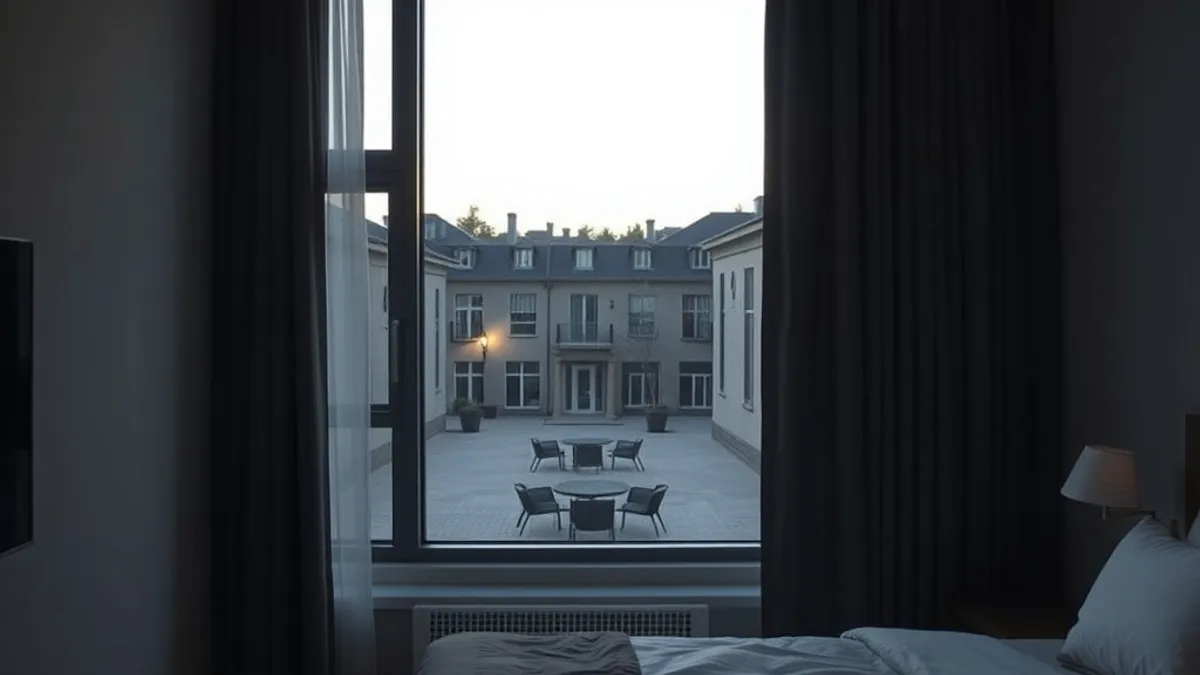
Street View vs Courtyard View
The view you choose can quietly decide how you sleep. Rooms facing an interior courtyard can be 5-10 decibels quieter than street-facing rooms — roughly the difference between a library and a normal conversation. That gap is large enough to mean waking at every delivery truck versus sleeping through the night.
What street-facing rooms absorb
A street-facing room takes everything the road produces: traffic throughout the day, delivery trucks that often arrive in the early morning hours, and spillover from nearby nightlife when bars close. In cities, this side of the hotel also catches sirens and buses starting their routes before dawn. If the hotel sits on a major artery rather than a side street, the effect multiplies.
When the courtyard isn’t quiet either
Here’s the mistake travelers make: assuming “courtyard” automatically means quiet. Courtyards can contain their own noise sources — a pool area with music and splashing kids, a breakfast terrace where conversation starts early, or the hotel’s air-conditioning plant humming away behind a low fence. A courtyard with a pool can be louder at 10 pm than the street at midnight.
So before you request a courtyard room, ask specifically what it contains. A simple question to the front desk — “what’s in the courtyard, and is it used at night?” — tells you whether you’ve found the quiet side of the building or just moved your noise problem indoors.
How to Request a Quiet Room When Booking
Most hotels will happily honor a quiet-room request, and the good news is that asking costs you nothing. Unlike upgrades or special amenities, quiet rooms carry the same rate as any other room in their category, so this is purely a matter of awareness and timing on your part. The real limiting factor is availability, not price. Front desks assign rooms on a first-come, first-served basis, and the quiet corners tend to go to whoever asked first. The travelers who consistently sleep well are the ones who ask early, clearly, and more than once.
- Add the request to your booking notes. When you reserve, write a short, specific line such as “quiet room requested, away from elevator, high floor if possible.” Specific wording gives staff something concrete to match against the room map.
- Confirm directly with the hotel 48-72 hours before arrival. A note in a booking system can get lost between the booking platform and the front desk. A direct call or email puts the request on the hotel’s own record, and most hotels accept these requests free of charge within that window.
- Call during off-peak hours. Mid-morning or mid-afternoon works best, when the front desk is not juggling check-outs and arrivals. A calm moment means the person you speak to can actually flag your reservation on the room map rather than promising to “see what’s available.”
- Repeat your request at check-in. Politely remind the agent you asked for a quiet room. Arriving before the 3-6 pm rush makes a real difference, since room assignments are still flexible early in the day and staff have time to move you before the hotel fills up.
Think of this as a three-touch system: booking note, pre-arrival confirmation, and check-in reminder. Each touch takes a minute, and together they turn a vague hope into a near-certain assignment. The system works because different staff members handle each stage, and each reminder reinforces the one before it. If the hotel is fully booked when you arrive, being remembered as the guest who asked politely three times still pays off. Staff will often prioritize you the moment a suitable room frees up, or flag your file so housekeeping can offer you a swap the following morning.
Reading Reviews for Noise Clues
Star ratings rarely tell you whether a hotel is quiet. A property can score well on cleanliness, location and breakfast while still having walls you can hear a conversation through. The fastest way to find out is to search the review text itself for noise-related keywords rather than trusting the overall score. Think of it as reading the reviews the way an inspector would, instead of skimming the average.
Try searching for phrases like “thin walls,” “street noise,” “club next door” or, just as useful, “slept great.” Both the complaints and the praise tell you what to expect. A handful of recent mentions of street noise is a far better predictor than a polished marketing description, and a cluster of guests sleeping well through the night is equally telling.
- Filter by recent dates. A renovation, a change of management, or a new bar opening next door can transform a hotel’s noise profile within months, so reviews from three years ago may no longer describe the room you’ll actually be sleeping in.
- Look for location-based mentions. Phrases like “above the restaurant” or “facing the parking lot” reveal exact problem rooms, letting you name the positions to avoid when you make your own request later.
- Weight business-traveler reviews more heavily. Frequent travelers tend to judge sleep quality against many other hotels rather than against the excitement of being on vacation, which makes their noise comments more reliable and easier to compare.
- Note patterns, not one-offs. A single grumpy review means little, but the same complaint appearing across several months, from different guests, in similar wording is a genuine signal worth acting on.
Ten minutes of keyword searching before you book is the cheapest soundproofing you will ever buy. It also tells you exactly which questions to ask the hotel, since you will already know whether the weak point is the street, the neighbors or the elevator bank. Bring those specific mentions with you when you contact the front desk, and you will get far more useful answers than you would from a vague request for “a quiet room.”
Backup Tactics for a Noisy Night
Even with careful planning, some nights go sideways: a wedding party on your floor, a delivery truck idling outside, or a neighbor who treats the walls as optional. That’s why experienced travelers pack a small noise kit as standard, the same way they pack a phone charger.
Your first line of defense
Foam earplugs and a white-noise app on your phone are the core of that kit. Together they mask mid-frequency sounds, which are exactly the ones that disturb sleep most: voices in the hallway, traffic hum and television bleed. Earplugs cost very little, weigh nothing, and work in hotels where no other fix is possible. A white-noise app adds a steady background layer that stops sudden sounds from startling you awake.
For hallway noise specifically, a rolled towel pressed against the door gap blocks a surprising amount of conversation and cart rumble in a pinch. It is not elegant, but it takes ten seconds and often makes the difference between drifting off and lying awake.
Fixing it properly the next day
If the noise is coming from a specific source, ask the front desk about a room change the next morning rather than at midnight. Morning is when housekeeping knows which rooms are genuinely empty, so staff can show you a real alternative instead of guessing. If the problem is chronic, photograph the room and raise it with management; many hotels will offer compensation or an upgrade once they see documented evidence. And if a hotel consistently delivers bad nights despite your requests, that pattern is worth remembering when you book your next trip.
The Quiet-Room Checklist at a Glance
Most bad hotel nights are not bad luck. They are rooms anyone could have predicted: a well-reviewed hotel booked without a thought, and you end up next to the elevator or above the bar. The fix is a short routine that takes minutes, not money.
Run through it before every booking. Aim for a high or top floor, a corner room, and a courtyard view you have confirmed is actually quiet, away from elevators and ice machines. Make a quiet request at booking, confirm it 48-72 hours ahead, and repeat it before the 3-6 pm check-in rush. Check reviews for noise keywords, and pack earplugs as insurance. Follow these steps and a good night’s sleep stops depending on luck. If this helped you, leave a comment or share the article with a fellow traveler.