A remote villa with no power lines in sight sounds like the perfect escape: total privacy, night skies full of stars, and nothing but the sound of wind or surf. But if the lights flicker out on night two or the showers run cold, that dreamy stay can turn frustrating fast. This is the real question behind off-grid villas: can a property truly supply its own power and water without leaving you uncomfortable?
The good news is that most off-grid disappointments are preventable with a few targeted questions before you book. This guide explains what off-grid villas actually are, what a properly sized solar system should cover, how to check the water supply and its quality, and what to confirm about connectivity, access and daily comforts. You’ll also find the exact questions to ask before booking, and where these properties tend to work best. Ask the right things upfront, and a self-sufficient villa can deliver one of the most restorative stays you’ll ever have.
What Off-Grid Villas Actually Are
Off-grid villas are properties that run fully or partly independent of the public utility grid. Instead of drawing mains electricity, they generate their own power, most often through solar panels paired with a battery bank that stores energy for evenings and cloudy stretches. Water follows the same logic: rather than a municipal supply, it comes from rainwater harvesting, a drilled well, or scheduled deliveries by truck.
The term covers a wide spectrum, and that’s where confusion often starts. At one end sit fully self-sufficient eco-retreats that never touch the grid at all. At the other are villas with a grid connection that simply lean on solar most days and fall back to mains power when needed. Both are marketed as off-grid, but the guest experience can differ quite a bit, especially during a week of heavy cloud.
Why these villas exist where they do
Most off-grid properties are built in remote destinations where extending power lines is impractical or prohibitively expensive. Think desert plateaus far from the nearest town, island interiors where the grid ends at the coast, or mountain valleys that never saw a utility pole. The remoteness is exactly what draws travelers here, but it also means the villa’s own systems are the only safety net. Understanding how those systems work is the first step to booking a stay that feels luxurious rather than makeshift.
Solar Power: What the System Should Cover
Solar is the heart of any off-grid villa, but not all systems are equal. A well-sized setup should be stated clearly in the listing: look for an array of 5-10 kW with battery storage, which is generally enough for lighting, fans, refrigeration, Wi-Fi and device charging without constant rationing. If a listing is vague about system size, that vagueness itself is a clue worth following up on.
The biggest power draw in any villa is air conditioning, and this is where expectations need managing. Many solar-only properties restrict AC to nighttime hours, when batteries are fully charged from the day’s sun. Ask directly whether air conditioning runs on solar at all, and what the restrictions are. Hot water matters too: electric water heaters drain batteries faster than almost anything else, so a well-designed villa will use solar-thermal panels or a gas system instead.
What to confirm about backup power
Even the best solar array has limits. Several consecutive cloudy days can drain a battery bank, so reliable off-grid villas usually list a backup generator or grid-tie fallback in their listing. Before booking, check a few specifics:
- Generator fuel and runtime: ask whether the generator runs on diesel, gasoline or propane, and whether fuel is stored on site so it can run for days, not just hours.
- Who switches it on: find out whether staff manage the changeover automatically or whether you’ll need to start it yourself if you’re staying without full service.
- What the backup covers: some generators only power essentials like lights and refrigeration, so ask whether outlets, kitchen appliances and AC stay live during backup mode.
- Noise and placement: a generator running near bedrooms can undo the seclusion you booked for, so ask where it sits and when it typically runs.
Clear answers to these four points tell you more about a villa’s reliability than any marketing photo of solar panels ever will.
Water Supply and Quality Checks
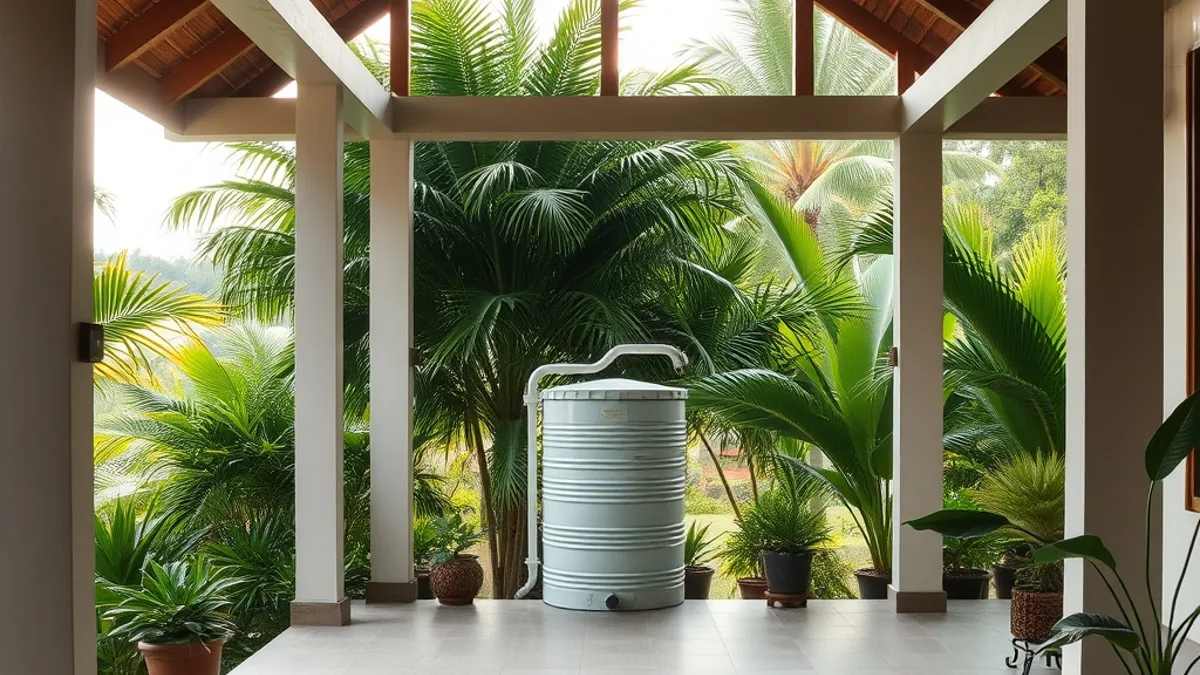
Power gets the attention, but water is what actually makes or breaks an off-grid stay. In tropical climates, most villas rely on rainwater harvesting, and a well-designed system can supply most of a property’s needs during the roughly November to March wet seasons. The critical question is what happens the rest of the year, so always ask about the dry-season plan, whether that means stored reserves, a well, or scheduled deliveries.
In arid regions the math is different. Water is often trucked in weekly, so confirm the tank capacity, ideally at least 5,000-10,000 liters for a villa, and that a delivery schedule actually exists. If you’re researching tropical destinations, places like the quiet enclaves around Ubud surrounded by rice fields show how abundant rainfall makes self-sufficiency far easier than in drier settings.
Quality and comfort checks
Beyond supply, a few practical checks reveal how well a villa’s water system really works:
- Drinking water source: ask whether water is filtered on site, such as through a multi-stage or UV system, or whether the villa provides refillable glass or plastic containers so you’re not buying bottled water all week.
- Water pressure: low pressure often signals a weak or undersized pump, which you’ll notice most in upstairs bathrooms and outdoor showers.
- Hot water consistency: showers that swing between hot and cold usually point to an undersized heater or a solar-thermal unit struggling on cloudy days.
- Filtration for showering: in some regions, guests appreciate a filter on shower taps too, especially where borehole or delivered water carries sediment.
Two or three honest answers here tell you whether the villa’s water setup is thoughtfully engineered or quietly patched together.
Connectivity, Access and Daily Comforts
Off-grid usually means off the internet too, at least in part. Remote villas typically rely on satellite or cellular connections, and performance can swing from excellent to nearly useless depending on weather, terrain and how many guests are streaming at once. Before booking, ask the host for a recent speed-test screenshot or look for guest reviews that specifically mention Wi-Fi reliability. Vague promises of “good internet” are not the same as evidence.
Road access is the second thing to pin down. Some remote villas sit at the end of unpaved tracks that take anywhere from around 20 to 60 minutes to drive, and a few require a 4WD vehicle, especially after rain. If you plan to rent a car, confirm what the rental company allows on those roads, and ask whether the villa offers airport transfers so you can skip the hassle entirely.
Finally, get clear on daily comforts. Off-grid properties often run leaner operations than standard resorts, and it is far better to know the gaps in advance than to discover them at check-in. Ask specifically about:
- Whether staff live on site or in a nearby village, and how quickly someone can respond if the power system fails or you need medical help
- What an emergency actually looks like in practice: the nearest clinic or hospital, and whether the villa has a radio, satellite phone or reliable way to call for help
- Which services are simply not offered, such as daily housekeeping, room service or on-site dining, and whether a cook can be arranged for a fee
- How supplies reach the villa, since food, fuel and bottled goods may arrive on a fixed schedule rather than on demand
Questions to Ask Before You Book
The best way to avoid disappointment at an off-grid villa is to ask direct, slightly awkward questions before you pay. A well-run property will answer them easily and in detail; hesitation or vague replies are themselves useful information. Treat the booking process as a test of how the operation is run. Hosts who can discuss their systems confidently almost always run them well, while those who deflect rarely improve after you arrive.
- Request specifics on the power system: battery capacity, what happens during long stretches without sun, and any stated power limits. Reliable villas usually list these details in the listing itself, not just promised in a message.
- Ask how the villa handled its last extended cloudy spell or dry-season water shortage. Every remote property has faced one, and the answer reveals whether management plans ahead or simply hopes for good weather.
- Confirm the cancellation policy is flexible. Off-grid conditions occasionally force relocations or closures, and you want terms that let you reschedule or get a refund without a fight.
- Book early for high season. Remote properties have very few rooms, so plan 3-6 months ahead, and expect nightly rates typically ranging from $150 to $600 depending on region and season.
Put the key answers in writing, either in the booking platform’s messages or in the listing itself. If a host promises unlimited air conditioning or guaranteed water, that promise should exist somewhere you can point to later. Screenshots of conversations and saved listing descriptions have settled more than one dispute at checkout, especially when connectivity is limited and phone calls are difficult. Written confirmation also helps you compare properties honestly, since vague verbal reassurances tend to blur together after your third inquiry.
A few minutes of written confirmation before booking is the cheapest insurance you will ever buy for a remote stay. It costs nothing, takes little effort, and gives you clear grounds for a refund if the villa fails to deliver what was promised.
Where Off-Grid Villas Shine
Not all off-grid destinations are equally demanding. The easiest places to run a self-sufficient villa are tropical islands and jungle settings, where strong sun charges the solar panels and abundant rain refills the water tanks. In these environments, a well-designed property can cover most of its own needs with minimal outside help, and the systems tend to work quietly in the background.
Desert and mountain retreats are a different story. With little rain to harvest, these properties depend more on delivered water and generator backup, which means more moving parts and more that can go wrong. Vetting matters more here: ask harder questions about tank capacity, delivery schedules and what happens when the generator is down. The rewards, dramatic landscapes and total silence, are often greater, but so is the importance of choosing an operator who has invested properly in redundancy.
Wellness and the off-grid match
Wellness-focused destinations have embraced off-grid design more than most, and it is easy to see why. Solar power means no humming generators, rainwater means no infrastructure scarring the landscape, and the whole point of the stay is quiet and immersion in nature. Places like Nosara in Costa Rica have built entire reputations on this combination of sustainable design and restorative atmosphere.
Whatever the setting, the pattern holds: the more remote and the harsher the climate, the more thoroughly you should check the systems before booking. When the fundamentals are solid, the setting becomes the whole experience rather than a gamble.
The Reward of Getting It Right
The appeal of an off-grid villa is easy to understand: deep seclusion, a lighter footprint and a stay that feels genuinely removed from everything. The worry is just as real. If the power cuts out on day two or the taps run dry mid-week, that dreamy escape can turn frustrating fast.
The good news is that the most common disappointments are avoidable. A well-run off-grid villa delivers exactly what it promises: reliable solar power, secure water and honest expectations about what is and isn’t available. Before you book, check the solar array size, water storage and delivery plans, backup systems and road access, and ask the owner direct questions about how the property handles cloudy spells or dry seasons. With the right questions asked, off-grid stays become some of the most memorable and restorative trips you can take. If you’ve stayed somewhere off-grid, share your experience in the comments below.