Choosing between a villa vs riad vs townhouse is tricky because all three promise character and privacy, yet they deliver completely different days once you arrive. One puts you alone with your group by a private pool, another tucks you into a centuries-old courtyard in the middle of a medina, and the third gives you a family-sized base inside a resort. Book the wrong one for your trip and even a beautiful property can feel frustrating.
This guide compares the three stay types side by side: their core structural differences, how space and layout actually work, who shares your space, what makes a riad unique, how to match each type to your trip, and the prices and booking windows to plan around. By the end, you should know exactly which one fits your group, budget and travel mood.
Villa vs Riad vs Townhouse: The Core Differences
These three stay types look similar in photos but are built on completely different ideas. Understanding the structure of each one explains almost everything about how your stay will feel, from noise levels to how far you walk for breakfast.
What each one actually is
A villa is a standalone private home, usually with 3-6 bedrooms, its own pool and a garden, rented whole to a single group. Nobody else has a key, nobody else uses the pool, and the property typically sits on its own plot away from immediate neighbors.
A riad is a historic Moroccan city house rebuilt around an interior courtyard, run like a small inn with 5-10 guest rooms. You rent a room, not the building, and share the common spaces with the other guests.
A townhouse is a multi-floor unit joined to neighbors on one or both sides, most often rented whole with 2-4 bedrooms. It usually sits inside a resort or residential complex, so you get your own front door but not your own island.
The one difference that matters most
The key structural difference is simple: a villa isolates you, a riad hides you inside a city, and a townhouse stacks you vertically next to others. That single sentence predicts your privacy, your noise levels and your daily routine. Everything else in this comparison flows from it.
Space and Layout: Floors, Courtyards and Pool Decks
How each stay type uses its footprint shapes your daily movement more than any decor choice. One spreads out, one folds inward, and one climbs upward.
Horizontal, inward and vertical
Villas spread horizontally: a living room, kitchen and 3-6 bedrooms across one or two levels, plus an outdoor pool and dining space that effectively double your floor plan in good weather. Groups drift between the pool deck, the shaded terrace and the interior without ever feeling on top of each other.
Riads compress everything around one courtyard, with rooms on one or two floors and a rooftop terrace as the social hub. The courtyard is the hallway, the living room and often the dining room at once, and the rooftop becomes the place everyone gravitates to at sunset.
Townhouses go vertical: 2-3 floors mean stairs between the bedroom, kitchen and living areas, trading floor space for height. That separation is a feature for families, since kids can sleep on a different level from the adults.
Matching layout to your group
Groups of 6 or more fit comfortably in a villa, couples fit best in a riad room, and families of 4-6 suit a whole townhouse. If your group spans generations or needs separate sleeping zones, the townhouse’s stacked floors often work better than a villa’s open plan.
Privacy Levels: Who Shares Your Space
Privacy is where these three stay types diverge most sharply, and it is the difference travelers regret ignoring. Before booking, be honest about who will share your mornings, your pool and your evenings.
Villas offer total privacy: no shared walls, no shared pool, and no staff unless you arrange it. You can hold a late dinner, play music or swim at midnight without thinking about anyone else. For a similar sense of seclusion in a tropical setting, some travelers look at quiet villa enclaves surrounded by rice fields, where the isolation comes from the landscape rather than walls.
Riads share the courtyard, breakfast table and rooftop with 5-10 other parties of guests, so quiet depends heavily on the house rules. Sound carries in a courtyard building, and a chatty group at the next table becomes part of your morning.
Townhouses share walls and usually a resort pool 20-50 meters away, giving medium privacy with hotel-style services nearby. You hear the neighbors occasionally, but reception, housekeeping and the pool are all a short walk off.
If uninterrupted silence is the priority, rank them villa first, townhouse second, riad third. A few practical checks before you book:
- Ask villa hosts exactly which staff visits are included, such as cleaning or gardening, and whether you can schedule them around your day
- Message riad owners about their quiet policy on the rooftop and whether rooms open directly onto the shared courtyard
- In townhouse complexes, request a unit at the edge of the rows, away from the pool and the main walkway, to cut foot traffic past your windows
The Riad Difference: Medina Living Behind Plain Walls
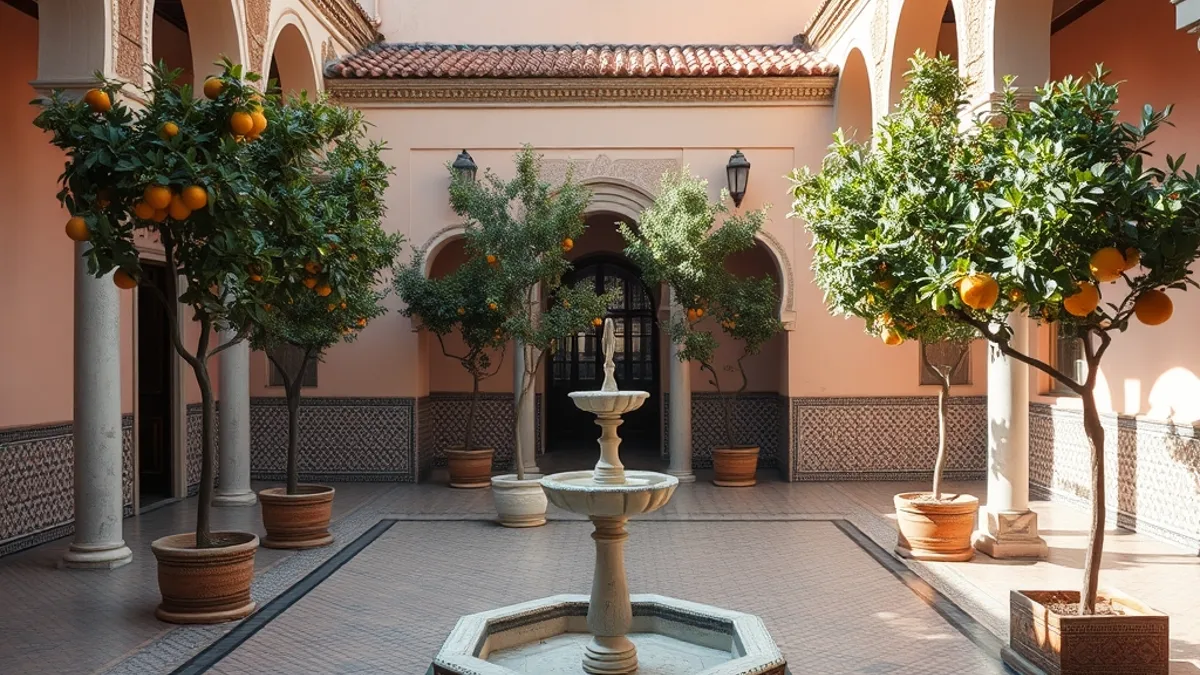
The first thing every riad guest notices is the contrast at the door. From the street, most riads look like plain walls with a heavy wooden door, almost indistinguishable from the neighboring houses in the medina. Step inside and the mood flips completely: a tiled courtyard, a fountain, orange trees and carved galleries wrap around you, while the noise of the souks stays outside. That contrast is deliberate, and it is the whole point of riad design.
Location is the other big draw. Most Marrakech riads sit deep inside the medina, typically a 10-15 minute walk from Jemaa el-Fnaa square, closer to the old city’s heart than most conventional hotels can sit. You step out of breakfast and straight into the alleys of the historic center, then retreat behind the same plain walls when the midday crowds get loud. If you like this idea of a quiet inner world behind a modest street facade, the same logic shows up elsewhere too, as in these courtyard stays that turn desert atmosphere into boutique peace.
Rooftop mornings set the rhythm
Riad rooftops typically serve breakfast between 8 and 10 am, and this is often the calmest hour of the day. You eat above the rooftops with medina views spreading out around you, well before the terraces and streets below fill up. Plan at least one morning around it rather than rushing out early.
The trade-off comes at arrival. Riads sit in narrow alleys with no vehicle access to the door, so taxis and drivers drop you at the nearest walkable point. Luggage is usually carried the last stretch by cart or by hand, sometimes through a maze of turns. Pack accordingly, tell the riad your arrival time, and let staff meet you at the drop-off point so the first walk is not a solo puzzle.
Matching the Stay Type to Your Trip
The right stay type depends less on amenities and more on what your trip is actually for. A villa is built around the property itself, a riad is built around the city outside the door, and a townhouse is built around a family’s daily routine. Match the type to the trip and most other decisions fall into place.
Choose a villa for group trips, birthdays, anniversaries and weeks where the pool, the kitchen and the terrace matter more than any sightseeing list. Choose a riad for a culture-heavy city break of 2-4 nights, when you want to step straight into the old town each morning and collapse back into it each evening. Choose a townhouse for family trips that need bedrooms on separate floors, plus a shared pool and hotel-style services nearby, without paying villa prices.
- Villa for celebration weeks: a full kitchen and long dining table let you cook together, hire a local chef for one night, or let the group split between the pool and shaded lounge without anyone leaving the property.
- Riad for first-time medina visitors: innkeepers typically arrange airport transfers, mark walking routes into the souks and recommend guides, which takes the guesswork out of a first 2-4 night stay.
- Townhouse for multi-generational families: stairs between floors give kids and grandparents separate sleeping zones, while the shared resort pool and on-site services handle the middle of the day.
- Destination matters too: beach and island trips favor villas and townhouses in resort zones, while historic medina cities are where riads have no real substitute.
If your week is a split of city days and pool days, consider booking one townhouse and adding a short riad stay at the start, so the trip opens with immersion and ends with space. The order matters more than most travelers expect.
Prices and Booking Windows to Plan Around
Budget planning starts with knowing what each type typically costs. A riad room runs roughly $80-250 per night, a whole townhouse about $150-400 per night, and a whole villa around $300-1,500 per night. Treat these as planning ranges rather than quotes, since location, season and size move them considerably in both directions.
The mistake travelers make most often is comparing per-night instead of per-person. Run the math before you book: a $900 villa split six ways comes to $150 each, which can undercut a $200 riad room booked three times for the same group. For groups of four or more, the villa almost always looks cheaper once you divide properly, and it adds a private pool and kitchen on top.
Timing your booking
Villas need the most lead time. Reserve 3-6 months ahead for peak season, which runs December-February in the tropics and June-August in the Mediterranean, when the best properties with private pools are picked over first. Leaving a villa booking until a month before a peak-season trip usually means choosing from what is left, not from what is best.
Riads and townhouses are more forgiving on timing, so shorter horizons are usually workable. The exception is the medina riad: houses with 10 or fewer rooms still sell out first in spring and autumn, when city-break demand peaks. If a specific riad is the reason you picked a destination, book it as early as you would a villa and treat everything else as flexible.
Choosing Between Villa, Riad and Townhouse
So which one should you book? Each stay type wins at something different: villas take privacy and group space, riads take location and atmosphere, and townhouses sit comfortably in the middle with a bit of both. All three promise character, but they deliver it in completely different ways — a villa retreats from the world, a riad immerses you in it, and a townhouse gives a family a practical base.
In practice, your budget, group size and trip length will decide faster than any amenity list. A couples’ city break points straight to a riad, a group celebration points to a villa, and a family trip with kids on separate floors points to a townhouse. Match the stay type to your travel mood — retreat, immersion or family base — and the choice makes itself. If this helped you compare, leave a comment or share the article.