Families often book a resort expecting kids eat free or at a steep discount, then get surprised at check-in by age caps, supervised club dining rules and dinner surcharges nobody mentioned at booking time. A child who ate free on last year’s beach trip may suddenly count as a paying adult at the next resort, and a “kids eat free” banner can quietly exclude the specialty restaurant your family actually wants to try. Resort kids buffets follow their own logic, and knowing it before you travel saves both money and dinnertime stress.
This guide walks through how child pricing and dining plans actually work, what proof of age resorts ask for, how buffet hours and kids stations run, what supervised kids club dining involves, and how to handle allergies and picky eaters. We also look at where family dining rules vary most by destination, then wrap up with a simple planning checklist so your next stay goes smoothly.
How Resort Kids Buffets and Dining Rules Actually Work
Most resorts price children by completed age bands rather than by whether they “look” like a kid. In practice, children aged 0-5 often eat free, while those aged 6-11 pay a child rate that usually runs 25-50% of the adult buffet price. The exact bands vary by resort, so a child who turns six mid-stay may move into the paid bracket depending on how the resort counts age.
Kids-eat-free deals come with fine print worth reading before you book. They typically apply only when the child shares a room with two paying adults, and usually only in the main buffet restaurant rather than specialty venues. If you are a family of three in one room, the deal may work; if grandparents book separately or you want the à la carte Italian place, the discount may vanish.
How your meal plan changes everything
The same child can eat free on one plan and pay full price on another. On an all-inclusive plan, kids usually mirror the adults’ package, though some resorts restrict free dining to designated restaurants and exclude 1-3 specialty venues. On half board, children may get breakfast and dinner at the child rate while lunch is charged separately. On a room-only plan, every meal is à la carte, and kids pay per dish with no buffet discount at all. Ask which restaurants the child rate covers before committing to a plan, not after you arrive.
Age Limits and Proof of Age
Age caps are typically set at 5, 11 or 12, and the cutoff matters more than most families realize. Some resorts use the child’s age on the day of dining rather than the age at booking, which means a birthday during your stay can push your child into a higher price band halfway through the trip. Others fix the age at arrival, so it pays to ask which system applies before you book.
Resorts commonly ask for passports or birth certificates at check-in to verify child rates. Bring copies for each child, especially if one is close to an age cutoff. Staff at the buffet entrance may also check room numbers or wristbands, so expect the policy to be enforced rather than assumed.
- Teens rarely qualify. Guests aged 12-17 are usually charged as adults or at a small discount, and almost never get kids buffet pricing, so budget for them as adults.
- Infants may have a separate category. Some resorts distinguish babies from older children, offering free meals but excluding them from kids club dining.
- Sibling discounts are uncommon. Two children of different ages are usually priced independently by their own age bands, not averaged or grouped.
If your child sits right on a boundary, email the resort before booking and get the answer in writing. That simple step prevents an awkward dispute at the host stand on your first evening.
Buffet Hours, Kids Stations and Early Sittings
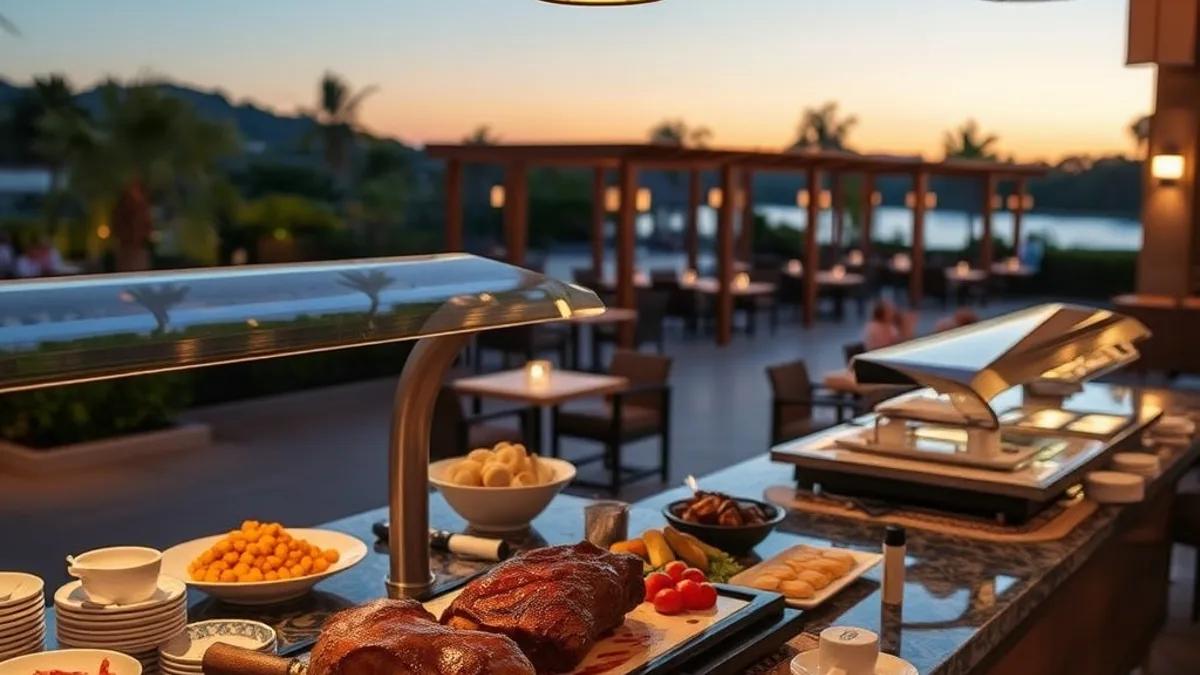
Dedicated kids buffet stations usually run alongside the main buffet rather than in a separate room. They feature lower counters sized for small hands and familiar dishes like plain pasta, chicken nuggets, cut fruit and mild rice dishes. Kids can serve themselves while parents fill their plates from the adult selection a few steps away, which makes one seating work for the whole family.
Early sittings and quieter hours
Early dinner sittings around 5:30-6:30 pm cater to families, opening roughly 1-2 hours before main dinner service. The kids stations are fully stocked at these hours, staff are more patient with slow eaters, and the atmosphere is relaxed about spills and noise. After 7:30 pm, many resorts shift to quieter main-service dining, better suited to couples and older guests. If your children eat late or nap long, check whether the kids stations stay stocked through the evening or wind down early.
Breakfast is the most flexible meal for kids, since buffets at that hour usually run for several hours and offer everything from cereal and pancakes to eggs cooked to order. Lunch is often the cheapest meal to add to a plan if you are not fully all-inclusive, and daytime buffets tend to be the most casual. Dinner carries the highest price and the strictest dress codes at many resorts, so if you are choosing one meal to eat out or order in, dinner is often the one to skip the buffet for.
Supervised Kids Club Dining
Many family resorts run supervised dining through their kids clubs, typically covering ages 4-12. The idea is simple: your child eats lunch or an early dinner with the club group, watched by club staff, while you sit down to a meal at your own pace. It is one of the main reasons parents choose a resort with a proper kids club in the first place.
The catch is that club meals almost always require sign-up in advance. Most resorts ask you to book your child’s lunch or early dinner at the club desk each morning, so the kitchen knows how many portions to prepare. Turning up at noon and hoping your child can join rarely works.
Supervised dining also has time limits. Most clubs close by 8-9 pm, which is earlier than many parents would like for an evening out. Some resorts offer extended evening sessions for an extra fee, but these vary widely, so ask at check-in rather than assuming late care is available.
- Meal sign-in sheets are standard practice, and a child who is not on the list for that day’s lunch or dinner is often turned away, even if the club itself has space.
- Staff-to-child ratios cap how many children can dine at once, so popular sessions on rainy days or busy holiday weeks can fill up quickly.
- Club meals are usually simpler than the main buffet, often served family-style at low tables, which suits younger children but may not appeal to older kids in the club’s age range.
- If your child has dietary needs, mention them when signing up each morning, since club kitchens prepare fixed portions rather than offering buffet choices.
Allergies, Picky Eaters and Special Requests
Allergies are the one dining issue you should never leave to chance at a resort buffet. Contact the resort 48-72 hours before arrival with the details, so the kitchen has time to label buffet items clearly and prepare alternatives for your child. When you arrive, introduce yourself to the restaurant manager and the head chef, and confirm which dishes are safe each day rather than relying on labels alone.
Picky eaters are a different challenge, and buffets are actually your best friend here. Breakfast and lunch are the easiest meals, because that is when made-to-order stations tend to be open. A child who refuses everything on the hot line will usually accept a custom omelette, a plain pasta from the cook-to-order station, or something simple off the grill.
High chairs and boosters
High chairs and booster seats are limited in number at most resorts, and the supply runs out fast during the peak 6-7 pm family sittings. Request one when you book, not when you sit down, and confirm again at check-in. If your child is still in a high chair, bringing a compact travel booster as backup is a small effort that can save you from balancing a toddler on your lap for a week of dinners.
Where Family Dining Rules Vary Most
Family dining rules are not uniform from one destination to the next, and knowing the local style helps you pick a resort that matches your routine. Beach destinations tend to be the most relaxed. In Thailand and the Maldives, resorts generally lean toward easy buffet access for children, with casual dress accepted at most family restaurants. If that laid-back approach appeals to you, have a look at beach resorts in Thailand built around slow spa mornings and easy family evenings for a feel of how this style works in practice.
City-edge resorts are a different story. They often enforce stricter dress codes in their main restaurants, and long pants for adults and closed shoes may be expected even at dinner buffets. Families with small children sometimes find these venues less forgiving about early sittings and wandering toddlers, so check the dress code before you pack.
Design and atmosphere differences
Family-focused resorts in Malaysia and Vietnam are often designed with early sittings in mind. It is common to find a dedicated kids pool right beside the buffet terrace, so children can swim while parents finish breakfast and dinner starts early without anyone feeling rushed.
Wellness-oriented resorts in Switzerland and Japan can be the opposite. Some limit children’s hours in shared dining spaces or restrict young kids in certain restaurants to preserve a quiet atmosphere. These rules are rarely advertised prominently, so ask directly before booking if quiet dining matters to your stay.
Planning Family Meals With Confidence
The surprise families hit at check-in is rarely the room — it’s the dining bill. Age caps, plan restrictions and kids club sign-up rules mean a child who eats free at one resort can cost close to full price at the one next door. The fix is simple: confirm the age bands, the plan type and the kids club meal hours before you book, not after you’ve already paid the deposit.
A few minutes of prep goes a long way. Send allergy details ahead of arrival, book an early sitting and reserve a high chair while you’re at it. Then match the resort’s dining style to your family’s rhythm — early eaters thrive where kids stations open at 5:30, while slower evenings suit quieter main-service dining. Get those details lined up and the stay becomes far easier. If this helped, share it or leave a comment below.