Every villa listing seems to include the same photo: a grill glowing beside the pool, plates stacked on a wooden counter, dusk settling in. The reality on arrival is often different. Guests find a rusty grate, an empty gas bottle nobody knows how to refill, and an “outdoor kitchen” that turns out to be a bucket and a tap at the edge of the garden.
This guide walks you through the barbecue and outdoor kitchen setup before you pay a deposit. We cover why the evening grill can define a villa stay, how to tell charcoal, gas and wood-fired setups apart, what a workable outdoor kitchen actually includes, and how layout, safety and season affect whether it gets used at all. You will also find the questions worth asking any host, plus a short checklist to run through before booking.
Why the Barbecue and Outdoor Kitchen Can Make or Break a Villa Stay
Ask anyone who has rented a villa for a week or more, and they will tell you the same thing: the evening grill becomes the centrepiece of the trip. After a day out, cooking outdoors and eating at your own pace replaces restaurant dinners two or three nights out of the week. It saves money, it keeps the group together, and it turns the villa itself into part of the experience rather than just a place to sleep.
Yet the phrase “BBQ area” in a listing covers an enormous range of reality. On one end sits a proper built-in setup with a clean grill and working tools. On the other sits a small portable grate, dragged out from a storage room, with no fuel, no tongs and no sign it was cleaned after the last guests. Both listings can honestly claim a barbecue.
What a genuine setup looks like
A real outdoor cooking area combines five elements: a proper grill, a prep surface, water, lighting and shelter. Remove any one of them and the whole thing starts to fray. A great grill with no counter space means juggling plates on your knees. A beautiful stone counter with no lighting means cooking blind by seven o’clock.
The good news is that each element is easy to verify separately. Instead of asking a host “is there a barbecue?”, ask about the grill, the counters, the water and the light as individual questions. The answers, and how quickly they arrive, tell you almost everything you need to know.
Grill Types and Fuel: Charcoal, Gas or Wood-Fired
The single most useful question you can ask a villa host is also the simplest: what kind of grill is it? “Barbecue” in a listing can mean any of three very different setups, and they demand different things from you as a guest. Confirm the grill type in writing before booking, so there is no surprise when you walk out to the terrace with your shopping bags.
Charcoal delivers the classic flavor most people picture, but it is the slowest option. Expect roughly 30 to 45 minutes from lighting to cooking temperature, and plan for the aftermath too: hot ash needs somewhere to go, so ask whether the villa has a safe disposal spot or a host who handles it. Wood-fired grills are a fixture of Mediterranean and tropical villas, and they can be wonderful, but they share the slow start and depend entirely on firewood being available. Ask whether the villa stocks wood or whether you will be hunting for a seller on arrival day.
Gas is the low-friction choice. A gas grill is ready in roughly 10 to 15 minutes, which suits families with hungry children or groups coming back late from an excursion. The key detail is the bottle: confirm the villa provides a full one, and that the host or manager knows exactly where refills are sold locally. In some rural areas, particularly on islands, a swap can take half a day, so a single bottle may need to last your whole stay.
- Size matters with wood fires. Traditional wood-fired grills in Mediterranean villas are often built as wide, low brick hearths; ask how many people they can realistically cook for at once, since a large group may need to grill in shifts.
- Check ignition, not just fuel. For gas grills, ask whether the igniter works or whether you will need long matches or a lighter you bring yourself; a dead igniter with no matches nearby is a common first-night frustration.
- Charcoal availability varies. In some destinations charcoal is sold at every corner shop, while in others you may need to ask the villa staff to buy it for you in town, so find out which situation applies.
- Climate shapes the choice. In humid tropical regions, including areas like the rice-field enclaves around Ubud, grills left between guests can rust or clog quickly, which makes a freshly cleaned grill even more important to request.
The Outdoor Kitchen Itself: Sink, Counters and Tools
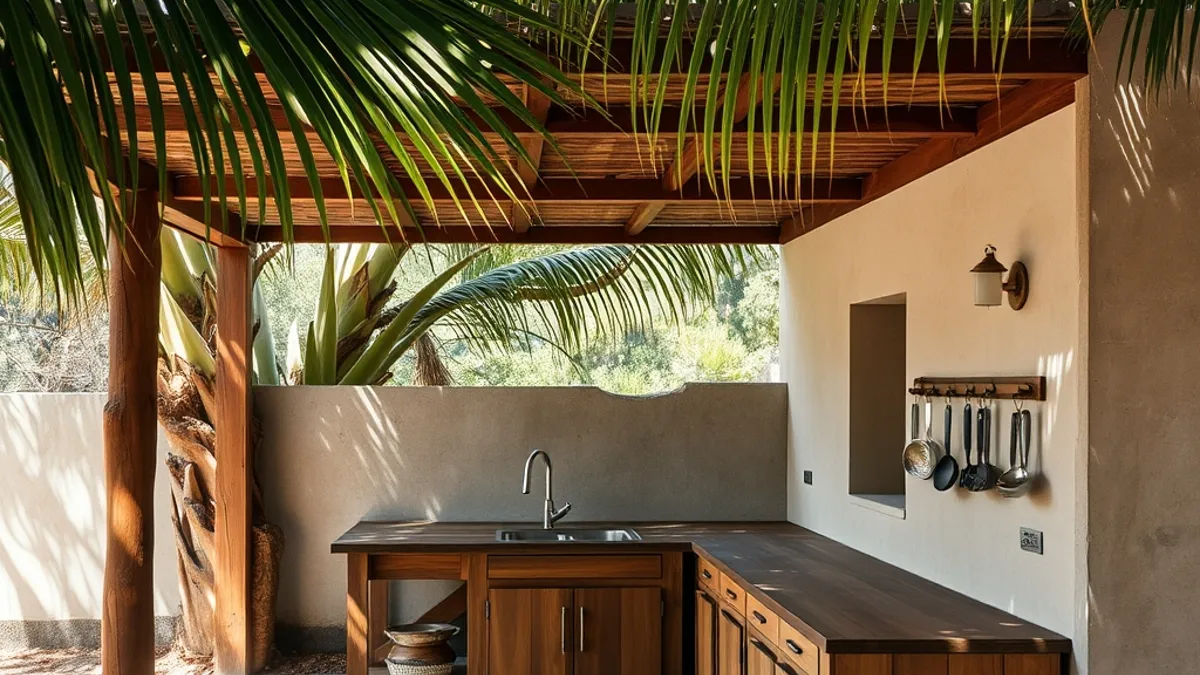
A grill on its own does not make an outdoor kitchen. The difference between a setup you use every night and one you abandon by day three usually comes down to the space and equipment around the grill, and it pays to check each piece before booking.
Start with counter space. You want at least 1.5 meters of continuous counter, so that raw prep, cooked food and plating never have to share the same spot. Anything less and you end up carrying raw chicken across the plating area, which is both stressful and a genuine food-safety problem in warm climates.
Next, water. A running-water sink changes everything. If the “kitchen” amounts to a standpipe in the garden with a plastic basin underneath, you will feel the difference by night two, when you are rinsing boards and hands in the dark with a hose that dribbles. Ask directly whether the sink has proper running water and a drain, not just an outdoor tap.
Then think about flow. Check whether a fridge or cooler sits within a few steps of the grill; walking back and forth to the indoor kitchen for every ingredient kills the rhythm of outdoor cooking and doubles your time on your feet.
- Count the tools, not just their existence. A useful kit means tongs, a grill brush, a sharp knife and a cutting board sized for real prep, not a single bent spatula; ask the host to confirm each item.
- Fuel should match your stay. Enough charcoal, gas or firewood for your entire booking should be on hand at arrival, so ask how the supply is calculated per guest or per night.
- Lighting needs to be functional, not decorative. A single bulb at the villa door is not enough; look for a light source that actually reaches the counter and grill, so you can see when meat is done.
- Ask about cleaning between guests. A grill brush is only useful if the grates arrive clean in the first place, so request that the grill is scrubbed before check-in and confirm who is responsible for ash removal during your stay.
Layout, Safety and Shade Around the Grill
Placement is the part of an outdoor kitchen that photos rarely reveal, and it is where a good setup quietly separates itself from a bad one. Start with distance: the grill should sit at least 3 meters from villa walls, thatch roofs or fabric pergolas. That buffer matters most in older wooden and palm-roof structures, where a stray spark or constant heat against a wall is a real risk rather than a theoretical one.
Think about the wind before you cook
Once you arrive, stand where you would actually cook and picture the prevailing wind. Smoke drifting into open bedrooms or the pool lounge can ruin an evening faster than rain, and in many villas the breeze direction is fixed by the layout, not by luck. If the grill faces straight into the seating area, ask whether it can be repositioned or whether a screen exists.
Coverage is the next thing to check. A covered cooking area keeps the grill usable during a tropical downpour and protects counters and tools between sessions, so you are not wiping down a soaked cutting board every morning. Finally, look down: the surface should be level and non-slip, and the cooking zone should be easy to keep away from small children, ideally with a clear boundary you can point to once and have everyone respect.
Season and Climate: When Outdoor Cooking Actually Works
Even a well-built outdoor kitchen only earns its keep in the right season. In tropical Southeast Asia, the dry window from November to April is when an open-air grill gets nightly use; in the wet months, the same setup can sit idle under a tarp.
Matching the season to the destination
On Indian Ocean and East African coasts, June to October brings the driest, breeziest grilling weather, which is exactly when evening cooking outdoors feels effortless rather than like a battle with the elements. During rainy months, a covered outdoor kitchen stops being a nice extra and becomes the only version that works, so if you are traveling off-season, treat full coverage as a requirement, not a bonus.
Climate also wears the equipment itself. High humidity and salt air corrode grills fast, so coastal villas need visibly recent cleaning and rust-free grates. If the grates are flaking or the burners are streaked with corrosion, the host has not been maintaining the setup, and your food will pay for it. Coastal destinations like Zanzibar show how much the dry season shapes whether the outdoor setup is a highlight or an afterthought; you can see this pattern in villas featured in Zanzibar oases for white sand quiet and palm-shadow ease, where the breeziest months are when the grill becomes the heart of the evening.
Questions to Ask the Host Before You Book
A few direct questions before you pay will save you from the most common outdoor-kitchen disappointments, and good hosts answer them without hesitation. Think of this as your final screening step: by now you know roughly what you want, and these five questions confirm whether a specific villa can actually deliver it. Send them together in one message so the host can reply in a single pass, and treat slow or evasive answers as useful information in themselves. Work through the list in order:
- Request recent photos of the actual grill and counter area. Pool shots and wide garden angles tell you nothing. You want a current close-up of the grill, the counters and the sink, ideally taken within the last few weeks, so you can judge the condition for yourself.
- Confirm how fuel is handled. Ask whether charcoal, gas or firewood is included in the rate or priced separately, and how much a typical stay consumes. A full gas bottle at check-in matters more than an almost-empty one left by the previous guests.
- Ask for a freshly cleaned grill within 24 hours of your arrival. Grates left with the last guest’s residue are the most common complaint, and a host who agrees in advance will usually follow through.
- Check the indoor kitchen as backup. A rainy night or a failed gas bottle should not mean no dinner, so confirm the indoor kitchen is usable and not just for show.
- Book early for peak season. For stays in the December to April window, reserve 3-6 months ahead, and expect roughly $150-$600 per night for a villa with a full outdoor kitchen.
Hosts who answer these questions quickly and specifically are usually the ones who maintain their setups properly. Vague replies about “a barbecue somewhere on the property” deserve the same skepticism you would apply to any listing photo that seems too good to be true. It also helps to put the key answers in writing, either in the booking platform’s messaging system or in a short follow-up message the host confirms, since a written record makes any misunderstanding far easier to resolve on arrival. Finally, save the conversation: if anything about the grill, fuel or cleaning falls short when you check in, a calm reference to what was agreed usually gets it fixed the same day.
The Pre-Arrival Check, In Brief
Villa photos promise a dreamy evening grill by the pool, but guests often arrive to find a rusty grate, no fuel and a kitchen that only works on paper. The fix is simple: treat the barbecue and outdoor kitchen as a checklist, not a photo. A real setup comes down to grill type and fuel, counter space and water, safe placement, and the right season.
Verify each element with the host before you pay, and you turn the evening grill from a listing promise into the best part of the stay. If this guide helped you sort the genuine outdoor kitchens from the portable-grate listings, leave a comment or share it with a friend planning a villa trip.