You’ve been there before: the hotel looked stunning online, all sunlit linens and airy spaces, and then you opened the door to a cramped room with dated furniture and a window facing a wall. The gap between the gallery and reality is one of the most common booking disappointments, and it happens because hotel photos are marketing assets, not documentation. Learning to evaluate hotel photos critically takes only a few minutes, but it can save you from paying for a room that never existed.
This guide walks you through the tricks professionals use and how to spot them. You’ll learn how wide-angle lenses and clever cropping stretch small rooms, how lighting and editing make dim spaces glow, and what missing photos are quietly telling you. We’ll also cover how to cross-check images against guest reviews and maps, how to adjust your checks for villas, city inns, and mountain retreats, and the key takeaways to remember before you book a non-refundable rate.
Why You Need to Evaluate Hotel Photos Before Booking
Here’s the first thing to understand: the photos in a hotel’s official gallery are not documentation of the rooms. They are marketing assets, produced with the same care as a fashion campaign. Professional photographers stage every detail, from the angle of the throw pillows to the folded towels, and they work with lighting equipment to make each space look its absolute best.
This isn’t deception in the legal sense, but it does mean the images are designed to sell, not to inform. A styled photo of a suite at its most flattering angle tells you very little about what you’ll actually experience at midnight when you’re dragging your suitcase around the bed.
Why the gap matters so much
The distance between a styled photo and the real room is the most common source of booking disappointment. Travelers routinely report arriving to find the room smaller, darker, or more worn than expected, and by then the money is often spent. If you booked a non-refundable rate, the styled photo has effectively cost you real money.
The good news is that learning a few visual checks takes minutes, not hours. Once you know what wide-angle distortion looks like, how editing leaves traces, and which missing photos signal problems, you can scan a listing in the time it takes to make coffee. Those few minutes can prevent a costly mistake, especially when cancellation is off the table.
Spotting Wide-Angle and Cropping Tricks
Wide-angle lenses are the workhorse of hotel photography, and for good reason: they sell space. Lenses in the 16-24mm range stretch rooms and bend walls, and they can make a room of 14-20 square meters, typical for a mid-range European double, look 30-40% larger than it really is. The photo isn’t lying about what’s in the room; it’s lying about how much room there is. That difference matters most in Europe, where a few square meters can be the gap between a comfortable stay and living out of your suitcase on the floor.
The trick leaves fingerprints, though. Once you know what to look for, distortion is fairly easy to catch.
- Curved doorframes and bowed walls: straight vertical lines that lean outward or bend near the edges of the frame are a classic wide-angle signature. If the doorframe looks like it’s melting, the room behind it is smaller than it appears.
- An oversized-looking bed: distortion exaggerates whatever is closest to the camera. If the bed seems to loom, it’s probably near the lens, not unusually large.
- Bed-to-room ratio: this is your most useful measuring stick. If a king bed fills most of the frame with little visible floor around it, the real room is likely tight, because a king bed is roughly the same size everywhere.
- What’s cropped out: missing windows, mirrors cut off at the edge, or frames that end right at a wall often hide something the photographer didn’t want to show, such as a poor view or a cramped corner.
When you spot one of these tells, don’t assume the worst about the room itself. Some distortion is simply standard practice, and the room may still be perfectly pleasant. Just adjust your mental estimate downward, compare the bed size to the visible floor space, and look for recent guest photos to confirm the real proportions before you commit to a non-refundable rate.
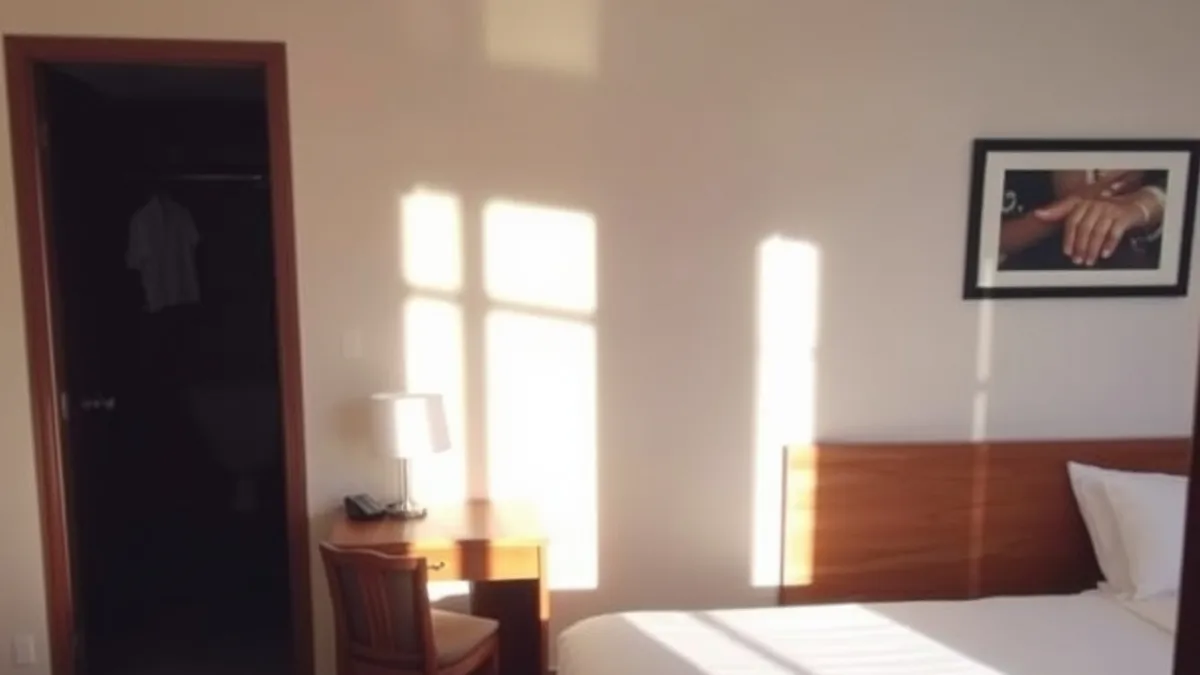
Reading Lighting, Editing, and Timing Cues
Lighting is where hotel photography becomes genuinely theatrical. A professional shoot often uses 1-3 external lights plus HDR blending, a technique that combines multiple exposures so both bright windows and dark corners show detail. The result is a dim, awkward room that looks bright, even, and inviting, in a way no natural lighting ever could.
The traces are usually visible if you slow down. Look for unnatural shadows that fall in odd directions, or corners that glow softly with no visible light source. Real rooms have contrast; heavily lit photos look almost evenly bright from wall to wall, like a showroom rather than a place someone sleeps.
Editing tells and golden-hour shots
Heavy editing leaves its own fingerprints. Skies with oversaturated blues, linens that are perfectly white with zero wrinkles, and interiors bathed in warm, flattering tones all suggest the image got a serious pass in editing software. None of these things is a problem on its own, but together they signal a listing working hard to flatter itself.
Exterior shots deserve special attention. Photos taken in golden hour, roughly one hour after sunrise or before sunset, flatter any building: warm light, long shadows, and softened details. They also hide neighboring buildings and weather. A terrace that glows at sunset may face a car park in full daylight, so ask the hotel what the view looks like at midday.
Finally, build a realistic baseline by cross-checking the same room in guest-uploaded photos taken within the last 12-24 months. Guests shoot with phones, in real lighting, with no staging, which makes their photos the closest thing to truth a listing can offer.
What Missing Photos Are Telling You
Count the photos before you fall in love with any of them. A listing with only 5-10 photos is a red flag in itself: professional galleries for even modest properties usually run much longer, so a short set often means the photographer simply ran out of flattering angles. The gaps are rarely accidental. Bathrooms, the view from the window, and the street outside are the three things most often left out, because they are the three things guests complain about most.
The bathroom is the classic omission. If there is no close-up of it anywhere in the gallery, assume it is small, dated, or built around a shower-over-tub setup that photographs poorly. Window and balcony shots deserve the same suspicion. When a listing shows a beautiful terrace but never shows what you see from it, the view is often a wall, a parking lot, or scaffolding from a construction site next door.
Resort listings follow their own pattern. Food and pool photos are cheap marketing wins, so their absence usually signals something the property would rather not advertise.
- No bathroom close-up: beyond size and age, check whether the listing also avoids showing the sink area or towels — cramped vanities and tired fixtures are the details photographers crop out first.
- Missing window or balcony shots: if the only outdoor images were clearly taken on a rooftop or common deck, the room itself may face an interior courtyard rather than the scenery in the hero photo.
- No food or pool photos in a resort listing: the pool shown, if any, may be shared with a neighboring property or only open seasonally, and the restaurant may be a small breakfast room rather than the full-service dining venue the price implies.
Cross-Checking Photos Against Reviews and Maps
The gallery tells you what the hotel wants you to see. Reviews and maps tell you what previous guests actually got. Cross-checking takes a few minutes and catches the tricks that photo-reading alone cannot, including borrowed images and creative geography. It also adds context that no single photo can provide: what the neighborhood sounds like at night, whether the “quiet lane” in the listing is actually a main road, and how the property has aged since its professional shoot. Think of it as a background check for your booking — the gallery is the sales pitch, while reviews, maps, and a reverse image search together form the evidence. None of these steps requires special tools or paid subscriptions; a browser and ten spare minutes are enough. The payoff is real, especially on prepaid rates where a wrong impression costs you the full amount.
- Run a reverse image search. Save a few gallery photos and search them through a reverse image tool. This can reveal whether the photos come from a different property entirely — a common trick with copied listings — or from an older renovation, before furniture was worn down or a neighboring building went up.
- Sort review photos by newest first. Guest uploads are unedited and unstaged. Prioritize recent uploads over older ones, since dated shots may describe a room that has since been renovated or let go. Then read the low-scoring reviews and look for complaints that repeat — thin walls, a tiny bathroom, a blocked view — because repetition is what the gallery was designed to hide.
- Verify the location claims on a map. Switch to satellite and street view around the pin. “Beachfront” should mean sand visible from the property, and “city center” should put you within a short walk of the main sights, not across a highway or up a steep hill the photos never mention.
- Match the room category to the rate. The stunning suite in the hero photo may not be the room sold at your price point. Open the rate description and confirm the exact category — standard, superior, deluxe, view type — is the one photographed, not a costlier upgrade shown first.
Doing these four checks in order takes roughly ten minutes. On a non-refundable rate, that is the cheapest insurance you will ever buy, and it catches the majority of listing disappointments before money changes hands.
Evaluating Photos for Different Stay Types
Different stay types hide different tricks, so your photo checklist should change with the destination. A beach villa and a city inn mislead in completely different ways, and knowing the pattern for each makes the gaps jump out faster.
Coastal villas and city inns
For coastal villas, the two selling points are the private pool and the sea view, and both are frequently borrowed. Look closely at pool photos: shared pools are shot from angles that hide neighboring loungers, and some listings show a staged pool that belongs to a different unit or a nearby club. Ask the host directly which unit the pool serves and whether the sea view is from the bedroom, the terrace, or only a rooftop deck. For a real-world example of what honest coastal villa photography looks like, browse this guide to Camps Bay villas with cinematic coastlines and private luxury and note how the views are framed from the units themselves.
City inns work the opposite way: they lead with atmosphere. Charming lobby, breakfast nook, and staircase photos are cheap to shoot and flattering, which is exactly why some listings lean on them while the rooms stay small, dark, and windowless. Count how many photos show guest rooms versus common areas. If the ratio is heavily lopsided toward the lobby, expect a compact room and check whether a window is mentioned in the room description at all.
Retreats and the final match
Mountain and lake retreats sell panoramas, and the trick is subtle: the photo may be genuine but taken from a viewpoint a short walk away, not from your room. Read the caption carefully — legitimate listings label shots as “from the terrace” or “nearby viewpoint.” If the caption is silent, ask whether the panorama is visible while lying in bed or sitting on the balcony, and request a photo taken from the specific room you are booking.
Finally, whatever the stay type, match each hero photo to the exact room name and category in the rate description before you pay. “Deluxe sea view” and “standard garden” can share a gallery while looking nothing alike, and the fine print always wins over the photography.
The Bottom Line on Reading Hotel Photos
If you have ever walked into a room that looked spacious and glowing online, only to find it cramped, dated, or facing a car park, the gap was almost certainly created by photography, not by luck. Wide-angle distortion, heavy editing, and missing shots are the three biggest marketing tricks to watch for whenever you scroll through a gallery.
The good news is that honest images are easy to find. Guest photos from the last 12-24 months and quick map checks give the most realistic picture of what you are actually buying. A few minutes of photo scrutiny costs nothing, and it can protect non-refundable bookings from real disappointment. If this helped you read a listing with sharper eyes, leave a comment or share the article with a fellow traveler.