Too many travelers pick a villa by its photos, then discover the reality after check-in: the Wi-Fi drops every time it rains, the power cuts out at dinner, and the “private pool” is a plunge pool barely bigger than a hot tub. By then, you have paid a deposit, unpacked your bags, and there is no front desk downstairs to fix any of it.
A simple villa amenities checklist solves this before you book. Instead of trusting vague phrases like “modern comforts,” you email the host a short list of specific, yes-or-no questions about pool size and cleaning, air conditioning coverage, tested Wi-Fi speeds and backup power. This guide walks you through each of those areas, explains what answers to expect from a well-run villa, and shows you how to time your booking so the best-equipped properties are still available. Ten minutes of questions now can save you a week of frustration later.
Why a Villa Amenities Checklist Beats Photo Browsing
Listing photos are marketing, not documentation. The pool is shot at golden hour from its most flattering angle, but no photographer includes the generator humming behind the garden wall, the router tucked into a ground-floor cabinet, or the bedroom that has no AC unit at all. Photos simply cannot answer the questions that decide whether your stay is comfortable.
This is why a written checklist beats browsing. It converts soft claims like “fully equipped” and “modern comforts” into yes-or-no questions you can paste into an email: Is there a unit in every bedroom? What speed do you test on the Wi-Fi? Does the generator run the air conditioning? Hosts who maintain their villas well can answer these quickly and precisely, and their answers tell you as much about the property as any photo gallery.
Why villas punish amenity gaps more than hotels do
In a hotel, a dead router or a failed AC unit is a front desk problem. Someone else handles it at midnight, and you might get a room swap or a fan delivered within minutes. In a villa, you are the facilities department. If the internet dies on the night before your video meetings or the cooling fails during a humid spell, you are messaging a host who may be asleep, off-island or managing several properties at once.
That gap is exactly what your checklist closes. Verifying the essentials before you pay shifts the conversation to a moment when the host still has every incentive to answer honestly, and it gives you grounds for a refund or a graceful pass if the answers come back vague. The sections that follow cover each amenity in the order travelers regret skipping: pools, air conditioning, Wi-Fi and backup power.
Pools: Size, Depth and Cleaning Schedule
The word “pool” covers an enormous range in villa listings. A “private pool” can be a swimmable 8-12 m lap pool where you can actually do lengths, or it can be a 3-4 m plunge pool that fits two people and a cooler. Neither is wrong, but they serve completely different trips, so ask the host for the actual dimensions in meters before you book. If the listing only says “stunning pool,” that is a prompt to ask, not an answer.
Comfort details matter just as much as size. Ask whether the pool is heated or shaded, since a shaded pool in a cool season or an unshaded one in full tropical sun can change how much you actually use it. If anyone in your group has sensitive skin, also ask whether the pool is saltwater or chlorine; saltwater systems are gentler for many swimmers, but they are not universal.
Then ask about maintenance. Well-run villas net and treat the pool daily or every other morning, usually before guests swim. If a host hesitates on this question or cannot describe a schedule, expect leaves, insects and cloudy water by mid-week.
- Entry and exit points: confirm there are proper steps or a gradual entry rather than only a ladder, which matters for older travelers and anyone with mobility concerns.
- Depth markings: ask whether the deep and shallow ends are clearly marked, especially if guests will be diving or jumping in.
- Barriers and fencing: if you are traveling with small children, ask whether the pool area can be fenced, gated or otherwise closed off from the living spaces and bedrooms.
- Furniture and shade nearby: check that loungers or a shaded seating area sit close to the pool, since a beautiful pool with nowhere to rest nearby gets used less than you expect.
Air Conditioning: Where It Cools and Where It Doesn’t
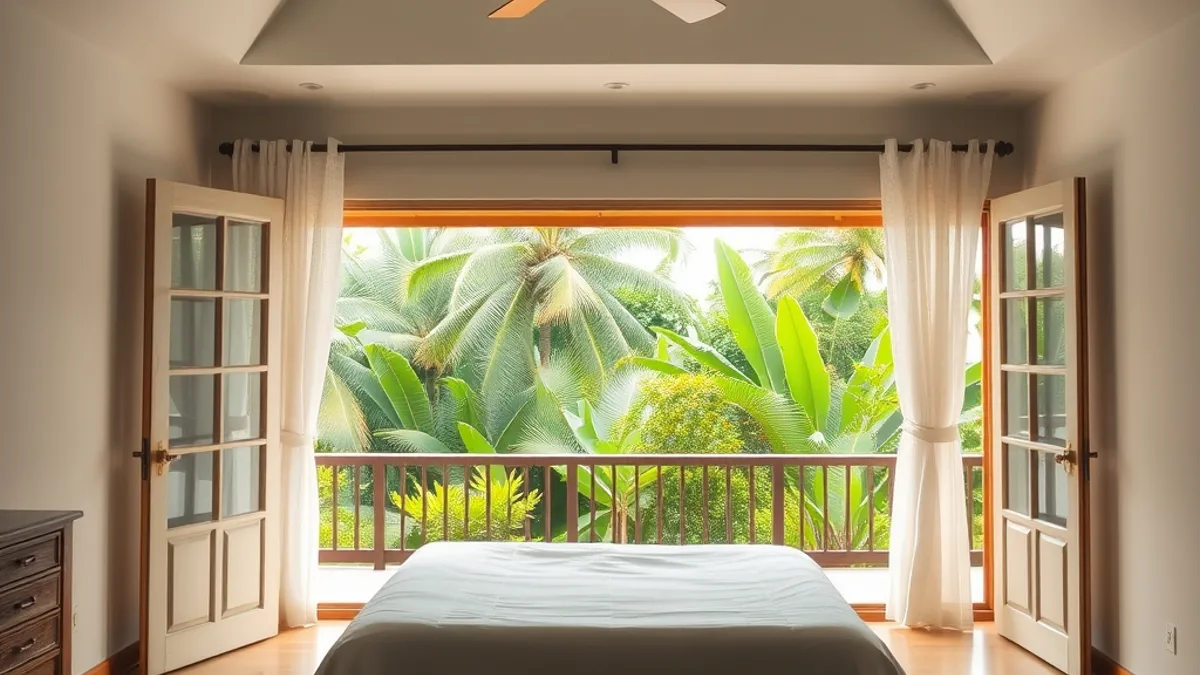
Air conditioning is where villa listings mislead most often. “Air conditioned villa” may mean one split unit in the master bedroom and nothing else. Verify that every bedroom you plan to use has its own unit, not just the one shown in the photos, and ask whether the property uses split or cassette units in the bedrooms, which is the standard setup, or genuine whole-villa central cooling, which is the premium tier. The two behave very differently on a hot afternoon.
Understand that in many tropical villas, the open-air living room, outdoor kitchen and garden bathroom have ceiling fans only. This is a design choice, not a defect, and many guests love it. But if you plan to work, cook or lounge indoors during the hottest hours, decide now whether fan-only spaces suit your comfort rather than discovering it in a sweat.
Finally, ask how the AC is allowed to run. Some budget villas meter electricity or restrict usage to set hours, which means no overnight cooling. If heavy use is billed separately, expect that 24/7 AC in a 2-3 bedroom villa typically adds around $10-25 per day; get the exact arrangement in writing.
- Remote controls and settings: confirm each unit has a working remote and ask whether guests can set their own temperature, since some hosts lock units to a fixed setting.
- Service history: ask when the filters and units were last cleaned or serviced; a poorly maintained split unit cools weakly and can smell musty within days.
- Bedroom layout: check that each unit cools its own room directly, since a single unit in a hallway rarely reaches beds behind closed doors or on another floor.
- Backup behavior: ask what happens to the AC when the power cuts, which connects directly to the backup power questions covered later in this guide.
Wi-Fi: Speeds, Router Location and Work-From-Villa Reality
Nothing ruins a workation faster than a villa whose Wi-Fi looks great in photos but drops every second video call. Before you book, ask the host for a tested speed figure, not a vague “fast internet” claim. Anything in the 50-100 Mbps range or better will comfortably handle video calls, streaming and large file uploads. Below 20 Mbps, expect pixelated calls and long buffering times, especially in the evening when everyone in the area is online.
Router placement matters just as much as raw speed. Many villas are built with thick concrete or stone walls that kill the signal in annexes, upstairs bedrooms or the far side of the pool deck. Ask exactly where the router sits relative to the rooms you will actually use, and whether there is a mesh unit or repeater for outdoor areas.
Recent guest reviews are your best reality check. Infrastructure upgrades and outages happen quickly, so a glowing review from three years ago tells you little. Filter reviews from the last 6 months and search specifically for mentions of Wi-Fi. If you work remotely, add these questions to your email:
- Dedicated workspace: ask whether there is a proper desk and an ergonomic chair, since a wicker lounger by the pool is not a realistic eight-hour workstation.
- Backup connectivity: request details on a portable hotspot or a local SIM option you can use if the main line goes down, and whether the villa has a second provider.
- Bandwidth limits: confirm there is no data cap or fair-usage throttle that kicks in after a few days of heavy streaming and calls.
Backup Power: Generators, Inverters and When They Matter
Power outages are one of those villa realities that listings almost never mention. In many tropical destinations, the grid drops for 2-6 hours at a time during monsoon season or the busy high season, when demand peaks. A villa with a backup generator or inverter keeps your AC, Wi-Fi and refrigerator running through it. A villa without one leaves you sweating in the dark with warm drinks and a dead router.
Not all backup power is equal, so dig into the details. Ask whether the generator or inverter covers the whole villa or only lights and fans, because keeping a fridge cold is not the same as keeping bedrooms cool. Also ask how the changeover happens: an automatic transfer switches over in seconds, while a manual switch may require someone to walk over and flip it.
Follow up on the human side too. Find out who starts the generator and how quickly they can do it. A 5-minute flicker is a minor inconvenience; a 30-minute blackout in tropical heat, with no staff on site, is a very different experience. This matters most in remote coastal and island locations where grid reliability is weakest. If you are eyeing an island stay, have a look at these sleek waterfront homes for island breaks and ask the power questions before you commit. A few extra checks:
- Fuel arrangements: ask whether the villa keeps fuel on site and how many hours of runtime a full tank provides during an extended outage.
- Noise level: generators vary widely, so ask how far the unit sits from bedrooms and whether guests mention the noise in reviews.
- Inverter limitations: if the villa uses an inverter rather than a generator, confirm which outlets it powers, since inverters often cannot handle AC compressors or pool pumps.
Timing Your Booking Around Verified Amenities
Once you know which amenities matter for your stay, the order of operations is simple: verify first, pay second. Email your full list of amenity questions before sending any deposit or payment. How a host responds tells you almost as much as the answers themselves. Hosts who reply with specific figures and details within 24-48 hours usually run a well-maintained property. Vague replies, or silence followed by a generic “everything works fine,” are a signal to keep looking.
Plan Around Peak Season
Timing matters. For a December-January peak season trip, complete your verification and book 2-4 months ahead. The villas with genuine lap pools, whole-villa AC and backup generators fill first, because returning guests rebook them year after year. If you wait until a few weeks before travel, you are choosing from the inventory other guests passed on, often for exactly the amenity gaps your checklist is designed to catch.
When the Listing Is Vague
If photos and descriptions leave you unsure, ask for a short video call or for recent photos of the generator unit, router and AC units. Most honest hosts are happy to walk you through a room on video and show the equipment running. A host who refuses a simple video call after you have asked detailed, polite questions is telling you something. Get the answers in writing, save the thread, and only then hand over your payment.
Your Pre-Booking Checklist in Brief
If you have ever arrived at a villa to find a tiny plunge pool instead of the swimmable one in the photos, weak Wi-Fi in the bedrooms, or no backup power during an evening outage, you know how much a written checklist matters. Photos sell the dream; a short list of direct questions reveals the reality before you pay.
Before booking, confirm the pool dimensions, cleaning schedule and safety features in writing. Verify that air conditioning reaches every bedroom, ask about usage limits and any electricity surcharge. Get tested Wi-Fi speeds, the router location and a backup connectivity option if you plan to work. Check backup power coverage and how quickly the switch-over happens. Once those answers are in hand, lock in your booking 2-4 months before the December-January peak season, when the best-equipped villas fill first. If this checklist saved you from a booking mistake, leave a comment or share it with a friend planning a villa trip.