Many travelers book remote lodges hoping for brilliant night skies, only to arrive during the wrong season or find the lodge sits under light-polluted skies. Stargazing at remote lodges can be unforgettable, but it rewards a little planning: the difference between a sky full of stars and a washed-out haze often comes down to moon phase, cloud statistics and how the lodge handles its outdoor lighting.
This guide walks through what makes lodge skies so dark, when to book for the clearest nights, how to separate genuinely dark properties from ones with clever marketing, and what equipment is actually worth packing. You will also find a realistic picture of how a night at a dark-sky lodge unfolds, a rundown of the best lodge regions in each hemisphere, and a short planning checklist to pull it all together before you commit to a stay.
Why Remote Lodges Offer the Best Stargazing
The darkest skies on Earth are not found at observatories or in national parks with visitor centers. They are found where people are not, and that is exactly where remote lodges are built. As a rule of thumb, a lodge sitting more than 50 kilometers from the nearest town of 10,000 or more people will typically fall under Bortle 1 or 2 skies, the two darkest classes on the light-pollution scale. Under these conditions the Milky Way is not just visible but bright enough to cast a faint shadow, and familiar constellations almost disappear into the sheer number of stars.
Why altitude and dry air matter
Distance from cities is only half the story. Lodges at high altitude or in desert climates, such as those in Chile’s Atacama, Namibia’s Namib desert, the Andes and the East African savanna, sit under thin, dry air with little moisture or dust to scatter light. The result is sharper, steadier stars and a Milky Way that looks almost three-dimensional.
There is also a practical advantage over an observatory tour. At a lodge, the sky is quite literally outside your door. You can stargaze from your own deck, terrace or fire pit, in a reclining chair with a drink at hand, and carry on as long as you like. If you wake at 3 a.m. and the sky is clear, nobody is closing up; the session can simply continue.
Best Seasons and Moon Phases for Stargazing at Remote Lodges
Even the darkest sky on Earth is ruined by the wrong moon. A full moon brightens the night sky enough to wash out the Milky Way core entirely, so the single most important date to check before booking is the lunar calendar. Aim to stay within roughly five nights of the new moon, when the moon is absent from the sky and the faintest stars reappear.
Moon phase is not the whole picture, though. Clouds matter just as much, which is why the dry season in each destination is prime stargazing time. In East Africa that typically means June to October, while Chile’s Atacama is at its clearest from November to April. Before booking anywhere else, check local cloud statistics for the months you plan to travel, since a new-moon week under monsoon cloud is worth very little.
Timing also determines what you will actually see. The Milky Way core, the brightest and most dramatic part of our galaxy, is visible roughly from March to October in the Southern Hemisphere and February to October in the Northern Hemisphere. Outside those windows you still get superb dark skies, just not the showpiece core.
- New-moon weeks sell out first. Dark-sky lodges know that serious stargazers book around the lunar calendar, so availability for those dates disappears fastest.
- Book three to six months ahead. That lead time gives you the best choice of rooms in the new-moon window rather than whatever is left over.
- Build in one spare night if you can. If clouds roll in on your first evening, an extra night gives the sky a chance to clear before you leave.
Choosing a Lodge with Genuinely Dark Skies
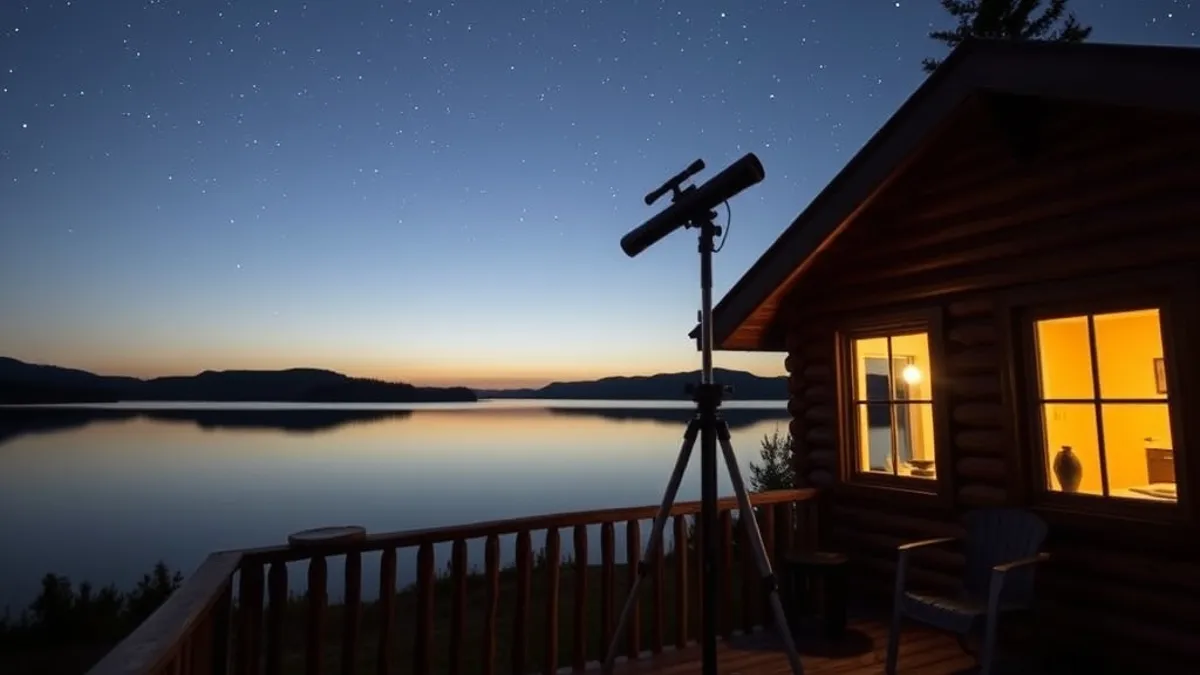
“Remote” is one of the most overused words in lodge marketing, and it tells you almost nothing about sky quality. Some properties advertise wilderness settings while running bright floodlights over the dining deck all night. Before you book, find the lodge’s exact location on a light-pollution map, such as those based on the Bortle scale or satellite brightness data, and judge the sky for yourself rather than trusting the brochure.
The next thing to investigate is how the lodge treats its own lighting. A property can sit in a genuinely dark region and still ruin its skies with unshielded bulbs. Look for lodges that use shielded, warm-toned, dimmable outdoor lights and that enforce a lights-out policy after a set hour. These details are usually mentioned on their website, and a quick email will confirm them.
Horizons matter too. From most of the lodge regions worth visiting, the richest parts of the sky, including the Milky Way core, sit toward the southern or equatorial sky, so prioritize lodges with open viewing from decks or fire pits rather than rooms enclosed by forest canopy or steep valley walls.
- Ask what the lights actually are. Warm amber bulbs aimed downward protect night vision; cool-white uplighting on trees does the opposite.
- Check the terrain around the buildings. A lodge on a rise or open plain gives you horizon-to-horizon viewing that a forested valley property cannot match.
- Look at the climate record. Desert and highland lodges in Namibia, Chile’s Atacama and Kenya’s Laikipia plateau are the most reliable bets, with the Atacama delivering more than 300 clear nights a year.
Equipment to Pack for Lodge Stargazing
Good news for anyone worried about gear: lodge stargazing rewards simplicity. The night sky is one of the few travel experiences where a modest, well-chosen kit beats a suitcase full of equipment, and where the most important tool is simply a comfortable place to lie back and look up.
Start with a pair of 10×50 or 15×70 binoculars, typically priced between $50 and $150. Unlike a telescope, they need no setup skill, no polar alignment and no fiddling in the dark. Hold them steady against a doorframe or rest your elbows on your knees, and they will reveal star clusters, the moons of Jupiter and the dark dust lanes that thread through the Milky Way. Many first-time stargazers find this more satisfying than any magnified view.
The second essential costs almost nothing: a red-light torch. Your eyes need 20-30 minutes to fully adapt to darkness, and a single blast of white light from a phone screen or headlamp wipes that out and starts the clock again. Red light preserves your night vision, which is why serious astronomy facilities insist on it.
- Download a stargazing app with an offline mode before you leave home, since remote lodges rarely have reliable Wi-Fi or cell coverage to stream sky maps on the spot.
- Pack a paper star chart or planisphere as a backup, because batteries die fast on cold nights and a printed chart never runs out of power.
- Bring a reclining chair or a thick blanket, since craning your neck upward while standing gets uncomfortable within minutes and cuts sessions short.
- Include hand warmers and a thermos in cold or high-altitude destinations, because warm hands make the difference between a 15-minute glance and a two-hour session.
As for telescopes: skip packing one. Large instruments are heavy, awkward to fly with and frustrating for beginners to operate alone. Unless the lodge runs guided sessions with its own equipment, cold and tired travelers rarely use what they bring, and the binoculars deliver most of the wow factor anyway.
What to Expect from a Night at a Dark-Sky Lodge
Once the sun goes down at a remote lodge, the evening follows a rhythm worth knowing. Most properties serve dinner early, often around sunset, precisely so guests can be outside when full darkness arrives. After the outdoor lights go out, resist the urge to check your phone; that waiting period is what turns a sky full of a few dozen stars into a sky full of thousands.
Once your eyes have adjusted, plan on one to three hours of viewing before midnight. This is usually the sweet spot: the sky is at its darkest, energy is still high, and you avoid the coldest, latest hours. Use your binoculars, trace constellations with an app, or simply lie back and watch for satellites and meteors between the stars.
Guided sessions and lodge astronomy
Many remote lodges offer guided sky tours, either with a resident telescope and trained staff or through partner astronomers who visit on set nights. These sessions are often included in the rate or bookable on site, so ask at check-in rather than assuming. A good guide can point out objects you would never find alone, from globular clusters to the Magellanic Clouds in southern skies.
Staying warm and shooting the sky
Expect a real temperature drop after sunset at desert and highland lodges, even in warm seasons. Dry air and altitude release heat quickly once the sun goes down, so pack layers, a hat and something windproof regardless of the daytime forecast.
Photographers should bring a sturdy tripod and plan on exposures of 10-20 seconds to capture the Milky Way without star trails. Some lodges run dedicated astro-photography nights with guidance on settings and composition, which are worth joining even if you normally shoot on a phone.
Top Lodge Regions for Stargazing by Hemisphere
Both hemispheres offer world-class dark-sky lodging, but the standouts differ in character. In the Southern Hemisphere, three regions rise to the top. Namibia’s NamibRand is a certified Dark Sky Reserve, one of the few places on Earth where lighting is actively managed across an entire reserve. Chile’s Atacama delivers some of the darkest, driest, most stable skies accessible anywhere, which is why major observatories cluster there. Kenya’s Laikipia plateau adds something no desert can: the southern sky viewed from an open savanna, with acacia silhouettes instead of rock formations.
In the Northern Hemisphere, the high-desert lodges of the US Southwest combine dark skies with dramatic red-rock country, while Icelandic highland cabins put you under skies that can, in winter, produce auroras on the same clear nights you spend stargazing. Alpine estates above 1,500 m offer thinner air and darker horizons than the valley towns below, and pair well with summer hiking. For a different alpine mood, the chalets of Queenstown pair lake stillness with mountain light and make a gentle introduction to southern-sky viewing.
The real trick is combining stargazing with a second draw. East African lodges give you safari by day and the Milky Way by night, which is a remarkably efficient use of a long-haul flight. Chile adds desert excursions, salt flats and valley wineries to the astronomy. Iceland layers northern lights, hot springs and glacier drives onto winter nights.
- NamibRand’s reserve status means lodges there follow strict lighting rules, so expect genuinely pitch-black grounds and guided walks between dinner and your room.
- Laikipia sits near the equator, so observers can see constellations from both hemispheres in a single night, a rare treat for northern travelers.
- US Southwest high-desert lodges often sit at elevations that thin the atmosphere, sharpening planetary views through lodge telescopes.
- Icelandic summer nights stay too bright for stargazing, so target the winter months if the night sky, not midnight sun, is your goal.
Whichever region tempts you, match it to your travel window using the season and moon-phase rules: pick the dry season for your destination, aim for a new-moon week, and book early, since those weeks sell out first at the best dark-sky lodges.
Planning Your Stargazing Lodge Stay
Stargazing at remote lodges comes down to three decisions: a dark-sky region, a new-moon week in the dry season, and a lodge with shielded lighting. Get those right, and the disappointment of arriving under hazy, light-polluted skies largely disappears. A lodge far from any sizeable town, timed to the darkest nights of the month, will deliver the kind of sky most travelers only see in photographs.
As for gear, keep it simple: binoculars, a red-light torch and warm layers cover most nights. Remember that full dark adaptation takes 20-30 minutes, so protect it by switching to red light the moment you step outside. Book 3-6 months ahead for the best new-moon availability, and confirm the lodge’s astronomy offerings before you commit. Do that, and your stay should reward you with the Milky Way overhead from your own deck. If this helped you plan a darker, clearer night under the stars, leave a comment or share this article.