You’ve found the perfect tropical villa: an open-air living room, a private plunge pool, a terrace made for sunset dinners. Then a familiar worry creeps in. Will mosquitoes turn those dreamy evenings into an itchy ordeal? And with so many products and promises out there, it’s hard to know which villa mosquito control methods actually work and which are just marketing.
This guide breaks it down honestly. We’ll explain why villas expose you to more mosquitoes than a sealed hotel tower, how screens and bed nets form your first line of defense, and what garden misting systems really cost. You’ll also learn how to pick a villa that takes mosquitoes seriously, plus simple personal habits that make a real difference. By the end, you’ll know exactly what to look for when booking and what to do each evening to keep your stay comfortable and largely bite-free.
Why Villa Mosquito Control Matters More Than You Think
Villas are wonderful precisely because of what makes them different from hotels: open-air living rooms, plunge pools, lush gardens, and wide terraces that blur the line between indoors and out. That same design, however, creates far more mosquito exposure than a sealed, air-conditioned hotel tower ever would. You’re essentially living in the mosquitoes’ habitat, with plenty of shaded corners and greenery around you.
The main culprit in most tropical destinations is the Aedes mosquito. It’s the species behind dengue and other diseases, and it behaves differently from the mosquitoes you might know from home. Aedes bites mainly in the two hours after dawn and the two hours before dusk, which is exactly when you want to be enjoying your terrace with coffee or a sundowner.
Where the bites actually happen
In practice, bites concentrate in a few predictable spots. Terraces and pool decks are the obvious ones, especially in the late afternoon. The other hotspot surprises many guests: bedrooms with doors propped open at sunset. That lovely evening breeze also carries in the mosquitoes that will find you at 2 a.m. Knowing these patterns is half the battle, because it tells you when and where to focus your defenses.
Screens and Sealed Openings: The First Line of Defense
Screens are the unsung heroes of a comfortable villa stay, yet they get far less attention than pools or views. A fine mesh screen of 1.2 mm or tighter on sliding doors and windows blocks most mosquito species while still letting the tropical breeze flow through. That balance matters, because the whole appeal of a villa is open-air living, and you shouldn’t have to seal yourself inside air conditioning just to get through the evening in peace.
But screens only work if they’re intact and actually used. Many villas have screens that look fine at first glance yet fail in small, frustrating ways. A single torn panel or a door that never quite closes can undo the effort of every other mosquito measure on the property. When you arrive, walk through the villa in daylight and test everything before your first evening outdoors.
- Self-closing hinges: Screen doors should swing shut on their own. If one stays open unless you push it, guests will forget, and mosquitoes will stroll right in.
- Threshold gaps: Run your hand along the bottom of each screen door. A gap at the floor threshold, even a small one, is an open invitation, since mosquitoes tend to fly low.
- Corner tears and holes: Check the mesh corners where cats, luggage, and cleaning equipment tend to snag. A fingernail-sized tear defeats the whole screen.
- Retractable options: On wide verandas, retractable screens roll away when not needed and pull down for open-air evenings, so you don’t have to choose between the view and the bites.
If a screen is damaged, report it immediately and ask for a repair or a room change. A good villa manager will arrange a fix the same day; a shrug tells you how seriously the property takes mosquitoes in general, and it may be worth reconsidering your booking.
Bed Nets and Bedroom Setup for Bite-Free Nights
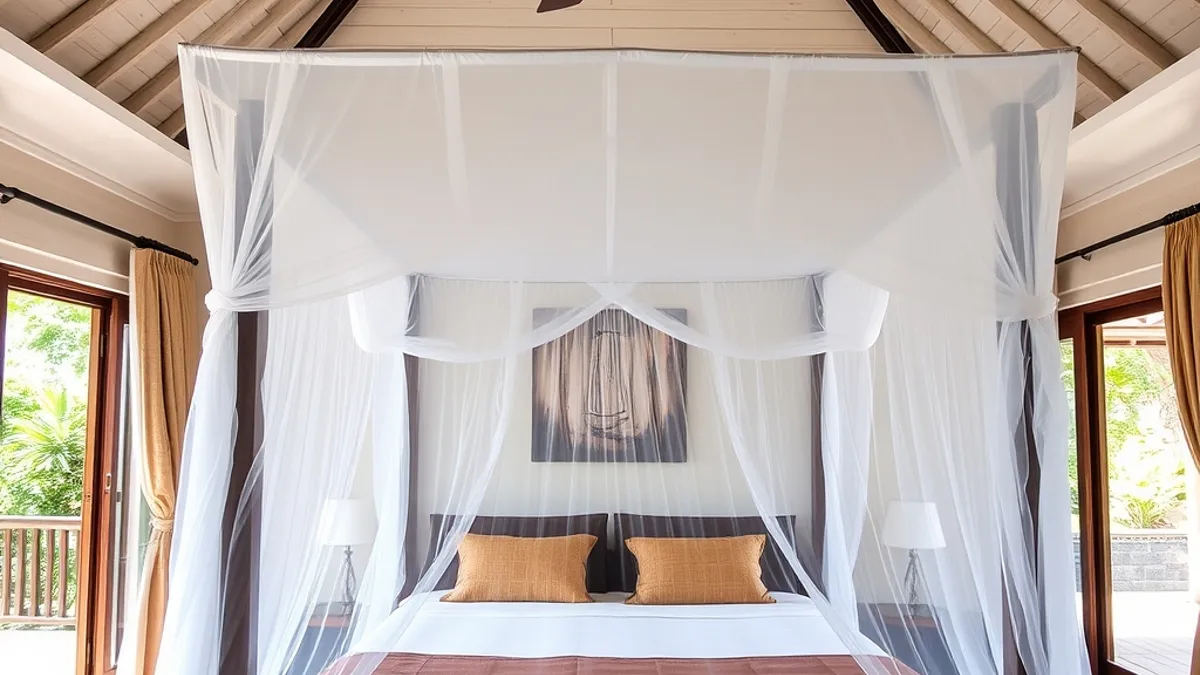
Even the best screens can’t cover everything, so your bedroom setup matters. Canopy nets over four-poster beds are standard in many tropical villas, and they work beautifully, provided you use them correctly. The most common mistake is leaving the net draped loosely around the bed. Before you sleep, tuck the net under the mattress on all sides so no mosquito can slip in through the bottom gap.
Nets also need checking every evening. A tiny tear you didn’t notice at check-in can undo everything, so run your eyes over the full canopy each night before bed. Keep a small repair kit in your luggage: a roll of clear tape or a needle-and-thread kit weighs almost nothing and fixes most tears in a minute.
Air movement is your quiet ally. A ceiling fan producing air speeds above roughly 2 m/s makes mosquito landings noticeably harder, because these insects are weak fliers. When booking, request fan-equipped bedrooms, and if the villa you’re considering is in a lush inland setting, look at options such as Ubud enclaves surrounded by rice fields and quiet tropical serenity, where well-designed bedrooms often combine fans, nets, and screens.
- Fan direction: Position the fan so airflow sweeps across the bed, not just around it. A direct breeze over your body is what disrupts landings.
- Net plus fan combo: Use both together. The net catches anything already in the room, while the fan discourages new arrivals.
- Evening sweep: Before dusk, do a quick check for mosquitoes that slipped in during the day, so you start the night with a clean room.
Garden Misting Systems and What They Cost
If you have ever sat on a villa terrace at sunset and wondered why the mosquitoes seem to vanish after a few days, there is a good chance an automatic misting system was doing the work quietly. These systems run a network of thin tubing through the garden, mounted along fence lines, eaves and planters, with nozzles that release a fine burst of insecticide at programmed times. The bursts are usually timed for dawn and dusk, which lines up neatly with when Aedes mosquitoes are most active and most likely to find you on the terrace.
Most systems are set on a timer from a small control unit, and many let you adjust the frequency and duration of each mist. A short spray lasting under a minute is typical, and well-designed setups aim the nozzles away from seating areas, pools and outdoor dining tables. If you are staying in a villa with a misting system, it is fair to ask the manager when it last ran and what product it uses, especially if children or pets will be playing on the lawn.
What misting actually costs
For owners and long-term renters considering installation, budgeting matters. A professionally installed system in a villa garden typically runs USD 1,500-4,000, with the final figure depending on how much coverage area the tubing and nozzles need to reach. Larger gardens with dense planting sit at the higher end, while a compact courtyard can come in lower. There are also running costs for refilling the insecticide reservoir, which vary with how often the system mists.
The most important thing to understand is what misting cannot do. It knocks down adult mosquitoes, but it does nothing to eliminate larvae breeding in standing water. A system that mists twice a day over a garden with water sitting in plant pot saucers, clogged gutters or an unmaintained pond will fight a losing battle. Misting works best combined with basic water management, so if you are evaluating a villa, treat the misting system as one layer of control rather than the whole answer.
How to Choose a Villa That Takes Mosquitoes Seriously
Villa listings love the phrase “tropical garden,” and it tells you almost nothing about whether you will spend your evenings swatting. A property that takes mosquitoes seriously will say so in the details: mentions of screens on the sliding doors, nets over the beds, ceiling fans in every bedroom, and a fogging or misting schedule for the grounds. When a listing spells these out, it usually means the owner has dealt with the problem rather than hoping guests won’t notice. The same logic applies when browsing overwater or beachfront options, and it is worth reading how properties describe their environment, as in this look at overwater villa living in the Maldives, where constant sea breezes change the mosquito picture entirely.
Beyond the listing text, ask the manager or host a direct question before booking: how often is standing water cleared from the property? Ponds, plant pot saucers, roof gutters and pool covers are the main breeding spots, and water should be emptied at least twice a week to break the breeding cycle. A host who answers confidently and specifically is a good sign; a vague “we spray sometimes” is not.
Location within the property’s surroundings matters just as much as what happens inside the fence line. Villas on breezy ridgelines or waterfronts generally face fewer mosquitoes than sheltered jungle plots, because steady wind makes it hard for mosquitoes to fly and land. A dense, enclosed garden with still air is exactly the conditions they favor, no matter how beautiful the foliage looks in the photos.
- Check the photos for screen doors and bed canopies. Zoom in on the bedroom and living room shots; visible mesh on sliding doors and a net draped over a four-poster bed are evidence, not just marketing copy.
- Ask about the drainage slope around the pool deck. Pool decks that pool water after rain become breeding spots within days, so a well-designed villa should shed water toward a drain rather than letting it sit in low patches.
- Look for villas near open water or open land rather than dense vegetation. A villa backing onto a lagoon, beach or cleared hillside gets more airflow than one hemmed in by thick tropical planting on all sides.
- Read recent guest reviews for the word “mosquito.” Reviews from the wet season are the most telling, since that is when mosquito activity peaks in most tropical destinations and any weakness in the villa’s setup will show up fast.
Personal Protection Habits During Your Stay
Even the best-screened villa cannot protect you once you step outside for a sunset drink or a garden dinner, so your personal habits carry real weight. The single most effective move is applying repellent before you go out, not after you feel the first bite. A DEET repellent in the 20-50% concentration range gives roughly 5-8 hours of protection, which comfortably covers a long dinner or an evening stroll. Apply it to exposed skin before the two-hour window around dusk, and reapply if you have been swimming or sweating heavily.
Clothing is your second layer of defense, and it matters most at exactly the times you are least likely to think about it: relaxed outdoor meals in the garden. Loose-fitting long sleeves and trousers are far more comfortable than they sound in the tropics, especially in lightweight fabrics, and they deny mosquitoes the easy access they get at ankles and shoulders. This becomes more important during and just after the wet season, when mosquito activity peaks across most tropical destinations and even a short walk from the car to the table can earn you a half-dozen bites.
Finally, build a small late-afternoon routine inside the villa. Any mosquito that found its way indoors earlier will be looking for a warm body once night falls, and an open bedroom door at sunset is an open invitation.
- Do a quick door sweep at dusk. Before closing up for the evening, spend a minute checking behind curtains and under tables inside the bedroom; a mosquito that entered at midday often rests on shaded surfaces until lights go out.
- Switch the fan on before sunset, not at bedtime. A ceiling fan running at air speeds above roughly 2 m/s noticeably reduces mosquito landings, and starting it early clears the room while you are still awake to notice a problem.
- Keep repellent and after-bite cream in two places. Stash one set by the front door for terrace evenings and another on the nightstand, so you never skip an application because the bottle is in the other room.
- Empty the vase or plant saucer on your own terrace. Even a decorative water feature or a flower vase on the outdoor table can hold larvae, so tip out and refresh the water at least twice a week during a longer stay.
The Bottom Line on Keeping Villas Bite-Free
If you have ever booked a dream tropical villa and then spent the evening swatting at your ankles instead of enjoying the terrace, the good news is that mosquito problems are largely solvable. Screens, tucked-in nets and fans form the reliable core of villa mosquito control, and they work quietly in the background while you relax. A property that gets these basics right protects you around the clock, not just when you remember to spray.
Misting systems add comfort at a cost, but they work best alongside regular draining of standing water rather than as a stand-alone fix. Choosing a breezy, well-screened villa and packing a good repellent covers both the property side and the personal side. Do that, and your evenings on the terrace belong to you again. Have a tip that worked at your villa rental? Leave a comment or share this article.