You’ve found the perfect safari lodge, the photos look stunning, and then a quiet worry creeps in: what are the malaria precautions actually like once you get there? Most lodge websites say almost nothing about screened rooms, bed nets, or repellent, leaving travelers to guess whether their chosen camp takes mosquito protection seriously. That uncertainty is frustrating, especially when you’re paying premium rates for a trip you’ve planned for months.
This guide walks you through exactly what matters. We’ll cover where malaria risk applies to lodge stays in places like the Okavango, Kruger’s lowveld fringe, and the Maasai Mara, how to time your trip and prophylaxis, and how to choose rooms that keep mosquitoes out. You’ll also learn which questions to ask before booking, what dusk-to-dawn habits make a real difference, and what to do if you feel unwell during or after your stay.
Where Malaria Risk Actually Applies to Lodge Stays
Malaria risk across African safari country is patchy, and knowing where it applies is the first step in planning your lodge stay. Northern Botswana is firmly in the risk zone: lodges around the Okavango Delta and Chobe sit in areas where transmission can happen year-round, with the danger peaking during the warm wet months of November to April. The delta’s waterways make for spectacular game viewing, but they also create ideal breeding habitat for Anopheles mosquitoes.
South Africa’s Kruger-area lodges in the lowveld carry a seasonal risk rather than a constant one. The wet months bring the highest exposure, while May to October sees risk drop to low levels. Many travelers visit in the dry season precisely because the combination of thinner vegetation and lower mosquito activity makes for easier, safer game viewing.
Kenya’s split picture
Kenya is a tale of two landscapes. Bush lodges near the Maasai Mara and coastal retreats along the Indian Ocean both sit in recognized risk areas. Nairobi, by contrast, sits at high altitude where malaria transmission is effectively absent, so a city stopover carries little concern.
On the safer end of the scale, desert and highland destinations are effectively risk-free. Namibia’s southern region, the Swaziland highveld, and South Africa’s interior all fall outside malaria zones, so lodges there need no special precautions beyond ordinary insect comfort. If avoiding the issue entirely matters to you, these destinations let you focus on the trip itself rather than the mosquito count.
Timing Your Trip and Your Prophylaxis
When you go matters almost as much as where you sleep. Southern Africa’s malaria risk drops sharply from May to October, the cool dry season, and some travelers on short trips in that window can reasonably skip prophylaxis entirely—though that is a decision for a doctor, not a booking agent. If your dates are flexible, pairing a dry-season safari with a coastal wind-down, such as the combination described in bluewater resorts in South Africa for safari elegance and coastal release, keeps risk low without sacrificing the trip.
- Book a travel-health consultation 4-6 weeks before departure. This lead time lets the clinic review your itinerary, prescribe the right antimalarial, and fit in any vaccines that need multiple doses. Last-minute appointments often force compromises.
- Match the drug to your schedule. Atovaquone-proguanil typically starts just 1-2 days before travel, which suits late planners. Mefloquine and doxycycline need 2-3 weeks of lead time, partly to check for side effects before you are in the bush.
- Discuss skipping prophylaxis if you travel May to October. In the dry months, risk in southern African safari areas is far lower, and a clinician may judge that repellent, screened rooms, and sensible habits are enough for a short stay. Never make this call on your own.
- Finish the full course after you leave. Depending on the drug, that means continuing for around 7 days or 4 weeks after exiting the risk area. Stopping early is one of the most common prophylaxis mistakes.
One practical note: write your dosing schedule down before you pack, including the end date, and set phone reminders for each dose. Safari days run long, and it is surprisingly easy to lose track of a nightly tablet when you are on a dawn game drive schedule. Bring more medication than you think you need in your carry-on, since replacements in remote lodge areas can be unreliable.
Choosing Rooms That Keep Mosquitoes Out
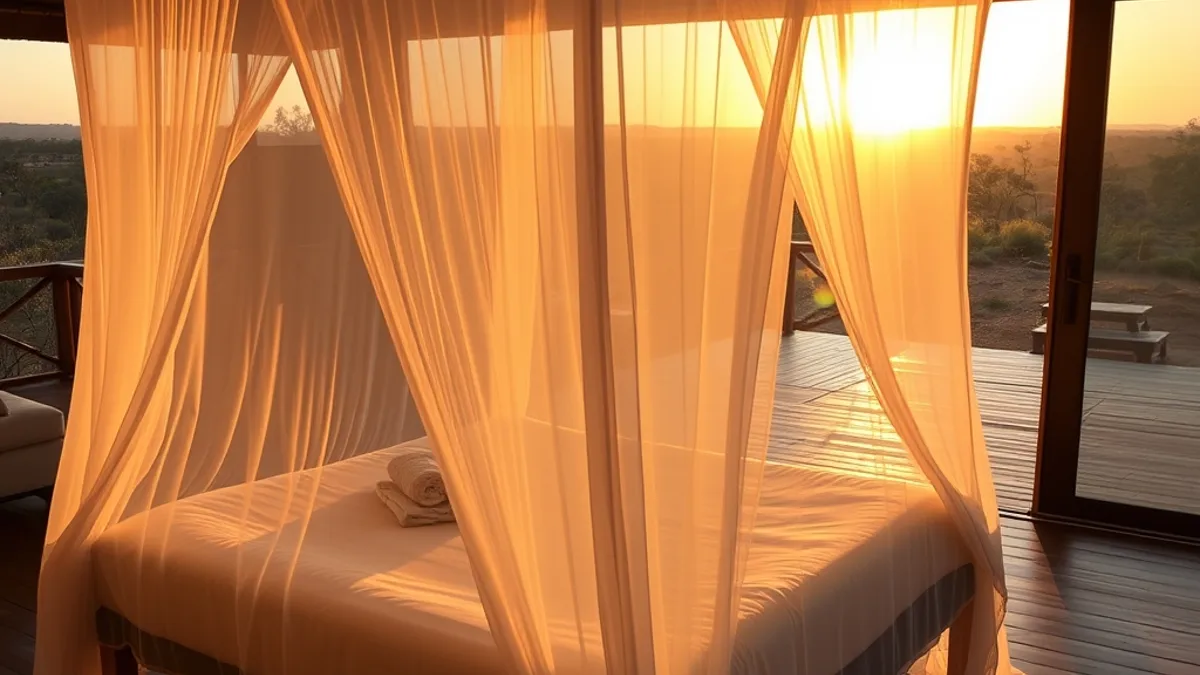
The single biggest factor in your malaria exposure at a lodge is the room itself. A fully screened, air-conditioned room or a sealed tented suite gives you a physical barrier against mosquitoes, while an open-sided chalet with canvas flaps and gaps leaves you relying on repellent alone through the night. When you browse a lodge’s website, look closely at the room photos: if you can see open air, thatched eaves without mesh, or wide doorways, ask directly what happens after sunset.
Location within the camp matters too. Mosquitoes that carry malaria breed in standing water, so rooms set back from lagoons, dams, waterholes and lush irrigated gardens typically see far less activity than those built right on the waterline. Upper-floor rooms also help, since Anopheles mosquitoes generally fly low. If a lodge offers a choice of room types, it is reasonable to request one farther from water and higher off the ground.
The best lodges treat mosquito control as part of daily housekeeping rather than an afterthought. Some fog the camp grounds, treat rooms at turndown with a mild insecticide spray, and leave plug-in repellent units running in every room as standard. These details rarely appear in brochures, so it pays to ask before you book rather than discover gaps on arrival.
- Ask about mesh maintenance schedules. Screens and zip-up mesh panels wear out with use; a lodge that inspects and repairs them between guest stays will keep the barrier intact, while a torn panel on an otherwise “screened” room defeats the purpose.
- Check how tents close at night. In tented camps, safety depends on zipping every flap fully and keeping it zipped from dusk onward; ask whether staff do evening checks or brief guests on this at orientation.
- Confirm whether plug-in units are refilled daily. A repellent unit only works if the tablet or liquid insert is replaced each day, so ask if housekeeping handles this automatically or if you need to request refills.
- Ask if room treatments use child-safe products. If you are traveling with young children, confirm what chemicals are sprayed in rooms and whether you can request an unsprayed room with alternative protection.
Nets, Repellent and Dusk-to-Dawn Habits
The mosquitoes that matter at safari lodges are the Anopheles species, and they feed mainly between 6pm and 6am. That single fact should shape your entire evening routine. Dinner on the deck, drinks around the fire and the drive back to your room after dark all fall inside the danger window, so plan for them rather than hoping for the best.
Cover up as the light fades. Long sleeves and long trousers at dinner and on evening drives make a real difference, especially in light colors, which mosquitoes seem to find less attractive than dark ones. Spray your ankles and neck before you head out, not after you feel the first bite.
Your repellent should be a DEET-based product of 20-50% concentration, applied to exposed skin from late afternoon onward. Lower concentrations wear off faster, and applying it too late in the day leaves a gap before the biting hours begin. If you use sunscreen too, apply the sunscreen first and let it settle.
If your room lacks proper screening or air-conditioning, sleep under a permethrin-treated net every night. Tuck the edges firmly under the mattress so no mosquito can slip in at floor level, and check the net carefully on arrival. If you find holes, don’t patch it yourself with tape or safety pins; ask housekeeping for a replacement. Good lodges keep spares and will swap one without fuss.
- Pack your own permethrin-treated net or a spray-on permethrin product if you’re staying at a very rustic camp where nets may not be standard, since some budget bush camps rely on guests bringing their own.
- Treat socks, hat brims and trouser cuffs with permethrin before you travel, as treating clothing at home gives you an extra layer of protection that repellent alone can’t provide.
- Reapply DEET after swimming or heavy sweating, because water and perspiration shorten its working time on skin.
- Keep the net closed all night, not just when you first get in, since a net left open while you sleepwalk to the bathroom at midnight defeats the purpose entirely.
- Switch off or dim lights inside unscreened rooms after dark, as bright light can draw mosquitoes toward your sleeping area through any gap in the canvas or mesh.
Questions to Ask Before You Book
The best time to sort out malaria protection is before you hand over a deposit, not when you arrive and find your chalet has open sides and no net. Lodge websites rarely spell out their mosquito-proofing in detail, and a photo gallery can’t tell you whether the family unit two rows back has proper mesh or a net tucked in a cupboard. A short email or phone call before booking tells you far more. Well-run lodges will answer these questions without hesitation, and the way they respond is itself a clue to how seriously they take guest health. Vague replies, or being told to “just ask at reception,” are worth taking seriously.
Start with the rooms themselves, then move to the camp’s surroundings, and finish with what happens if something goes wrong. A lodge can be perfectly safe on paper but sit beside a dam that breeds mosquitoes all season, so the answers need to fit together as a picture. Get confirmations in writing if you can, so there’s no disagreement at check-in.
- Are all guest rooms screened or air-conditioned, and do you supply nets and repellent free of charge? Ask specifically whether every room type is protected, including the cheaper chalets and family units, because some lodges screen only their top suites. Confirm that nets and repellent come at no extra cost rather than as a paid extra from the curio shop, and that this is settled at booking rather than on arrival.
- How far are the rooms from standing water, and do you run mosquito control around the camp? Rooms set 50+ meters from lagoons, dams and irrigated gardens face lower mosquito pressure. Ask whether the lodge fogs the camp, treats rooms at turndown or stocks plug-in repellent units as standard equipment.
- Do you keep rapid malaria test kits and have a doctor or airstrip evacuation plan on call? A good answer includes a named doctor or clinic, a working relationship with an air evacuation service and staff trained to use the test kits. Ask how long an evacuation from the camp typically takes.
- Is the camp open or closed season, and how does your risk profile change between wet and dry months? Some camps close entirely in the wettest months, while others stay open with a different insect burden. Ask which month you’re booking into and what the camp does differently about mosquitoes in that season compared to the rest of the year.
Finally, note the answers down alongside your booking confirmation. If a lodge promises screened rooms and free nets in writing, you have something to fall back on if the reality doesn’t match, and most lodges will move you to a better room rather than argue the point.
If You Feel Unwell During or After Your Stay
Most lodge stays end with nothing worse than a few mosquito bites and a great set of photos, but malaria deserves respect even after you fly home. Fever, chills, headaches or body aches at any point within a year of a malaria-zone stay warrant an immediate malaria test. Don’t wait to see if it passes, and don’t assume it’s just flu or travel fatigue. A simple blood test at any clinic or hospital settles the question quickly, and early treatment makes all the difference.
Tell every doctor you see that you visited a malaria area, even months later. Some malaria parasites can lie dormant in the body for long periods before causing symptoms, so a trip from last season is still medically relevant. Write it down and say it out loud at the appointment, because doctors don’t always think to ask about travel from months earlier.
While You’re Still at the Lodge
If you feel feverish during your stay, report it to staff straight away rather than waiting until morning. Serious lodges keep rapid malaria test kits on site and can arrange air evacuation if needed, so raising the alarm early gives you the full range of options. Ask at check-in where the test kits are kept and who to wake at night.
Check Your Insurance Before You Go
Medical evacuation from a remote bush airstrip can be expensive, so confirm before departure that your travel insurance covers medical evacuation specifically, not just hospital treatment. Check whether the policy covers the whole region you’re visiting and whether pre-approval by phone is required before an evacuation flight. Keep the insurer’s emergency number saved offline on your phone, since lodge Wi-Fi is rarely dependable when you need it most.
Wrapping Up Your Lodge Malaria Plan
Most lodge websites stay quiet about mosquito protection, so the answers you need come from a few deliberate choices. Match your destination and season to the risk level first, then favor screened or air-conditioned rooms and confirm at booking that nets and repellent are supplied at no extra cost. Those two steps do more than any last-minute purchase at the camp shop.
Next, start prophylaxis on the schedule your travel-health clinic gives you, and keep the dusk-to-dawn habits going: repellent on exposed skin, long sleeves at dinner, and net edges tucked in if your room needs one. Finally, ask the four booking questions before you pay, and remember the post-trip fever rule, since malaria can appear months later. Get these pieces lined up and your safari lodge stay stays a pleasure. If this helped you plan, leave a comment or share the article with a fellow traveler.