Many travelers book a room labeled “accessible,” arrive with a wheelchair or mobility aid, and discover the bathroom has a tub, the doorway is too narrow, or the bed is far too high to transfer onto. The label alone rarely tells you enough, because accessible hotel rooms can mean anything from a hearing-friendly room to a fully wheelchair-adapted space.
The good news is that a handful of specific questions, asked before you pay, prevent almost all of these surprises. This guide walks through why the word “accessible” on a booking site doesn’t guarantee a fit for your needs, which bathroom, shower, doorway, and bed details to confirm, how to time your booking and get written confirmation, what to check beyond the room itself, and how different destinations handle accessibility differently. It closes with a simple pre-booking checklist you can reuse on every trip.
Why ‘Accessible’ on a Hotel Site Doesn’t Mean Accessible for You
The word “accessible” covers a wide range of needs, and hotels use it for all of them. A room may be labeled accessible because it serves guests with hearing or vision needs, which means it could have visual alarms and a flashing doorbell but still have a standard tub instead of a roll-in shower. If your requirements are mobility-based, never assume the label matches them.
Building age matters too. In older properties, the accessible room may sit in a different wing, or the only step-free route to it may run through a service corridor or up a ramp that was added as an afterthought. That can mean longer distances, awkward routes, or a room that technically meets requirements while being impractical in practice.
Why photos rarely settle the question
Hotel galleries almost always show the bed, the view, and the lobby. They rarely show the bathroom, the doorway widths, or the bed height from the floor, which are exactly the details that decide whether a room works for you. A room can look spacious in photos and still have a bathroom door that a wheelchair cannot clear.
Treat the label as a starting point, not an answer. The sections below give you the specific questions to ask, and the measurements to request, before any money changes hands.
Questions About the Bathroom and Shower
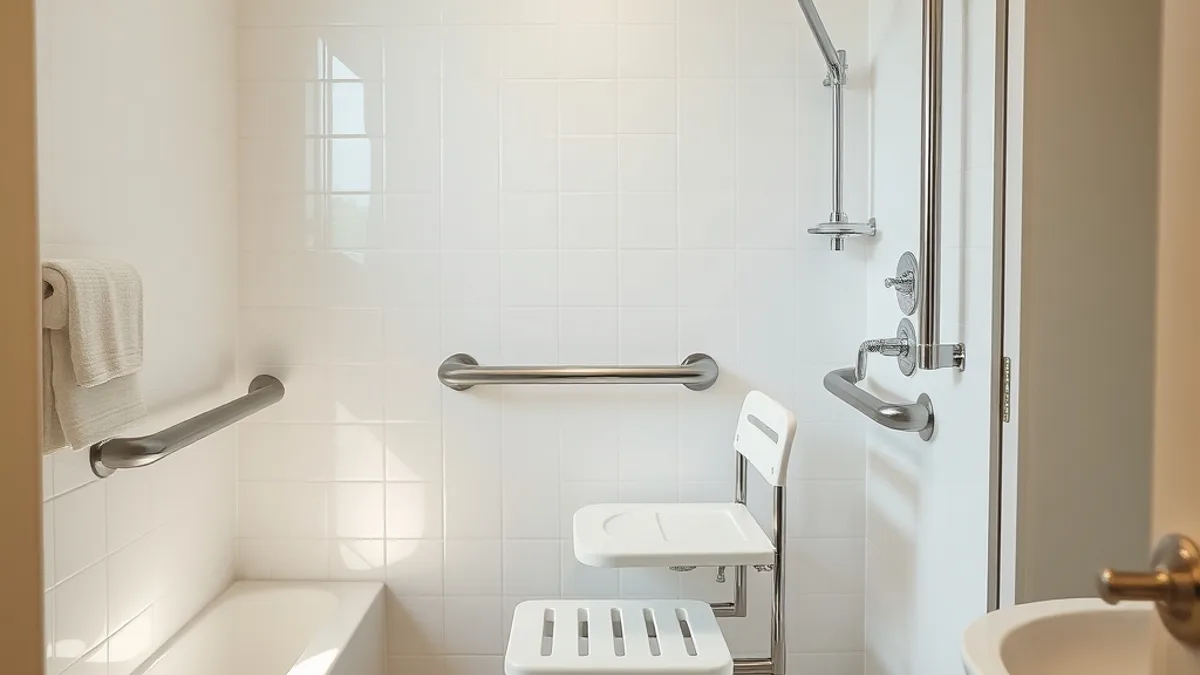
The bathroom is where most accessible room bookings succeed or fail, so start your questions there. The single most important one: does the room have a roll-in shower or a tub? Roll-in showers are the standard for truly wheelchair-accessible bathrooms, and a room can be labeled accessible while still having a tub you cannot use.
Follow up on the shower’s fittings. A fold-down seat and a handheld showerhead turn a roll-in shower from technically compliant into genuinely usable, so ask about both by name. Then move to the grab bars, which are a baseline accessibility feature. Confirm they are installed beside the toilet and inside the shower, not just on one wall of one area.
Finally, ask about the bathroom door itself: its clear width and which way it swings. A door that swings into the bathroom eats turning space, which matters enormously for wheelchair users who need to close the door behind them and maneuver inside.
- Ask whether the shower seat is fixed or fold-down, and whether it is positioned so you can transfer onto it from your chair rather than reaching across the shower.
- Ask whether the handheld showerhead sits on an adjustable rail or a fixed mount, since a fixed head at standing height is of limited use from a seated position.
- Ask whether the sink has knee clearance underneath and whether the mirror and towel bars are reachable from a seated position.
- Ask whether the bathroom has an emergency cord or pull cord that reaches the floor, so it can be reached if you fall or need assistance.
Questions About Doors, Beds and Room Layout
Doorways, Bed Height and Getting Around Inside the Room
Doors and beds are the other two dealbreakers, and both come down to numbers. Start with the guest room doorway: ask for the clear width, not the door’s nominal size. Anything under 32 inches rules out most wheelchairs, since ADA-compliant doors measure at least 32 inches of clear width. Many older properties fall short without realizing it, so do not assume a reservation in an accessible room automatically means the doorway will work for your chair.
Next, ask for the bed height in inches, measured from the floor to the top of the mattress. Bed heights of 20-23 inches suit most wheelchair transfers. If the bed is higher, ask whether housekeeping can remove the bed frame or legs, or whether the hotel has bed risers that can bring the mattress into your transfer range. Some hotels will also remove chairs, ottomans, or desks to open up floor space, so ask what staff are able to move before you arrive.
- Ask for the turning radius available beside the bed and in the main living area, since a full 360-degree turn needs clear floor space, not just a wide room.
- Ask whether closet rods are lowered or whether staff will hang clothes within reach, and whether shelves and drawers can be used from a seated position.
- Ask about the height of light switches and thermostats, and whether bedside lamps can be reached from the bed.
- Ask whether the door has a peephole at seated height or an alternative, such as a digital viewer or a chain you can reach.
Getting these measurements in writing protects you if something changes between booking and check-in. A room that looked perfect online can still fail on a single number, and it is far easier to switch rooms before you pay than to argue at the front desk after a long day of travel.
Booking Your Accessible Room: Timing and Confirmation
Accessible rooms are the first rooms to disappear from a hotel’s inventory, and the ones that get booked wrong most often. A reservation that says “accessible room requested” is not the same as a confirmed accessible room. Most properties hold only a handful of these rooms, so a vague request can easily leave you with a standard room and a note that nobody read. Timing, written confirmation and a direct relationship with the hotel are what turn a hopeful booking into a room that actually works when you arrive.
- Book 4-8 weeks ahead. Most hotels hold only 1-3 accessible rooms, and they are usually the first to sell out, especially in high season. Booking early gives you the best chance of getting the specific room type you need rather than whatever is left after everyone else has chosen.
- Email a written list of your required features after booking. List each item you need, such as a roll-in shower, a fold-down shower seat, or a bed at transfer height. Ask the hotel to confirm each feature individually in writing, one by one. A written reply gives you something concrete to reference if anything is wrong at check-in, and it makes it much harder for the property to claim you never asked.
- Call the hotel directly 48-72 hours before arrival. Reconfirm the room type and any equipment you requested, such as a shower chair. Front desk staff change between booking and arrival, and notes sometimes get lost between the central reservation system and the property itself, so a direct call catches problems while there is still time to fix them.
One more tip: book directly with the hotel when you can. Accessible rooms typically cost the same as standard rooms when booked directly, and a direct relationship makes it easier to speak with someone who can actually see the notes on your reservation. Third-party sites rarely pass special requests along reliably. Keep copies of your emails and confirmation numbers on your phone so they are handy at check-in, and bring the name of the person who confirmed your details in case anything needs sorting out on arrival.
Beyond the Room: Entrances, Parking and On-Site Access
A perfectly accessible room is not much use if you cannot get to it, park near it, or enjoy the rest of the property. Hotels often describe their lobby and rooms in detail while saying little about the route from the parking lot or the steps leading down to the pool. Ask about these areas specifically before you book, because they are where surprises happen most often.
Start with arrival: you want a step-free path from your car to the entrance without detours through service corridors or around the back of the building. Then think about how you will spend your time at the hotel, and ask about each space you plan to use. A few specific questions to add to your list:
- Accessible parking location. Confirm the accessible spaces are within 100 feet of an entrance and that the route from the space to the door is step-free and reasonably smooth, not a gravel path or a steep ramp.
- Common areas. Ask whether the pool, gym, restaurant and spa are reachable by elevator from your floor, and whether each has an accessible entry and an accessible restroom nearby. A ground-floor restaurant on a mezzanine level is more common than you might think.
- Pool and spa entries. If swimming matters to you, ask whether the pool has a lift, a zero-entry slope, or steps only. The same goes for hot tubs, which often have a single deep step.
- Equipment loans and rentals. Ask whether the hotel provides shower chairs, raised toilet seats or other equipment, and if not, which local medical rental firms they recommend. A hotel that has answered this question before usually has a useful answer ready.
Getting these answers in writing alongside your room confirmation saves you from awkward conversations at the front desk. It also tells you a lot about how seriously the property takes accessibility overall.
Matching Accessible Hotels to Your Destination
Where you travel shapes how easy it is to find a room that truly fits your needs. The same hotel chain can offer a flawless accessible room in one city and a marginal one in another, simply because of the building it occupies. Matching your expectations to your destination saves frustration before you ever pick up the phone.
Beach resorts
Beach resorts often place their accessible rooms in newer wings, while older buildings on the same property may have narrow doorways or stepped entrances. When you call, ask which building has had the most recent renovation and request a room in that wing specifically. Also ask about the route from that wing to the beach, the pool and the restaurants, since distances at resorts can be long and paths may be sandy or sloped.
Historic-city inns and coastal stays
Historic-city inns are the riskiest category for width and step issues. Charming old buildings frequently have doorways too narrow for most wheelchairs, raised thresholds and stair-only access to guest floors, so get actual measurements before you commit to a booking. Ask for the clear doorway width, the entrance route and whether an elevator serves all floors.
Coastal and lakeside stays, on the other hand, can pair accessibility with calm scenery once the core room questions are answered. Many newer waterfront properties were built with accessible rooms from the start, and flat terrain often makes getting around easier than in a hillside town. Once you have confirmed the bathroom, doorway and bed details, these destinations can be among the most relaxing choices for travelers with mobility needs.
Your Pre-Booking Checklist for Accessible Hotel Rooms
Hotel labels only tell you so much, and your needs may not match what a listing means by that word. The only reliable way to know a room truly works for you is to ask specific questions about the bathroom, doors, bed height and on-site access before you pay, and to get every answer in writing. A written confirmation gives you something concrete to point to if anything is missing when you arrive.
Once you have those answers, book early, since accessible rooms are limited at almost every property, and reconfirm your room close to arrival. If a hotel can answer your questions clearly and put them in writing, that is usually a good sign the rest of your stay will go smoothly too. Have you run into an “accessible” room that wasn’t? Share your experience or this article with someone planning a trip.