You’ve booked the safari lodge of your dreams, checked the game drives twice, and packed the right lenses. Then you read a review mentioning “unbearable afternoons” and start wondering: will the deck misting actually help, is a ceiling fan enough at night, and does the suite even have air con? With lodge cooling options varying so widely between properties, it pays to know how each method works before you commit.
This guide compares all three. We’ll explain where misting systems shine (and where they fail), why fans suit tented suites so well, and when air con becomes the non-negotiable choice. You’ll also find the power and water trade-offs behind each option, advice on matching cooling to your destination and season, and a practical list of questions to ask before booking — so your midday hours at the lodge feel like a treat, not an endurance test.
How Lodge Misting Systems Work and Where They Shine
Misting systems sound like a luxury gimmick until you sit under one in the Kalahari at noon. The concept is simple: high-pressure nozzles run along the edge of a deck roof or pergola and push out an ultra-fine spray of water. That spray flash-evaporates the moment it hits dry air, and the evaporation process pulls heat out of the atmosphere around it. Done well, the effect drops the perceived temperature by roughly 5–10°C — enough to turn a stifling deck into a genuinely pleasant place to linger.
Where misting works best
The catch is humidity. Flash evaporation needs dry air to work, which is why misting is the signature cooling tool of arid safari regions — think lodges on the Kalahari fringes or along the Namib edge, where humidity typically stays below 40%. In those conditions, a misted deck keeps outdoor lounging, lunch service and plunge-pool areas usable right through the 11:00–15:00 heat peak, when most guests would otherwise retreat indoors.
The downsides to know
Two caveats matter. First, fine spray can drift and dampen cushions, books, cameras and phones left on nearby tables — keep electronics tucked away or under cover. Second, misting adds almost nothing in humid coastal air; if the air is already saturated, the water simply can’t evaporate, and you’re left with a damp deck instead of a cooler one.
Ceiling and Standalone Fans: Low-Energy Comfort With a Breeze
Here’s the most important thing to understand about fans: they cool people, not rooms. A ceiling fan or a good standalone unit moves air across your skin, speeding up evaporation and creating a wind-chill effect that makes you feel about 2–4°C cooler. The actual room temperature doesn’t drop at all — but for sleeping and lounging, feeling cooler is what counts.
Why tents and open-fronted suites love fans
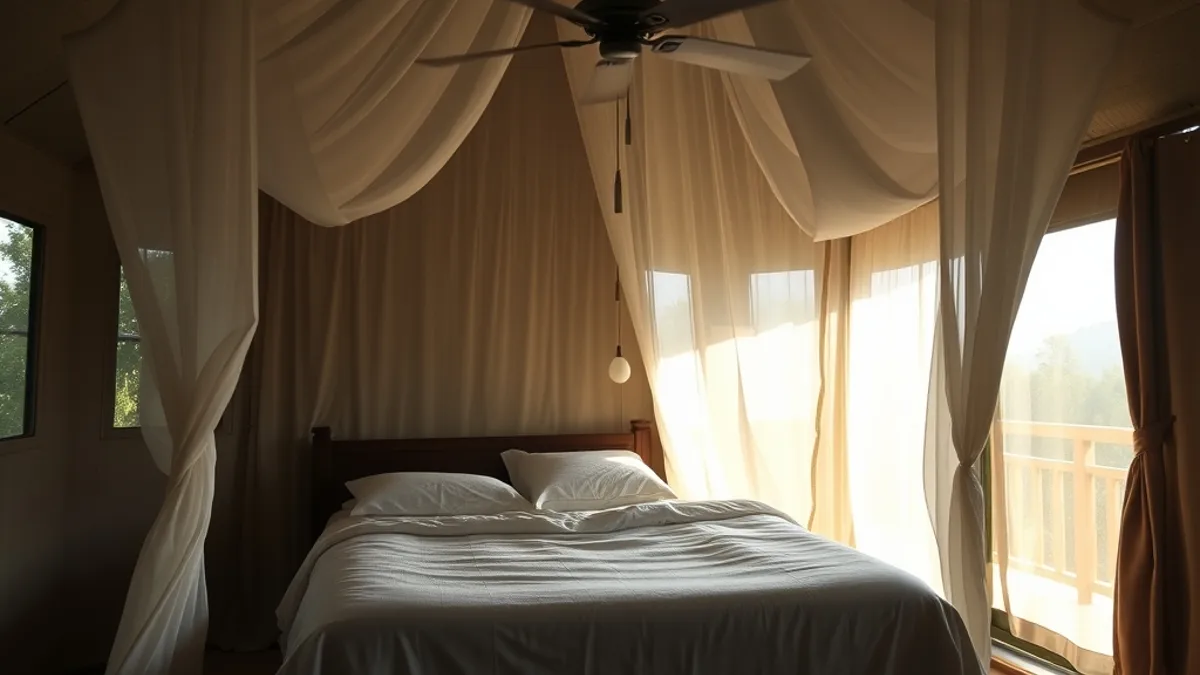
Fans are the natural choice where air con physically can’t work. Tented suites and open-fronted rooms have no sealed walls or doors to trap cold air, so a split unit would be pointless. A fan combined with the natural breeze through mesh panels, on the other hand, keeps air moving all night and makes canvas rooms surprisingly comfortable even in the hottest months.
There’s a bonus many guests don’t think about until they arrive: sound. Fans on low settings are nearly silent, preserving the dawn birdcalls and evening bush sounds that are half the reason you’re there. The hum of an air con compressor, by contrast, can mask exactly the ambience you paid for.
Getting the most from a fan
Fans work best in partnership with the room itself. During the hottest months, keep windows open on the shade side of the suite so cooler air flows through as the fan circulates it. Close curtains on the sun-facing side during midday, then let the fan do the rest once temperatures ease toward evening.
Air Con in Lodge Suites: When Sealed Comfort Wins
When humidity climbs, misting fails and fans just push hot, wet air around. That’s where air con earns its place. A typical split-unit system in a lodge suite runs 9,000–12,000 BTU, which is enough to keep a standard 20–30 m² suite genuinely cool — not just subjectively cooler, but at a temperature where you’ll actually sleep well. In humid destinations, this isn’t a luxury; it’s the only method that also strips moisture from the air.
Humidity is the deciding factor
Along tropical coasts, humidity often exceeds 70%, and no amount of breeze or spray offsets that. A ceiling fan will keep air moving and make you feel marginally less sticky, but the room stays heavy and damp. If your trip involves tropical coastal stays, air con should be the non-negotiable on your checklist — the same applies whether you’re browsing safari suites or open-air pavilions in humid island destinations like Koh Samui.
Check the power schedule before you book
Air con is power-hungry, and many remote lodges run on generators or solar. Some keep units available around the clock; others only run them during certain hours. Ask the lodge directly whether in-room air con runs all night or switches off during game drives or low-power periods — arriving with the wrong assumption is a common source of complaints.
One trade-off to weigh: sealed glass-front suites with air con give you reliable sleep on nights above 30°C, but they trade away some bush ambience. You’ll hear the evening sounds through glass rather than open canvas — a fair price for deep sleep in serious heat, but worth knowing in advance.
Power, Water and Sustainability Trade-Offs
Off-grid lodges live or die by their power budget, and cooling is usually the biggest draw on it. A split-unit compressor can pull more electricity than the lights, pumps and Wi-Fi in the rest of the camp combined, so many solar-powered properties only switch air con on during the middle of the day, when the panels are producing at full tilt and the battery bank is topped up. By evening, when you actually want to sleep cool, the system may be off limits.
Water is the other hidden cost. Misting systems look effortless, but high-pressure pumps push through a surprising amount of water over a long lunch service, and in the Kalahari or along the Namib edge every liter is trucked in or painstakingly pumped. Some desert lodges have quietly retired their misters during drought years, so don’t assume the deck will be foggy just because the photos show it.
Fans remain the quiet sustainability hero of the bush. A ceiling fan draws a fraction of the power of even the smallest split unit, which is why tented camps can run them all night off batteries without a second thought.
- Some lodges use timer switches or key-card slots that physically cut air con when you leave the room, so a “24-hour” claim may still mean you can’t pre-cool the suite before returning from an afternoon drive.
- Misting nozzles need regular descaling in hard-water areas, and a poorly maintained system can spit droplets instead of fine mist — worth noticing on arrival rather than at booking.
- Stand-alone inverter units or portable evaporative coolers appear at a handful of eco-camps as a middle path, using far less power than a compressor while adding more than a fan alone.
- Lodge websites rarely spell out their cooling policies, so a short email before booking is the only reliable way to know whether your 21:00 shower will be followed by a sweaty night.
Matching the Cooling Method to Your Destination and Season
The right cooling setup depends far less on the lodge’s budget than on where it sits and when you visit. A misted deck that feels miraculous in the dry Kalahari would be pointless on a humid Indian Ocean shoreline, where the air is already saturated and evaporation simply doesn’t happen. Match the method to the climate and the season, and your midday hours transform from endurance tests into the best part of the day.
Southern Africa’s dry-season safari months, roughly June through October, deliver the hottest midday lodge hours of the year. This is where the winning combination is outdoor misting for the deck and a good ceiling fan for the room — no air con needed, and the open windows let the evening bush sounds in.
Humid tropics are a different animal. Along coastal Southeast Asia and on Indian Ocean islands, humidity regularly climbs past the point where fans and misters can help, and air con becomes the non-negotiable for comfortable sleep. If a polished beach stay is what you’re after, the Le Morne nests for honeymoon calm and polished tropical living show the kind of sealed, glass-fronted suites that make humid nights genuinely restful.
- Desert lodges often swing 15°C or more between afternoon and dawn, so a room that bakes at 14:00 can be cold by 03:00 — fans plus a blanket beat air con in these places.
- High-altitude safari properties in places like the Kenyan or Tanzanian highlands rarely need mechanical cooling at all; a shaded veranda and a fan for the odd warm spell usually suffice.
- Shoulder-season trips, such as the green months just before or after peak dry season, bring milder heat and lower rates — a window open to the breeze can carry you through without ever touching a thermostat.
- If you’re combining a bush leg with a beach leg on one trip, expect to switch cooling styles mid-journey; pack accordingly rather than assuming one lodge experience predicts the other.
Questions to Ask Before You Book a Warm-Climate Lodge
Lodge photos rarely show the thing that decides whether you’ll enjoy your stay: how the property handles heat. A suite that looks dreamy at sunset can turn into a sauna by mid-afternoon, and the difference usually comes down to details no brochure volunteers. The good news is that these details are easy to uncover — you just have to know what to ask. Ask these four questions before you pay your deposit, and you’ll sidestep most warm-weather disappointments.
- Ask whether air con runs 24 hours or only during specific power windows. At solar-powered lodges, in-room cooling is often capped to daytime hours with strong sun, which means the unit may shut down exactly when you want to sleep. If you’re a hot sleeper, get this confirmed in writing before you book.
- Ask whether the main lounge or dining deck has misting, shade or fans for midday downtime. On a dry-season safari, the hours between your morning and afternoon game drives are spent at camp, and a shaded, fan-cooled or misted deck makes those hours a pleasure rather than a siege. Without it, you may find yourself retreating to your room instead of enjoying the property’s best viewing spots.
- Ask whether the rooms are sealed units with glass fronts or open-sided tented suites relying on breeze. Tented suites offer wonderful ambience but depend on cross-ventilation and a functioning fan, while sealed glass-front suites hold a set temperature all night — a real trade-off between atmosphere and sleep quality, especially for light sleepers.
- Ask what the typical midday temperature is in your travel month at that exact location. “It’s usually warm” means nothing; a camp on a rocky outcrop can run several degrees cooler than one on a low, heat-trapping plain an hour away. Ask for the specific figure for your dates, and compare it against what you know you can sleep in.
Any well-run lodge will answer these happily, and vague or evasive replies are themselves useful information — a property that can’t describe its own cooling setup probably hasn’t thought hard about it. Ten minutes of email before booking is far cheaper than two weeks of sweaty, sleepless nights in a suite that looked perfect online. Frame your questions politely but specifically, and most reservations teams will respond with refreshingly honest answers.
Choosing Your Lodge Cooling Setup With Confidence
If you’ve booked a dream lodge only to find the midday heat brutal, the good news is that each cooling method has a clear job. Misting wins for dry-climate decks, fans win for quiet open-air rooms, and air con wins for humid nights. Match the method to your destination’s humidity and season rather than assuming one size fits all, and that sweltering afternoon on the deck or in your suite becomes a non-issue.
The last step is simple: confirm power availability and the cooling setup with the lodge before booking to avoid midday misery. A quick question about generator hours, room design or deck misting saves you from unpleasant surprises. If this guide helped you plan a cooler safari or beach stay, leave a comment or share it with a fellow traveler.