Booking a family room can feel like a gamble, and many families lose. They pay for a suite when two connecting rooms would have given everyone a real bed and a second bathroom, or they book two rooms when a single suite would have cost less and worked better. The connecting rooms vs suites decision trips up even frequent travelers, because hotels rarely explain the trade-offs clearly on their booking pages.
This guide breaks the choice down step by step. We start with the core difference between the two room types, then look at when connecting rooms work better for families and when a family suite is the smarter pick. From there, we compare what each option really costs, show you how to verify the room type before you book, and explain how your destination changes the space you should expect. A short bottom line at the end pulls it all together for your next family stay.
Connecting Rooms vs Suites: The Core Difference
Connecting rooms are exactly what the name suggests: two separate standard rooms with a door between them. Each room functions on its own, with its own bathroom, its own TV and its own entrance from the hallway. A standard hotel room averages around 25-35 square meters, so you effectively double your footprint when you book a pair.
A suite is a different animal. It is one large unit, usually 45-70 square meters, with a living area and a separate or partitioned bedroom. Everyone shares the same front door, and the whole family shares the same space during the day.
The practical trade-offs
The biggest difference shows up in bathrooms and beds. Connecting rooms give you two bathrooms and two TVs, which matters more than most parents expect until they have queued outside a single bathroom with three kids. Suites give you shared living space but often only one bathroom, since many family suites are built on a one-bathroom layout.
Sleeping capacity is the other limit. Sofa beds in suites typically sleep two, which caps most suites at four guests. Two connecting rooms, by contrast, sleep 4-6 in real beds. If your family is larger than four, the math often makes the decision for you before price even enters the picture.
When Connecting Rooms Work Better for Families
Connecting rooms shine for families of five or six. With two rooms, everyone gets a real bed, and you get two bathrooms, which is the single biggest quality-of-life upgrade for a larger family. No suite in the standard range reliably sleeps six, so a pair of rooms is often the most sensible configuration for a bigger group. Each room typically has its own TV, storage and climate control, so nobody has to compromise on temperature or bedtime routines.
The layout also suits mixed-age groups. Teens and grandparents want privacy and separate sleep schedules, and two rooms with a door between them deliver exactly that. The early risers can watch TV in one room while the late sleepers rest in the other, and the door can be closed or left open depending on how much supervision younger children need.
What to sort out before you book
Two rooms also mean two closets, two luggage spaces and a much shorter morning bathroom queue. A few practical steps make the setup work smoothly:
- Request connecting rooms 2-3 months ahead of travel, since interconnecting pairs are limited in number and sell out early in family-heavy seasons.
- Confirm in writing that the interconnecting door is guaranteed, not just that the rooms are adjacent, because adjacent rooms without a door defeat the purpose entirely.
- Ask which room pair you are being assigned, since some hotels only have working connecting doors on certain floors or in certain wings.
- Check whether both rooms have the bed configuration your family needs, such as two doubles in one room and twins in the other, before you accept the pairing.
Keep in mind that connecting rooms cannot always be guaranteed until check-in, so a written confirmation from the hotel is your best protection. If you arrive and the door pairing is wrong, ask at the front desk immediately rather than settling in first.
When a Family Suite Is the Smarter Choice
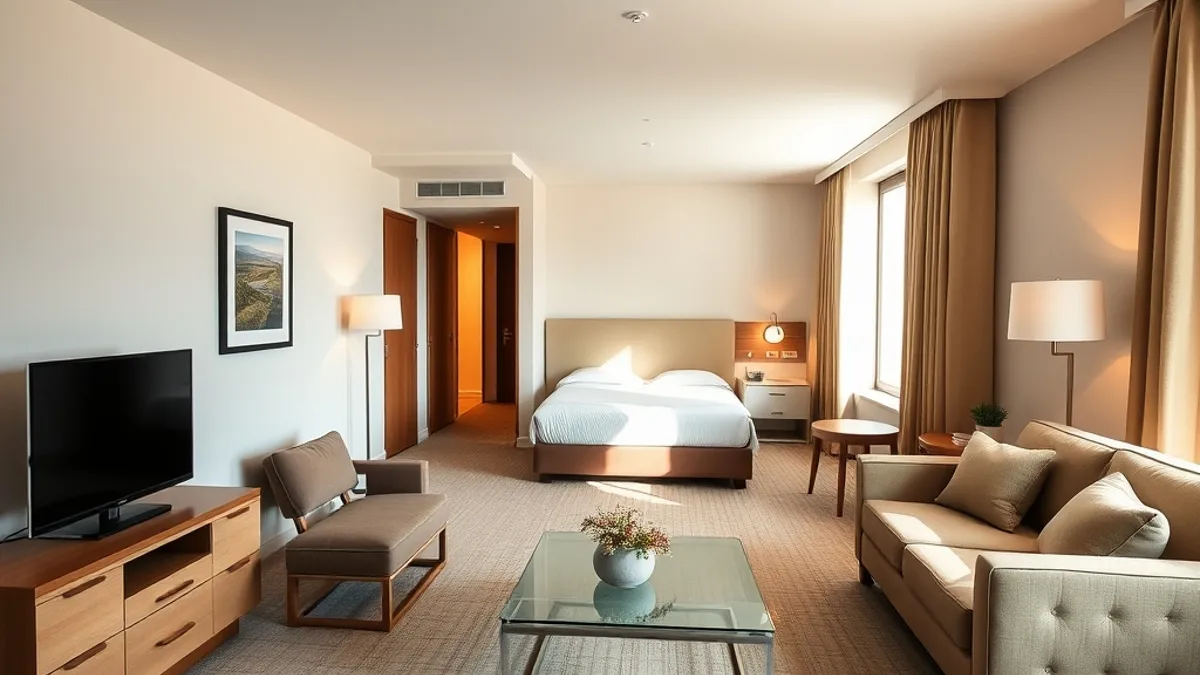
For families of three or four with young children, a suite usually wins. The shared living area gives you a common space for daytime naps or an early bedtime, so the kids can sleep in the bedroom area while the room stays usable. Anyone who has spent a hotel evening whispering in the dark with a sleeping toddler across the bed knows exactly why this matters.
That living area changes your evenings. Parents can talk, watch TV or work after the kids fall asleep without leaving the room, sitting at a proper table or on a sofa instead of huddling in a bathroom or on the bed. One key, one bill and one bathroom to manage can also be simpler with toddlers, since you are not herding little ones through an interconnecting door every time someone needs the toilet.
Small savings that add up
Many family suites also come with a kitchenette, and that is where real money gets saved. A few things worth using it for:
- Breakfasts: cereal, fruit, yogurt and coffee in the suite cost a fraction of a hotel breakfast for four, and you avoid the morning rush to a set restaurant time.
- Baby food and bottles: a small fridge and kettle let you prepare formula and store jars and pouches, which is far easier than hunting for open shops or room service at odd hours.
- Picky-eater snacks: keeping crackers, cut fruit and drinks on hand tides kids over between meals and cuts down on impulse snack purchases.
If your days are spent out and about and you only need the room for sleep and naps, a suite covers everything a young family actually uses.
Price Comparison: What Each Option Really Costs
Let’s talk money, because the sticker prices for these two options can mislead you. Connecting rooms typically cost 30-50% more than a single standard room, since you are literally paying for two rooms. That sounds steep until you remember you are also getting two bathrooms, two TVs and real beds for up to six people.
Suites often cost less than two separate rooms, which is why they look like the obvious bargain. The catch is timing: suite prices often jump 40-60% in school holiday peak seasons, when family demand is highest. A suite that seemed reasonably priced in May can look very different over the Christmas break.
Compare like with like
When weighing a suite against connecting rooms, compare the suite rate against two discounted standard rooms, not the rack rate. Hotels routinely offer deals on standard rooms, so the real alternative to a suite may be noticeably cheaper than the price listed on the door. Check both rates on the same dates before assuming the suite wins.
Finally, factor in what a suite saves you beyond the nightly rate. Many family suites include a kitchenette, and even a small fridge and microwave lets you prepare breakfasts and baby food instead of paying for every meal at a restaurant or room service. Over a week, those savings can quietly offset a meaningful chunk of the room price difference.
How to Verify the Room Type Before You Book
Booking photos and category names can hide a lot of detail, so a few minutes of verification before you pay can save your family trip from a serious room mix-up. Treat it as part of the booking process, not an optional extra. Hotels handle these requests in different ways, and the difference between a confirmed layout and a hopeful one often comes down to how you ask and who you ask.
- Contact the hotel directly. Email or call the property, not just the central booking line, and confirm that an interconnecting door exists in the exact room pair you would be assigned. Some hotels only have certain rooms configured with doors between them, so the front desk or reservations team at the property itself is the best source of truth.
- Request real floor plans for suites. Ask for the floor plan with exact square meters and bed sizes rather than trusting marketing photos, which are often shot in the largest or best-configured unit. A 45 square meter suite and a 70 square meter suite are very different places to spend a week with kids.
- Ask about extra beds. Check whether rollaway beds or cribs are available, whether there is a charge, and whether they physically fit the room layout alongside your luggage. A sofa bed that sleeps two may remove the need for a rollaway entirely, freeing up floor space and saving a fee.
- Get it in writing. Ask for written confirmation of the connecting door or suite configuration, because even a friendly phone promise can disappear by the time you arrive at the front desk. A note attached to your reservation gives you something concrete to point to at check-in if the assignment has changed overnight.
Doing this two to three months before travel gives the hotel time to note your request properly and improves your odds of the configuration you actually booked. It also leaves room to follow up a week or two before departure, which is a good moment to remind the property of your needs. If the property hesitates to confirm anything in writing, treat that as useful information about how likely your request is to be honored, and consider a different hotel or room type if the layout matters to your trip.
Destination Matters: Space Expectations by Region
Where you are traveling shapes what “family room” even means. The same hotel chain can offer very different configurations in a city center than it does on a beach, so it pays to adjust your expectations by region before you start comparing rates.
City hotels skew heavily toward connecting rooms, simply because floor space is limited and large suites are rare or expensive. If you are spending a few nights in a major city and mainly using the room for sleeping and showers, two connecting rooms can work well and often cost less than the few genuine family suites available.
Resort destinations usually give you more choice. Many offer both family suites and multi-bedroom villas, which effectively gives you a third option: a whole residence with several bedrooms, a full kitchen and often a private pool. Coastal destinations favor this villa-style stay in particular, and it is easy to see the appeal in places where the whole point of the trip is slow mornings and afternoons by the water. For a sense of how relaxed yet refined that style of stay can feel, the Noosa residences show coastal Australia at its laid-back best, with space to spread out that a standard room simply cannot match.
The deciding factor should be how much time you will actually spend indoors. A family out on excursions from dawn to dusk can happily manage a compact suite, while a family planning pool days, rainy afternoons and lazy breakfasts will feel every square meter. If a villa stay appeals, look at options like the residences described in private pool villas in Bali to see what that style of stay looks like in practice, then match the room type to your itinerary rather than to the photos.
The Bottom Line for Your Next Family Stay
So which should your family book? Connecting rooms make the most sense for larger groups of five or six who need two bathrooms, real beds for everyone and a bit of privacy between generations. A suite is usually the smarter pick if you have one or two young children, where a single shared living space and the chance to relax after the kids fall asleep matter more than a second bathroom.
On budget, expect connecting rooms to run 30-50% more than a single standard room, and watch for suite prices that can jump 40-60% during school holiday peak seasons. Whatever you choose, confirm the interconnecting door, bed sizes and any guarantee in writing, ideally 2-3 months before you travel. If this helped you decide, leave a comment or share it with another planning parent.