The photos look dreamy: an infinity pool spilling toward the horizon, a sunset terrace with nothing between you and the sea. What the photos rarely show is the climb. Many travelers only discover after booking that their cliffside villas come with more than a hundred steps, steep pathways and limited vehicle access, which can turn a romantic escape into a daily workout.
This guide walks through what to check before you pay a deposit. We cover why these elevated properties command premium prices, how to get an honest step count from a host, what to look for in railings and edge design, and how luggage, groceries and guests actually reach the door. We also look at matching the layout to your group’s mobility, plus a booking strategy that helps you secure the right unit at the right price. Read on before you reserve, not after.
Why Cliffside Villas Command Their Views and Their Price
Height is the whole point of a cliffside villa. Sitting well above the shoreline, these properties look straight out over the water, which means unobstructed sunset and horizon views that beachfront properties often lack. At sea level, a dune, a seawall or the neighboring resort can cut your sightline; on a cliff, nothing does. The same elevation also keeps you above the noise of beach bars and boat traffic, so evenings tend to be noticeably quieter.
Privacy follows the same logic. Cliffside plots are harder to build on, so there are simply fewer of them, and neighbors are fewer too. You are far more likely to have an unoverlooked terrace or pool than in a dense beachfront row. That scarcity and seclusion are exactly what you are paying for.
What the premium looks like
Expect nightly rates typically 20 to 40 percent above comparable sea-level villas, and the gap widens where the property runs a funicular or shuttle to solve the access problem. That machinery is expensive to install and maintain, and the convenience is baked into the price. When comparing options, treat the rate difference as the cost of the view, the privacy and the logistics all together, then decide which of those matter most to you.
The Reality of Steps: Counting Before You Book
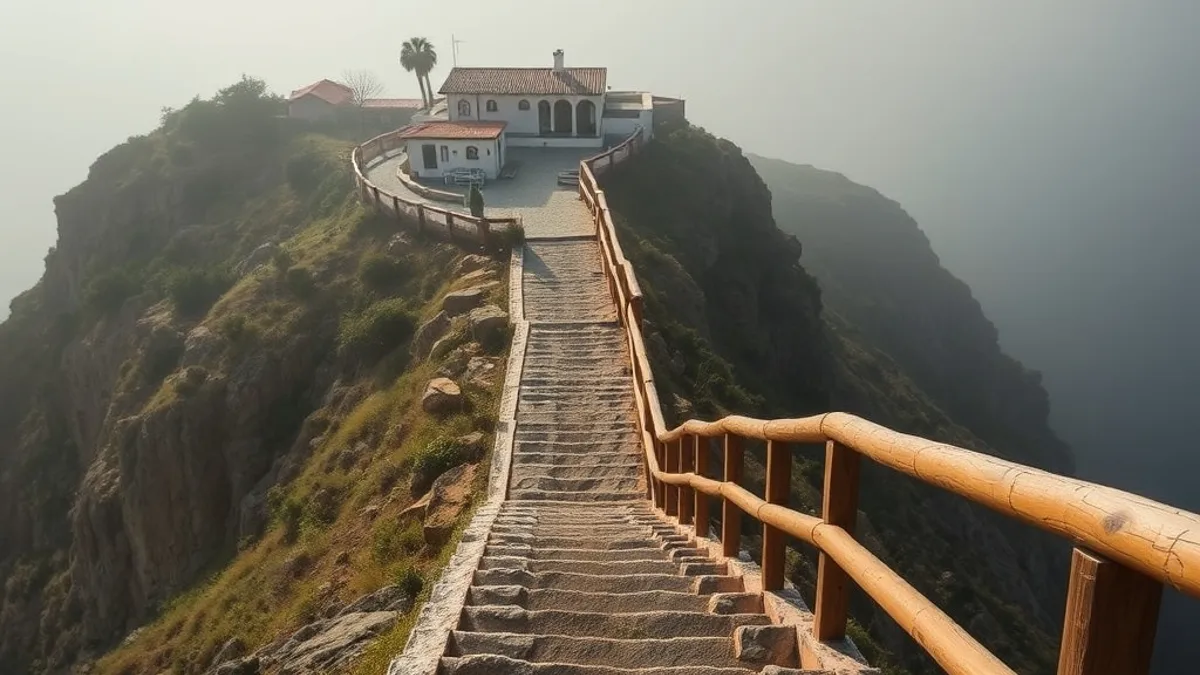
Steps are the defining feature of a cliffside stay, and they vary enormously from one property to the next. A typical cliffside villa involves 60 to 150 exterior steps from parking or the drop-off point to the front door. That is fine if you are fit and traveling light, but it changes the character of a trip if you are carrying a toddler, shopping bags or a bad knee. This is the single most important question to resolve before booking, because no photo will tell you.
Ask the host for the exact step count, the gradient of any sloped sections, and whether someone carries luggage for you on arrival and departure. Reputable listings state these details; vague answers are a warning sign in themselves. It also helps to understand where the steps actually sit, since the entrance is often only part of the story:
- Separate descents for amenities: the pool, the dining terrace and the beach path frequently sit at different levels, so each one can mean its own additional climb back up, not just the route to your door.
- Unit level within the villa: choosing a ground-floor or mid-level unit can cut your daily stair use roughly in half compared to a top-floor unit, which matters most when you are going in and out several times a day.
- Night-time returns: a staircase that feels easy at noon in daylight is a different proposition after dinner, so ask whether the route is lit and whether there is a handrail the whole way.
Once you have these answers in writing, you can judge honestly whether the layout suits your group, or whether you should push for a different unit.
Safety Railings and Edge Design Worth Checking
Height delivers the views, but it also creates real edges, and the quality of edge design separates well-managed villas from careless ones. On a properly run property, railings run at least 100 cm high along all exposed terraces and pathways, not just at the obvious viewpoints. When you review photos or take a video call with the host, look along the full length of every terrace: gaps in protection, low walls used as seating edges, or open stretches beside a steep drop are all reasons to ask questions.
Staircases deserve special attention. A continuous handrail you can grip the entire way down is what you want, not just decorative posts at the top and bottom. On a long exterior flight, the middle sections are where people slip, especially after rain or a glass of wine. Ask directly whether handrails run the full length of each staircase.
- Pool fencing for toddlers: if you travel with small children, confirm that the pool area is fenced with a self-closing gate, and ask whether an infinity edge has a shallow buffer zone before the drop, since an unfenced infinity pool on a cliff is a serious hazard for a wandering toddler.
- Lighting for evening returns: ask whether stairs and paths have motion-sensor or low-level lighting for coming back after dark, and whether a torch is provided in the room as a backup.
- Surface condition: check that treads and pathways are non-slip and well maintained, since worn stone or loose tiles on a steep route are far more dangerous than the same flaw on flat ground.
None of these checks takes more than a few questions, and each one tells you a lot about how seriously the property takes its guests’ safety.
Access Issues: Vehicles, Luggage and Supplies
One of the biggest surprises for first-time cliffside villa guests is discovering that the car parks nowhere near the front door. Many cliffside properties have no vehicle access at all, so the drop-off point can sit anywhere from a short stroll to a serious walk away, often down steps the whole way. Before booking, ask exactly where you will be dropped off and how far, in both distance and steps, you will need to carry your bags.
Some larger resorts solve this with funiculars, shuttles or golf carts that whisk you from reception to your villa. It is a genuine luxury, especially with luggage or in summer heat, but it does not come free. This convenience is typically priced into the higher nightly rate, which is one reason cliffside properties with mechanical access charge a premium over comparable sea-level options.
Supplies and services on a slope
Ask practical questions before you commit: how do groceries reach the villa, does housekeeping carry equipment up and down daily, and how would an ambulance or doctor reach you in an emergency? A well-run property will have clear answers, whether that means staff deliveries, a service lift or an arrangement with local medical services. If the host hesitates, treat that as a warning sign.
Timing matters too. In the shoulder months of May-June and September-October, the access logistics are exactly the same as in high season, but you share the steps, shuttles and narrow paths with far fewer people. The experience is calmer and the logistics feel easier, even though nothing about the property itself has changed.
Matching a Cliffside Villa to Your Mobility and Travel Group
Cliffside villas reward some travelers and frustrate others, and the difference usually comes down to mobility and honesty about it. The right match depends less on the view, which is often spectacular everywhere on the cliff, and more on how the layout fits the people actually staying there.
If mobility is a concern
Travelers with limited mobility should request a ground-floor unit and ask for written confirmation of step-free routes from drop-off to bedroom, pool and dining. A verbal assurance that the villa is “mostly flat” is not enough, because cliffside plots rarely are. Choosing a ground-floor or mid-level unit also means you can expect around half the daily stair climbs of a top-floor unit, which matters enormously over a week-long stay.
Groups traveling with older family members should look for villas where the bedrooms, pool and dining area all sit on the same level. Multi-level layouts that look romantic in photos can mean a dozen stair trips a day for someone who finds stairs tiring, and that quietly ruins a holiday.
If your group is fit and adventurous
Fit couples and hikers can embrace steeper layouts with confidence. The payoff for all those steps is the most dramatic positions on the coast: higher terraces, wider horizons and a genuine sense of seclusion that flat sea-level properties rarely achieve. If everyone in your group is comfortable with stairs, a steep villa can be the best value on the market.
Whatever your situation, disclose mobility needs at booking, not on arrival. Properties often have several units with very different layouts, and early disclosure gives them time to assign you the right one. Mentioning a knee problem at check-in usually helps no one.
Booking Strategy for Cliffside Villas
Cliffside villas reward travelers who do their homework before paying a deposit. The view is easy to verify from photos; the steps, railings and access are not, which is why the booking process matters more here than for almost any other villa type. A villa that photographs beautifully can still turn out to be exhausting to reach each day, so treat the reservation itself as part of your research. Work through the following steps in order, and keep a record of every answer you receive in writing.
- Book early for high season. Reserve 6 to 9 months ahead for high-season dates in popular coastal regions. The most dramatic clifftop units are few in number and tend to be claimed first, so late bookers often end up with the steepest access or the weakest layouts. If you have your heart set on a specific villa or a particular stretch of coastline, this lead time is not optional; it is the difference between choosing your unit and accepting whatever remains.
- Consider the shoulder season. Stays in May-June and September-October typically run 15 to 30 percent cheaper, with the same views and the same access logistics but fewer crowds. If your dates are flexible, this is the easiest saving available. The sea and weather are often still pleasant in these months, and you will share viewpoints, village streets and restaurant terraces with far fewer people.
- Get the details in writing. Before paying any deposit, ask for the exact step count, railing heights along exposed edges, lighting on stairs, and the access terms, including drop-off distance and any shuttle or funicular arrangements. Reputable hosts answer these questions readily; vague replies are a signal to keep looking. Save the email thread, because if the property does not match what was described, you will want that record when discussing a refund or a room change.
- Compare the true total cost. Once you factor in access services, tips for luggage porters and any shuttle fees, compare the total against a comparable sea-level villa. Sometimes the cliffside option justifies itself; sometimes the flat property with a good view is the smarter spend. Do this calculation for your whole stay, not just one night, since daily access costs add up quickly over a week or more.
A few emails before booking will tell you more about a cliffside villa than any photo gallery. Hosts who answer step counts and railing questions clearly are usually the ones who manage the property well, and that shows up in every part of the stay. Hosts who dodge the questions often manage everything else the same way, so let their responsiveness guide your choice as much as the view does.
The Balanced View on Cliffside Stays
Cliffside villas ask for something in return for what they give. The effort of 60 to 150 steps, the higher nightly rate and the access logistics are the price of views, privacy and drama that flat properties simply cannot offer. Whether that trade suits you depends entirely on knowing what you are signing up for before you pay the deposit.
That is why the checks matter: confirm the step count, railing heights and vehicle access in writing, and match the layout to your group’s mobility. Book early for high season or travel in shoulder season for better value on the same views. Do that, and the dream photos and the reality will finally match. If this helped you plan your own stay, leave a comment or share the article.