You’ve booked the resort. The photos looked perfect, the reviews were glowing, and then you arrive, unfold the property map, and realize there are four pools — none of them labeled in a way that tells you which one is actually yours. Will the big central one be a party? Is the small one at the back adults-only? And where should your kids realistically spend the week? Most travelers just pick the pool nearest their room and hope for the best, which is how couples end up beside the water slides and families end up shushed.
This guide to resort pools breaks down the three zones you’ll find at most large properties: the main pool, quiet and adults-only pools, and kids’ pools. We’ll explain why resorts build multiple pools in the first place, what each zone offers, how to match a zone to your trip, and a few etiquette tips that will make you the guest everyone is glad to share a deck with.
Why Resorts Build Multiple Pools Instead of One Big One
Spend five minutes at any busy resort pool and the problem becomes obvious: a toddler shrieking near a fountain while a couple two meters away tries to read. Families need shallow, splashy water and noise-tolerant space. Couples and solo travelers want calm. A single pool cannot serve both groups at once, so someone always goes home disappointed.
Zoning solves this. By splitting the pool area into distinct zones, resorts spread crowds across the property, which cuts noise levels and reduces the fight for loungers during the peak hours between 10:00 and 15:00, when the sun deck is at its most crowded. Instead of everyone competing for the same twenty meters of shade, guests naturally distribute themselves by mood.
Why bigger resorts go even further
Once a resort has a main pool, a quiet pool, and a kids’ pool covered, larger properties often add a third or fourth option with a specific purpose. Swim-up bar pools keep drinks flowing without guests leaving the water. Lap pools give fitness swimmers a lane to themselves. Spa-integrated pools — often heated and attached to the wellness center — serve guests booked into treatments. Each extra pool is a signal that the property has thought about how different guests actually use water.
So before you book, look past the prettiest pool photo and ask what each pool on the map is for. That question alone will tell you more about the resort than its star rating.
The Main Pool: The Social Heart of the Resort
The main pool is exactly what it sounds like: the biggest and busiest pool on the property, and the one that appears in most of the marketing photos. These pools typically span 300–800 square meters and sit closest to the bars, restaurants, and activities, so you can swim, eat, drink, and join a water volleyball game without walking more than a few steps.
What should you expect from the atmosphere? Music, for one — usually a playlist that switches from background to party as the day goes on. Pool games and activities organized by the entertainment team are common, and many main pools include a swim-up bar. Depths typically run 1.2–1.5 meters, which is comfortable for confident adult swimmers but too deep for young children who aren’t swimming independently.
Who the main pool suits best
This is the zone for travelers who want atmosphere, people-watching, and easy access to food and drinks all day. If your ideal pool day involves a cocktail, some background music, and the option to join in or just watch, the main pool will feel like the center of your vacation. It’s also the most social spot to meet other guests.
On the other hand, if you read or nap poolside, the main pool is the wrong address. Speakers, splashing, and scheduled games run through the afternoon, and there’s no volume dial. Some properties get the balance right by design — the approach described in this look at family-friendly luxury resorts in Malaysia shows how a lively main pool can coexist with island-green quiet elsewhere on the property. The key is knowing what you’re signing up for before you drop your towel.
Quiet Pools and Adults-Only Zones
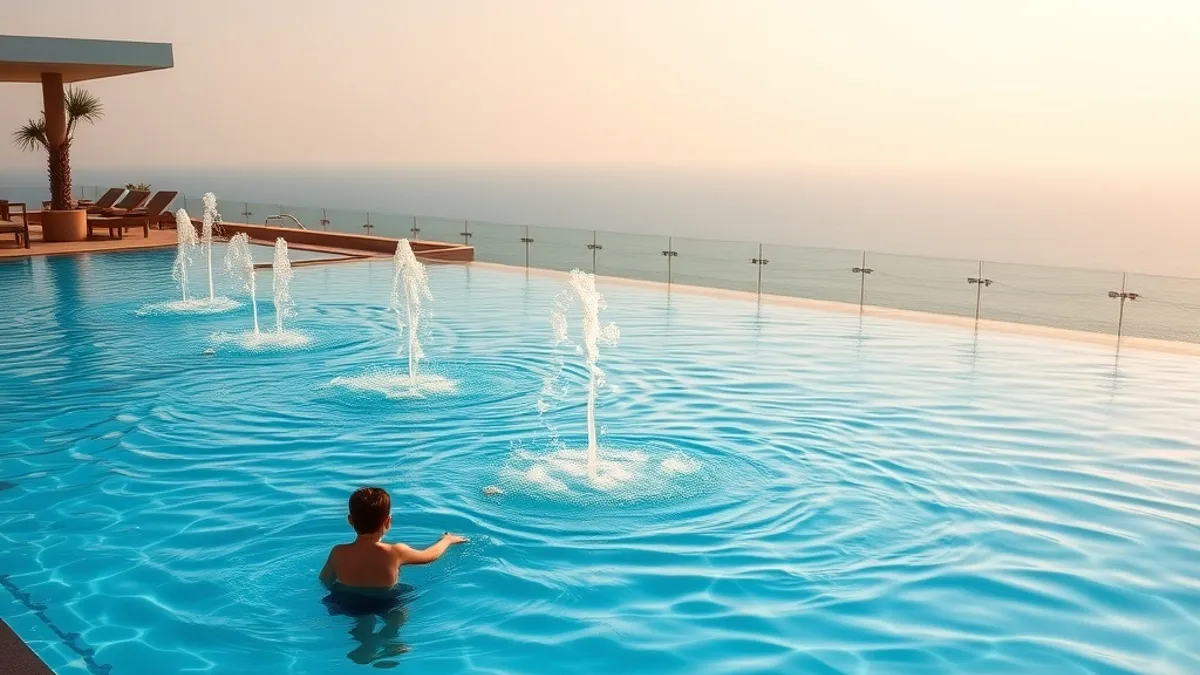
Nearly every mid-size and large resort now sets aside at least one pool for guests who want the water without the soundtrack. These quiet pools are typically adults-only or open to ages 16 and up, and they’re usually tucked behind buildings or placed on upper terraces, deliberately separated from the main deck. You may need to walk a few minutes to reach one — that’s the point.
What “quiet” actually means in practice
The numbers back up the calm: quiet pools commonly see 50–70% fewer guests than the main pool, which means shorter lines at the pool bar, open loungers at midday, and water you can actually swim in. The rules tend to be library-style. Music, if any, stays low. Phone calls move away from the deck. Reading, napping, and long conversations are the main activities, and most guests police this themselves because they chose the zone for exactly those reasons.
Check the age policy before you book
Here’s where travelers get caught: room categories are often marketed with a “pool view,” but the pool outside your window may be an adults-only zone. If you’re booking a family room and the map shows a serene pool nearby, confirm whether children are allowed in it before you assume it’s your splash spot. Some quiet pools restrict children entirely, with no exceptions for well-behaved kids or off-peak weeks. A quick email to the resort before booking saves an awkward conversation at check-in — and possibly a week of wrangling kids who aren’t allowed in the water below your balcony.
Kids’ Pools: Depth, Safety Features, and Shade
Kids’ pools are built around one idea: shallow water that small children can stand and play in without an adult holding them the whole time. The standard depth runs from 0.3 to 0.6 meters, which means even toddlers can wade in comfortably while parents sit at the edge. Many resorts go beyond a simple shallow basin and add splash pads, ground-level fountains, and small slides designed for younger guests.
Shade matters more here than at any other pool in the resort. Children’s skin burns faster than adults’, and the risk peaks in the middle of the day between 10:00 and 15:00, exactly when families tend to be at the pool. A kids’ zone with no cover forces you into constant sunscreen reapplication or an early retreat to the room, so it pays to check photos or ask before you book.
Location is the third piece of the puzzle. Resorts usually cluster family rooms and connecting rooms around the kids’ pool, which keeps the walk back for naps, snacks, and forgotten toys short. This placement is popular and rooms near the kids’ zone go first, so it is worth requesting it when you book rather than hoping for it at check-in.
- Splash pads replace deep water with fountains and sprays on a non-slip surface, so children who are too young for even a shallow pool can still join in safely.
- Small slides in kids’ zones are usually short and end in very shallow water, but it is still worth watching how older children use them around toddlers.
- Shaded canopies or pergolas over part of the pool and the surrounding loungers let families stay out through the sunniest hours without moving indoors.
- Connecting rooms near the kids’ zone suit larger families, since parents can put young children to bed in one room while staying within earshot in the next.
- A nearby family bathroom or changing station makes the difference between a quick swim and a logistical operation, so check what facilities sit next to the kids’ pool.
How to Choose the Right Pool Zone for Your Stay
The right pool zone depends less on the pool itself and more on the kind of trip you are taking. A honeymooning couple and a family with three children can stay at the same resort and have completely different experiences, simply because of which pool they gravitate to. One will remember peaceful mornings with a book; the other will remember splash pads and new friends for the kids. Neither is wrong, but choosing badly can turn a dream booking into a week of frustration. A few practical steps before and during booking will put you in the right corner of the property from day one, without any extra cost.
- Match the zone to your trip type. Couples and honeymooners are generally happiest at the quiet pool or adults-only zone, where noise stays low and loungers are easier to find. Families should aim for the kids’ zone, where shallow water and other children keep everyone entertained. Groups of friends usually want the main pool, with its music, activities, and easy access to the bar.
- Book a room wing facing your preferred zone. A pool-facing room sounds like an upgrade, but rooms near the main pool trade the view for noise that can carry until about 19:00 in the evening. If you value quiet, request a wing facing the quiet pool or a garden side instead, and leave the main-pool view to guests who plan to be in the middle of it all day.
- Check whether the pools are heated. If you are traveling outside the peak summer months, heated pools typically hold water at 26–28°C in shoulder season, while unheated pools can drop below 24°C and feel cold for anything beyond a quick dip. This single detail often decides whether the pool gets used at all on an off-season trip, so ask the resort directly rather than assuming.
- Review the resort map before arrival. Most resorts publish a property map on their website or send one with your booking confirmation. Knowing where each zone sits lets you request a specific wing or floor at check-in, and front desk staff are far more able to help when you ask for something concrete rather than “somewhere quiet”.
None of these steps takes more than a few minutes, and together they shape your whole stay. The difference between a room two minutes from the kids’ pool and one on the far side of the property is the difference between relaxed mornings and daily logistics. It is also the difference between sleeping well and lying awake while music drifts across the terrace. Do the homework before you travel rather than after, and if anything is unclear, a short email to the resort will usually settle it. A little preparation here pays off every single day of your trip.
Pool Etiquette and Practical Tips Worth Knowing
Every resort pool develops its own unwritten rules, and most of them come down to timing and consideration. The most visible one is lounger saving: at busy resorts in high season, guests commonly reserve sunbeds with towels before 08:00, and the best spots near the main pool are gone shortly after. You can either join the early race or sidestep it entirely by choosing a quieter zone, where loungers are usually still free at mid-morning.
Opening hours shape your day too. Many resorts open their pools from 07:00 to 19:00, and some extend to 21:00 in summer. The early window is the best-kept secret in resort holidays: before 09:00 the water is calmest, the decks are nearly empty, and the light is soft enough for genuinely good photos. If you want a swim without a crowd, set one early alarm during your stay and see the difference for yourself.
The last rule is the simplest: respect the zone boundaries. Adults-only pools exist because guests have paid for or chosen a child-free environment, and quiet zones fall apart the moment someone starts a loud game of water volleyball. If your group wants energy and games, the main pool is where that belongs, and everyone gets the experience they came for.
- Bring your own towels early if the resort charges or limits towel exchange, since the towel hut can develop its own queue once the morning rush starts.
- Use the early hours for lap swimming or photos, because the water surface is flat and the deck is clear in a way it never is later in the day.
- Ask staff about evening hours on arrival, since some resorts extend opening to 21:00 in summer and a late swim after dinner can become the highlight of the day.
- Keep phone calls and speakers out of quiet zones, where library-style rules usually apply, and take conversations to the main deck or your room instead.
- Check the age policy before entering an adults-only pool, as some are strictly 18+ while others allow 16 and up, and the rules are enforced even when the pool looks empty.
Finding Your Perfect Pool Zone
If you have ever arrived at a resort with three or four pools on the map and no idea which one suits you, the answer comes down to three roles. The main pool is the social heart, built for atmosphere, music, and easy access to bars. The quiet pool, often adults-only or 16+, offers calm with far fewer guests. The kids’ pool keeps younger children safe in shallow water close to family rooms.
Choosing the right zone means matching it to your trip type, booking a room wing that faces your preferred pool, and checking practical details like depth, heating, and age policies before you commit. Do that, and the pool you end up beside will actually fit the holiday you planned. Found this useful, or have a pool zone story of your own? Leave a comment or share the article with a fellow traveler.