Many villas are marketed as wheelchair accessible, yet the label often falls apart the moment you arrive. A single step at the front door, a bathroom with a raised shower tray or a bed that is too low for a safe transfer can turn a booked holiday into a stressful scramble for alternatives. The word accessible means different things to different owners, so it pays to know exactly which features to verify before you pay a deposit.
This guide walks through the details that matter most in accessible villas, from step-free entry and doorway widths to roll-in showers, bed heights and pool access. You will also find practical advice on verifying claims with photos and video walkthroughs before booking, plus a shortlist of the key numbers to check first. Work through each section and you will be able to separate genuinely usable villas from those that simply borrowed the word accessible.
Step-Free Entry and Arrival Access
The arrival experience sets the tone for your whole stay, and it is where most villas fall short. Confirm the main entrance is truly step-free, because a single 15 cm step at the door is the most common dealbreaker. Owners often describe a property as accessible because there is a ramp somewhere, without mentioning that the ramp stops short of the actual doorway or that a lip remains at the threshold.
Getting the ramp details right
Ask specifically for the ramp length and gradient. A slope of about 1:12 is manageable, meaning 1 cm of height needs roughly 12 cm of ramp length, while anything steeper than 1:8 is unsafe for independent use. A short, steep ramp can be more dangerous than a step, especially in wet weather, so treat vague answers like “it’s a gentle slope” as a warning sign rather than reassurance.
The path from car to door
Check that the parking spot, drop-off area and path to the door are paved and level, not gravel or grass. Loose surfaces are exhausting or impossible for many wheelchair users, and a beautiful villa with a 50-meter gravel drive may effectively have no usable entrance at all. Also verify that any gate or door at the entrance is at least 81 cm wide and easy to open from a seated position, since heavy wrought-iron gates or self-closing doors can block access before you even reach the ramp.
Doorways, Corridors and Turning Space Indoors
Once you are inside, the next hurdle is moving around freely. Insist on interior doorways of 81-90 cm, because many villas pass on entry width but fail between bedrooms and bathrooms. A beautiful living room means little if the bathroom door is 70 cm wide and your chair cannot pass through it.
Turning space matters just as much as door width. Ask whether bedrooms, bathrooms and the living area each offer a 150 cm turning circle, which is what a manual or powered chair needs to rotate without reversing into walls or furniture. The most reliable way to check all of this is to request a floor plan and study it carefully before booking.
Finally, confirm that at least one full bathroom, kitchen and bedroom sit on the same level as the entrance. Many villas spread these rooms across two floors, and if there is no lift or stair lift, the ground floor may only offer a bedroom with no usable bathroom.
- Corridor width: hallways narrower than the doorways themselves can pinch movement, so ask for measurements of the narrowest point, not just the doors.
- Thresholds between rooms: raised strips at doorways, common in older stone villas, can stop a powered chair or block small front casters even when the door itself is wide enough.
- Furniture placement: a large coffee table, tight dining chairs or a bed pushed against the wall can shrink an adequate room into an unusable one, so ask whether furniture can be moved or removed on request.
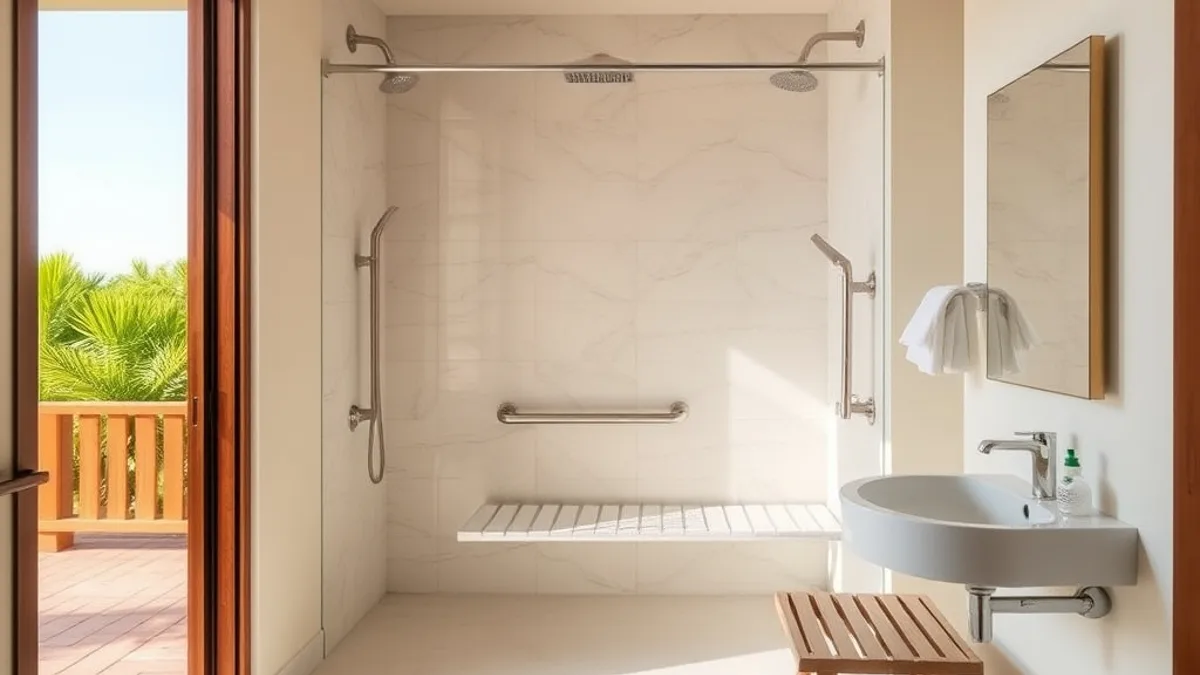
Bathrooms: Roll-In Showers and Grab Bars
The bathroom is where accessibility claims are tested most harshly, and where vague marketing does the most damage. Look for a genuine roll-in shower with a threshold under 2 cm, not a step-over tray described loosely as accessible. Some owners list a walk-in shower as roll-in when the tray still has a 10 cm lip, which makes an independent shower impossible for many users.
Seating and support inside the shower
Verify that there is a fold-down shower seat and that grab bars are mounted at 85-95 cm height. Ideally the grab bars should be load-bearing rather than suction fittings, which can detach under body weight. Ask directly how the bars are fixed to the wall, because a suction bar that looks convincing in photos will not hold you if you slip.
Toilet and sink usability
Check the toilet height, usually 45-50 cm, and whether grab bars or clear transfer space sit beside it. A toilet tucked into a corner with a towel rail on one side leaves nowhere to transfer from. Also ask if the sink has knee clearance underneath so it can be used from the chair; a pedestal sink forces you to wash hands sideways at an awkward angle. These details take one phone call each to confirm, and they make the difference between a bathroom you can use independently and one you cannot use at all.
Bedroom and Kitchen Heights That Actually Work
Bed and kitchen measurements decide whether you can actually use the villa or just look at it. A bed that sits too high or too low turns every morning into a struggle, so confirm the mattress top is between 45-55 cm from the floor. At that height, most wheelchair users can complete a safe side transfer with a sturdy surface to push off from.
The layout around the bed matters just as much as its height. Ask whether there is open space on at least one side of the bed for your chair to pull up alongside, and whether there is clearance underneath the frame for a footrest to slide beneath. A bed pushed into a corner with no transfer space fails even when the mattress height is perfect.
If the mattress sits too low, a frame raised on sturdy blocks is a simple fix that many villa owners can arrange. Ask in advance, though, because not all bed frames can be lifted safely, and you want this settled before arrival rather than on the first night.
- Confirm that light switches, sockets and climate controls sit between 40-120 cm so you can reach them from a seated position, including bedside sockets for charging a powered chair or medical equipment overnight.
- In self-catering villas, check that kitchen counters measure 75-85 cm so you can roll your knees underneath and actually prepare food rather than working at an awkward angle.
- Look for a cooktop with front-mounted controls, so you never have to reach across a live burner, and an oven installed at waist height instead of a low unit you would have to bend down to load.
Pools, Terraces and Outdoor Living
A villa can be flawless indoors and still lose its appeal the moment you step outside. Pools are the biggest culprit: many listings advertise a pool as accessible when the only way in is a ladder. Ask specifically whether the pool offers a hoist, a graduated entry with shallow steps you can enter gradually, or a step-free ramp. Ladders alone exclude many wheelchair users, so treat a vague answer as a no.
Paths, terraces and gardens
Next, trace every route from the villa to the places you actually plan to spend time. Terraces, outdoor dining areas and gardens should connect through level or ramped paths with no steps along the way. One flight of garden stairs can confine you to the living room for the whole trip, so walk the route with the owner on a video call if you can.
Outdoor showers and sun loungers deserve a specific question too. A shower is only usable if you can reach it over firm, level ground, and a lounger is only inviting if you can park your chair beside it comfortably.
Coastal villas
In coastal destinations, verify that the route from the villa to the beach or jetty is paved. It is remarkably common for a property to be accessible right up to the terrace edge and then turn into soft sand or rough track, cutting you off from the water entirely.
How to Verify Claims Before You Book
The word accessible means very different things to different owners, so verification is your job before any money changes hands. Some hosts genuinely understand wheelchair users’ needs, while others simply add the label because there are no steps at the front door. Fortunately, a short checklist of steps filters out unsuitable villas quickly, saves hours of back-and-forth messaging, and gives you real recourse if something does not match what you were promised. Work through it in order for every property on your list, and you will quickly see which owners are worth dealing with.
- Request dated photos or a live video walkthrough. Ask specifically for the entrance, bathroom and bedroom, taken or filmed recently. A generic gallery photo of a smiling couple tells you nothing about a 15 cm step hiding behind the front door. A video call lets you ask the owner to show exact measurements on camera, which is far harder to fudge than a carefully angled photo.
- Book 3-6 months ahead. Genuinely accessible villas are scarce, and the best ones sell out first in high season. Late searches leave you choosing between compromise properties and cancellation. Starting early also gives you time to walk away from a vague or evasive owner and keep looking.
- Budget for a 10-20% premium. Villas with genuine accessibility features often cost 10-20% more than comparable standard villas, so a suspiciously cheap accessible listing usually signals that a feature is missing or exaggerated. Treat that saving as a warning sign rather than a bargain, and ask what exactly is missing.
- Get written confirmation of every feature you need. Include equipment such as shower chairs, hoists or pool access aids in the message thread, before paying the deposit. Written confirmation gives you something concrete to point to if anything falls short on arrival, and it makes a refund or rebooking claim far easier to win if the listing turns out to be inaccurate.
Owners who respond promptly, send real photos and confirm details in writing are showing you how they operate before you ever arrive. That responsiveness is often the best sign of a stay that will match the listing, so weigh it as heavily as the photos themselves when you make your final choice.
The Shortlist That Saves Your Holiday
So how do you avoid the villas that look accessible in the photos but fail on arrival? The answer is to treat accessibility as an all-or-nothing checklist. A villa is only truly accessible if the entry, doorways, bathroom, bed and outdoor space all pass inspection — not just one of them. A beautiful roll-in shower means little if the bedroom door is too narrow to reach it.
When you compare listings, check the numbers first: doorways of 81-90 cm, turning circles of at least 150 cm, shower thresholds under 2 cm and bed heights of 45-55 cm. Then back those numbers up with a video walkthrough, and make sure the host puts every agreed feature in writing before you pay the deposit. Book 3-6 months ahead, because the genuinely accessible villas sell out first. Do that, and a risky listing becomes a reliable stay. Have a question or a tip of your own? Leave a comment or share this article.