Picture this: you land at a small dirt airstrip in the middle of a safari reserve, only to watch the pilot shake their head at your hard-shell suitcase. On bush flights luggage rules are not suggestions but hard limits, and travelers who arrive with 23 kg checked bags often discover too late that the aircraft simply cannot take them.
Light aircraft flying into remote camps work nothing like the commercial jets that got you to the region. Weight is calculated before every departure, cargo holds are tiny, and baggage allowances typically sit at 15-20 kg per person including hand luggage. This article explains why these rules exist, how to choose the right bag, what your passenger weight has to do with your seat, and how to plan your booking so nothing gets left behind on the tarmac.
Why Bush Flights Have Strict Luggage Rules
The first thing to understand about light aircraft is that performance depends entirely on total load. Before departure, the pilot calculates the combined weight of every passenger, every bag, and the fuel on board. If the numbers do not work, someone or something has to come off the aircraft. There is no flexibility in this system, which is why operators ask for your baggage details well before you arrive at the airstrip.
Small doors, smaller holds
Even if the weight were not an issue, the physical space would be. Aircraft such as Cessna Caravans, which commonly seat 4-12 passengers, have small cargo doors and narrow holds. A large hard-shell suitcase simply will not fit through the opening, no matter how gently you try to angle it. Ground crew load bags piece by piece into the hold and often into the cabin as well, so bags need to be squishy and manageable.
The airstrips themselves add another constraint. Most safari regions are served by short, unpaved gravel or dirt strips. A heavily loaded aircraft needs more runway to get airborne, and these strips offer little margin for error. That is why takeoff weight is limited even further on hot days and on longer routes, and why the total load calculation matters so much on every single flight.
Weight Limits and Baggage Allowances on Bush Flights
Most bush flight operators cap total luggage at 15-20 kg per person, and this figure includes everything: your main duffel, your camera bag, and any hand luggage. Camera and laptop bags usually count within the total allowance, not in addition to it, so weigh them together with your main bag before you leave home. Baggage dimensions are typically limited to around 60-70 cm per bag so that each piece fits through the cargo door of a small aircraft.
If you know in advance that you need more capacity, for example because you are carrying dive gear or extensive camera equipment, pre-book excess weight as freight at extra cost. Do not hope for gate leniency. Unlike a commercial airline, the pilot cannot simply squeeze your bag on if the weight-and-balance numbers are already at their limit, and turning up with unbooked overweight luggage risks it flying on a later aircraft or not at all.
- Ask whether the allowance is per person or per booking. Some operators pool allowances across a family or group, which helps when one traveler carries heavy camera gear and another packs light.
- Check whether the limit changes by route. Flights into smaller, higher-altitude or shorter airstrips sometimes carry stricter limits than longer main routes, so confirm the figure for each leg of your trip.
- Weigh your bags fully packed. Include straps, water bottles and anything you have clipped on, since ground crews weigh the bag as they receive it, not the empty duffel you measured at home.
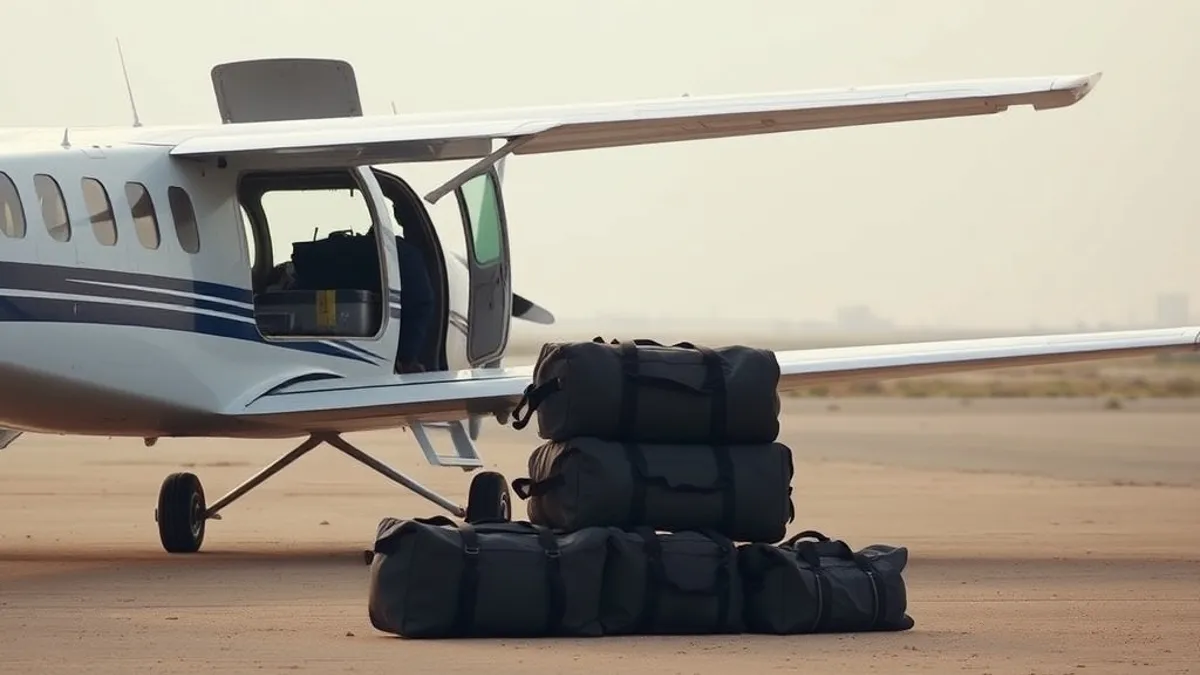
Choosing the Right Bag for Light Aircraft Transfers
The right bag makes bush flights dramatically easier. Use a soft-sided duffel without wheels or a frame, because hard shells cannot be loaded into the narrow holds of light aircraft. The bag needs to flex so ground crew can slot it into awkward spaces, and wheels add dead weight and bulk that serve no purpose on a gravel airstrip anyway.
Comfort and organisation
Choose a duffel with backpack straps if you can. At many airstrips there are no porters or trolleys, and you will be carrying your own bag across gravel and uneven ground from the aircraft to the vehicle. Padded shoulder straps or a proper backpack harness turn that short walk from a struggle into a non-event, and they also help when you are hauling the bag through lodges and airport terminals.
How you pack matters as much as what you pack. Compressible layers of clothing squeeze into a flexible duffel far better than rigid folded stacks, and soft items can fill the awkward corners around the bag’s shape. Use dry bags or packing cubes to keep gear organized inside one flexible bag: one cube for clothes, one for toiletries, one for chargers and cables. Dry bags have the added benefit of protecting your gear from dust, which is unavoidable on open-sided aircraft and gravel strips, and from the occasional rain shower during loading. When the bag can be squashed, cinched and reshaped, it will fit through the cargo door without a fight.
Passenger Weights and Seat Assignments
If there is one thing that surprises first-time safari flyers, it is the question about body weight at booking. It is not a formality. On a light aircraft carrying four to twelve passengers, your weight is a core part of the weight-and-balance calculation the pilot performs before every departure, alongside fuel and baggage. Give an honest figure, and add a couple of kilograms if you are traveling with heavy clothing or boots you will wear on board.
Underestimating your weight is not just awkward, it can force last-minute load reshuffling at the airstrip or even leave baggage behind. Operators would far rather you overstate slightly than understate. If your weight changes between booking and departure, for example after a long trip, mention it when you check in.
Seat assignments work differently here too. You cannot choose a window seat or sit next to your partner by preference, because seating is arranged according to load distribution. The pilot places passengers to keep the aircraft within its center-of-gravity limits, and that calculation is done shortly before departure, not when you book.
- Heavier passengers or larger groups may be split across two flights on popular routes, since a single aircraft may not have the payload for everyone plus luggage, so build flexibility into your schedule.
- Children are usually weighed together with their luggage and any car seat or carrier they use, so tell the operator about these items when you book.
- If you feel airsick in the rear rows or prefer a particular side for photography, mention it politely at check-in; pilots will accommodate preferences when the load allows, but the weight calculation always comes first.
What to Carry On Board the Aircraft
Cabin space on a light aircraft is closer to a large car than an airliner. There is no overhead locker, no under-seat stowage in most cases, and little room to move. Whatever you bring into the cabin needs to sit on your lap or squeeze into a small compartment behind the seats, so keep it genuinely small.
The solution is a compact soft daypack that holds your true essentials: camera, binoculars, medication, passports and travel documents, and perhaps a power bank. Since items like camera and laptop bags are deducted from your overall allowance rather than added on top, plan for the daypack as part of your total weight from the start instead of treating it as a free extra.
Keep valuables with you, not in the hold
Baggage is loaded into the hold and you will not have access to it during the flight. Anything fragile, valuable or medically necessary belongs in your daypack, ideally cushioned with a soft cloth. Lenses and drone batteries also travel better in the cabin, where temperature swings are milder.
Dress in layers instead of packing bulk
Early morning flights can be chilly and midday flights warm, so wear a light fleece or softshell you can take off on board and fold onto your lap. This keeps you comfortable without a bulky jacket competing for the tiny cabin space, and it shaves weight off your checked duffel at the same time.
Booking, Schedules and Luggage Logistics
Most luggage problems on bush flights come down to one thing: assumptions. Limits vary between operators and between routes, and a transfer that allows generous baggage on one charter may be far tighter on another. The fix is simple. When you book, ask for the baggage allowance in writing, including whether camera bags count separately, and keep that confirmation handy when you pack.
If you know you will exceed the standard allowance, perhaps because of photography gear or a long trip, arrange excess space at the same time as your seat. Excess luggage can often be pre-booked as freight at extra cost, but space on small aircraft is finite and disappears quickly in high season. Booking several weeks ahead gives the operator time to plan the load; leaving it to the airstrip rarely works.
Your lodge can also be part of the solution. Many safari lodges are happy to store the suitcase you arrived with while you fly in with a duffel, and some can forward luggage to your next stop. If you are planning a stay in the Laikipia region, a base like a spacious homestead near Nanyuki makes it easy to leave non-safari gear safely behind between flights.
- Ask whether the operator weighs bags at check-in or estimates them; a weighed check-in means you should re-pack the night before rather than gamble at the airstrip.
- Clarify who handles freight logistics for excess items, since some lodges arrange road transfers for extra baggage instead, which can be cheaper than paying air freight on a full flight.
- Label every bag with your name, final destination lodge and booking reference, as bags are often transferred between aircraft or vehicles without you present.
Packing Smart for Your Bush Flight
Arriving at a bush airstrip with a 23 kg hard-shell suitcase is a mistake many travelers only make once. Small aircraft simply cannot take the load, and there is no hold big enough to hide it in. The fix is straightforward: a soft-sided duffel, a total allowance of 15-20 kg including your camera bag, and an honest body weight given at booking.
Carry your essentials on board in a small daypack, and pre-book any excess luggage as freight rather than hoping for leniency at the airstrip. Do those three things and your light aircraft transfer becomes one of the highlights of your trip instead of a hurdle. If you have flown a bush flight recently, share your experience or questions in the comments below.