Fly-in lodges promise untouched wilderness, but getting there usually means trading a commercial jet for a small bush plane. If you pack the way you would for an international flight, you may find yourself repacking on the airstrip while the rest of your group watches. Bush plane luggage limits are strict, and pilots enforce them without exceptions.
Most light aircraft allow just 10-15 kg per passenger, and that figure includes your camera bag and anything you carry on board. The good news is that packing for a lodge stay is a skill you can learn quickly. This article walks you through why the limits exist, which bag actually fits through a cargo door, how to fit a week of clothing into one duffel, how to handle camera gear within your cap, what to do about excess weight, arrival day logistics at remote airstrips, and a final checklist before you fly.
Why Bush Plane Luggage Limits Are So Strict
The reason bush plane luggage limits feel so tight comes down to physics. Light aircraft such as the Cessna Caravan, a workhorse on lodge routes, typically carry only 5-12 passengers. Unlike a commercial jet, every single kilo on board affects the pilot’s weight and balance calculations, which determine whether the plane can take off safely and how it handles in the air.
Your allowance covers everything you bring
When an operator quotes a weight allowance of 10-15 kg per person, travelers often assume it applies only to checked bags. It does not. That cap includes your camera bag, daypack, handbag and any other hand luggage on the aircraft. If your duffel weighs 12 kg and your camera bag weighs 5 kg, you are already over on a 15 kg allowance.
Keep this in mind from the moment you start packing, not when you arrive at the airstrip. Check your charter operator’s exact allowance when you book, because it varies by aircraft and route.
Pilots can and do refuse bags
At a remote airstrip there is no storage room, no later flight guaranteed and no negotiation. If your bag is oversized or pushes the aircraft over its weight limit, the pilot can refuse it on the spot, and there is typically no compensation for whatever gets left behind. In dry season, when flights are full and enforcement is at its tightest, this happens regularly. A few minutes with a luggage scale at home is far cheaper than losing your belongings at the start of your trip.
Choosing the Right Bag: Soft Duffels Only
The single most common packing mistake for a fly-in lodge trip is bringing the wrong bag. Hard-sided suitcases look tidy and protect your belongings at home, but on a small aircraft they are a liability. The cargo doors and baggage compartments on light aircraft are small, and your bag needs to squeeze through both a narrow door and an awkwardly shaped hold.
Why soft duffels work and hard cases fail
The baggage compartments on most light aircraft measure roughly 80-100 cm long, and the space inside is often irregular rather than box-shaped. A soft-sided duffel without an internal frame can be squashed, angled and pushed into that space by the ground crew. A wheeled hard case keeps its shape no matter what, and if it does not fit, it does not fly. Rigid backpacks with external frames cause the same problem.
When a bag cannot fit, it frequently gets left behind at the departure point. That is why almost every charter operator states in its booking terms that soft bags are required.
The right size and style
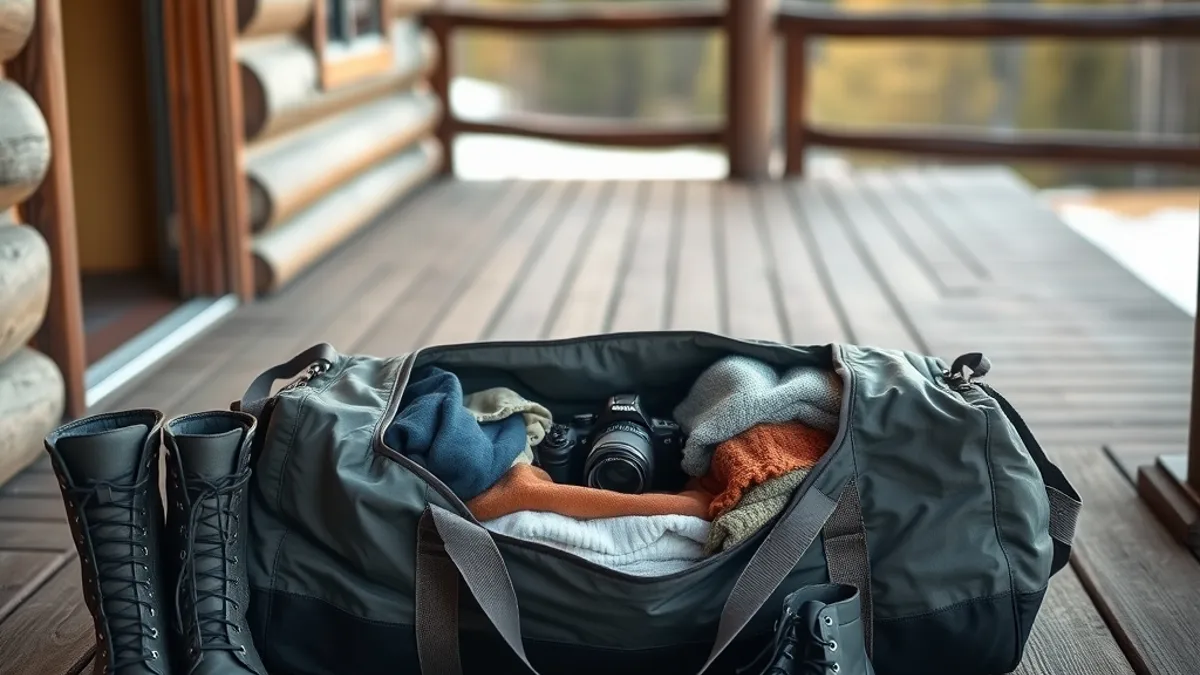
Look for a compressible duffel in the 60-80 liter range with padded backpack straps. That capacity is large enough for a week at a lodge with laundry service, yet small enough to stay within a typical 10-15 kg allowance without overpacking. Backpack straps matter more than you might expect, since airstrip transfers often involve walking across gravel or grass with your bag in hand. Choose a duffel with sturdy zips and reinforced handles, because it will be loaded and unloaded by hand on every leg of the journey.
Packing Light for a Week at a Fly-In Lodge
Packing for a week at a fly-in lodge is really an exercise in trusting the laundry service. Most lodges wash and press your clothes every 1-2 days, which means you genuinely do not need seven days of outfits. Plan for just 3-4 outfit changes and let the lodge handle the rest. Give your first morning’s clothes a quick check before the evening game drive, since turnaround is usually fast but not instant, and a damp shirt at dusk is no fun in an open vehicle.
The key to comfort is layering. Early-morning game drives start out cold, with wind rushing past an open vehicle, while midday temperatures can feel positively hot. Neutral, quick-drying layers in khaki, olive and gray let you add or remove pieces as conditions change without carrying separate outfits for each part of the day. Choose fabrics that dry overnight on a windowsill or balcony rail, because even with regular laundry service you will occasionally want a fresh option between pickups.
Practical space savers
- Two pairs of shoes only. One sturdy walking pair for game drives and walking safaris, and one lightweight camp pair or sandal for evenings. Shoes are the heaviest, bulkiest items in most bags, so this rule alone saves several kilos.
- Decant toiletries into 50-100 ml containers. Full-size bottles of shampoo or insect repellent add hundreds of grams each, and you will never finish them in a week.
- Share within your group. One bottle of sunscreen, one first-aid kit and one power bank per couple or family is plenty, rather than each traveler carrying their own set.
- Roll and compress. Rolling clothes into tight cylinders saves space in a duffel and makes it easy to pull out one item without unpacking everything.
Camera Gear and Valuables Within a 15 kg Cap
Camera gear is where most travelers blow their weight allowance, and it is also the gear that suffers most when things go wrong. The baggage hold on a light aircraft like a Cessna Caravan is unpressurised and unheated, so temperatures and pressure up there are nothing your lenses want to experience. Keep camera bodies and lenses with you in the cabin, where you can watch them and where conditions stay reasonable.
The second mistake is treating camera equipment as an extra. Your cameras, lenses, drone, batteries and binoculars all count toward your total 10-15 kg allowance, exactly the same as your socks and safari shirts. If you show up with 12 kg of clothes and 8 kg of camera gear, something is getting left on the tarmac, and it will not be the socks.
A padded soft camera insert inside your duffel is the smartest weight trade you can make. A dedicated hard camera case can weigh several kilos on its own, while an insert adds only a few hundred grams and squashes flat for the flight home.
- Carry batteries in the cabin: lithium batteries should stay with you rather than in the hold, and cold conditions in an unheated compartment drain them faster.
- Choose two versatile lenses over a full kit: a wide zoom and a longer zoom cover most safari situations without doubling your gear weight.
- Remove straps, hoods and chargers you will not use: editing the accessories alone can save a full kilo for other essentials.
- Use padding you already own: wrapping lenses in clothing inside the insert adds protection without adding weight.
What to Do About Excess Weight
Even careful packers occasionally end up over the limit, and it is far better to discover that in your hallway than on a dusty airstrip. During dry season, when flights to the most popular lodges are fullest, enforcement tends to be at its strictest. The good news is that excess weight has workable solutions, as long as you plan for them before travel day rather than improvising at the airstrip.
- Weigh your packed duffel at home. A simple luggage scale costs little and removes all guesswork. If you do not own one, step on the bathroom scale holding the bag, step on without it, and subtract. Do this a few days out, not the night before, so you still have time to repack.
- Know what happens if you are over. Excess baggage is typically charged per kilo, and if the aircraft is already full, your bag may travel on a later flight and meet you at the lodge hours after you land. Ask your operator for the current rate when you book.
- Ask about buying an extra seat for baggage. On heavy-load charters, some operators sell an extra seat purely for camera gear or equipment. It is expensive, but for photographers with long lenses it can be the difference between bringing the kit and leaving it behind.
- Leave the extras at your gateway base. Formal wear, extra books, duplicate toiletries and souvenir space can all stay at your gateway hotel or city base until you return from the bush. Most lodges run laundry every day or two, so you genuinely do not need the surplus.
Run through these steps a few days before departure, not the morning of your flight. That buffer gives you time to repack, redistribute weight between bags, or make a call to your operator if the numbers do not add up. Arriving at the airstrip with a compliant duffel is one of the simplest ways to start a fly-in trip calmly.
Arrival Day Logistics at Remote Airstrips
Arrival day at a remote airstrip is short, dusty and wonderfully informal compared to a commercial airport, and a little preparation makes it smooth. There is usually no terminal to speak of: you step off the light aircraft, someone pulls your duffel from the pod, and your lodge’s transfer vehicle waits a few steps away on the strip. That vehicle is often an open safari-style truck, which means you, your bag and the dry-season dust all share the same ride, so dress for wind and sun rather than air conditioning. Confirm your exact weight allowance and bag dimensions with the lodge or operator when you book, because these vary between operators and are enforced most tightly during the dry-season peak from June to October. It also pays to ask two simple questions ahead of time: how long the flight leg to the airstrip typically runs, and whether the lodge provides water, shade or a welcome at the strip while you wait.
Before you leave the gateway airport, repack so the things you need in the first and last hours of the journey sit within reach, not buried at the bottom of a duffel that has been strapped into a cargo pod for an hour. Think in terms of two moments: the hour you land, when you will want sunscreen, a hat, water and your camera within easy grab; and the hour you depart the gateway, when passports, boarding details and snacks for a delayed leg matter most. A final hotel-room repack the night before, with the duffel left unzipped and the daypack loaded, saves you from digging through straps and compression buckles on a hot airstrip while the plane idles.
- Pack dust protection for electronics: a dry bag, ziplock bags or a simple scarf wrapped around your camera bag keeps fine dust out of buttons and ports on the open transfer vehicle.
- Use a small daypack for essentials: keep passports, medication, cash, sunglasses and one change of clothes with you in the cabin and on your lap in the truck.
- Wear your heaviest items on your body: boots, a jacket and jeans worn instead of packed do not count against your allowance.
- Keep a copy of your booking details handy offline: remote airstrips rarely have signal, so screenshots on your phone beat searching for an email that will not load.
Final Packing Checklist for Fly-In Lodge Stays
If you remember one thing from all of this, make it this: a fly-in lodge trip is not a commercial airline trip. Small aircraft have hard limits, and travelers who pack like they are flying a wide-body jet often watch their bags get left behind at the airstrip. Bush plane luggage limits reward soft duffels, 10-15 kg totals and ruthless editing, so pack for the aircraft you are actually boarding.
The good news is that a week fits in one bag more easily than you think. Laundry service, layering and cabin-kept camera gear make a week fit in one bag, and a compressible duffel handles the rest. Weigh, compress and confirm allowances before travel day for a smooth airstrip handoff. If this guide helped you streamline your packing, leave a comment or share it with a fellow traveler heading to a fly-in lodge.