Every parent dreams of that first night under canvas with their little ones: fairy lights, hot chocolate, the sound of crickets instead of cartoons. Then reality kicks in. What about the fire pit two meters away? Will the tent deck have a railing a toddler can scale in seconds? And is anyone equipped for a 3 a.m. wake-up in a unit that was clearly designed for adults? Choosing the right glamping site for toddlers means looking past the pretty photos and asking sharper questions.
This guide walks you through exactly what matters: which safety features separate a genuinely family-ready site from a marketing shot, how to pick a tent or lodge layout that protects precious naps, why short travel distances make or break the trip, and which season gives you the best weather for your money. We will also cover the facilities that save a rainy afternoon, the questions to email before you book, and how to budget sensibly. By the end, you will have a clear checklist for finding a site where the whole family actually sleeps.
What Makes a Glamping Site for Toddlers Actually Safe
The biggest difference between an adult-friendly tent and a genuinely toddler-safe one is containment. Look for fully enclosed decks or solid lodges with child-height railings rather than open platforms with a drop on three sides. A curious two-year-old can cross an open deck in the time it takes you to pour a coffee, so this single feature should sit near the top of your list. Ask the site directly whether the railings are continuous and whether gaps between boards are too narrow for small heads and limbs.
Fire is the second thing to check. Many glamping sites position a fire pit or BBQ as the centerpiece of the experience, which is wonderful for marshmallows and less wonderful when it sits a few steps from where your toddler sleeps. Confirm that fire pits, BBQs and lanterns are set well back from sleeping areas, or ask whether the unit uses indoor-safe alternatives instead. Some sites offer electric lanterns and communal fire areas away from the tents, which is often the better setup with small children.
Supervision and emergency basics
Think about sightlines next. A fenced playground that is visible from your tent porch changes your entire day: one parent can keep an eye on the kids from a deck chair while the other packs bags, prepares food or simply rests. An unfenced playground across the site means constant hand-holding, which defeats the purpose of a relaxing break.
Finally, ask two practical questions before booking. Does the site have first-aid trained staff on site, and how far is the nearest pharmacy or clinic? A drive of roughly 15-20 minutes is a reasonable benchmark for rural locations, but you want the site to confirm it rather than guess. Pack your own basic kit too, since even well-staffed sites rarely carry children’s dosages of common medicines.
Choosing the Right Tent, Lodge or Cabin Layout for Young Children
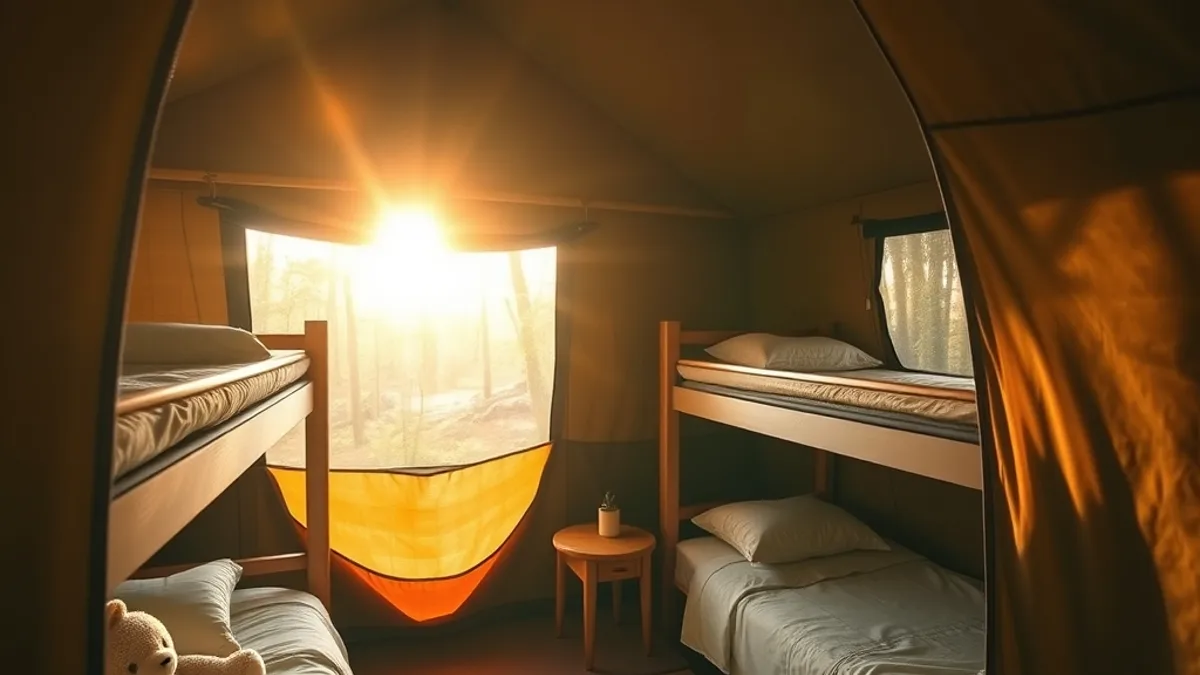
The layout of your unit decides whether the trip feels like a holiday or an endurance test. A family tent or lodge of 25-35 sqm comfortably sleeps two adults and one to two young children, and that size matters for a specific reason: you need somewhere to sit after bedtime. Units with a separate sleeping nook let naps survive the parents’ evening, so you can read, talk or enjoy a glass of wine by lamplight instead of lying rigid in the dark at 8 p.m. If you are dreaming of that kind of slow evening, this kind of layout is exactly what makes it possible, the same unhurried rhythm you find in places built for slow French countryside mornings.
Bed type is the next dealbreaker. Air mattresses feel like a bargain until your toddler rolls off one at midnight onto a cold canvas floor. Real beds or low fixed bunks keep everyone where they belong, and a low bunk with a rail can feel like an adventure rather than a hazard for young children.
- Cots and high chairs on request: sites that provide these save you from checking a travel cot and a folding high chair onto a flight, freeing up luggage space for clothes and toys.
- Blackout lining: canvas is bright at 5 a.m. in summer, and lining over the sleeping nook can buy you an extra hour or more of sleep.
- Bathroom distance: an en-suite toilet is ideal, but anything under 30 meters from your unit keeps night-time trips manageable in pajamas and wellies.
Ask the site to confirm all three in writing before you pay. Photos rarely show whether the cot is a proper one or a foam floor mattress, and this is exactly the kind of detail that separates a site that welcomes toddlers from one that merely tolerates them.
Location and Distance: Keeping Travel Days Short
Toddlers have a travel tolerance measured in minutes, not hours. Keep the drive within 1-2 hours of home or your arrival airport, and the journey becomes part of the adventure rather than the thing you need a holiday to recover from. If you are flying in, pick a destination where the transfer is short and predictable. The area around Paphos, for example, has family homes and resorts built for sunshine and Mediterranean ease, and the same logic applies to glamping: the less time in transit, the more time in the paddling pool.
The luggage haul test
Once you arrive, you still have to get everything from the car to your tent. Favour sites where parking sits within a 10-15 minute walk of the accommodation, or better yet, where the site offers carts or wheelbarrows for luggage. A toddler on your hip, a bag of snacks, and two duffel bags turn a 20-minute uphill trek into a genuine ordeal, so ask about this before booking rather than discovering it on arrival.
Look at what surrounds the site as well. The best family locations put a few essentials within walking distance: a shallow paddling spot for hot afternoons, a farm trail short enough for small legs, and a small shop where you can buy milk and snacks without getting back in the car. These little conveniences matter more with toddlers than any luxury feature.
Be equally honest about what to avoid. Sites beside main roads mean constant vigilance the moment your child takes a step, and accommodation next to water without natural barriers such as hedges, fences or a change in level demands the same. Young children roam fast and quietly, so choose a setting where the boundaries are built in rather than enforced by your own reflexes.
Picking the Right Season and Weather Window
Canvas accommodation lives and dies by the weather, and toddlers feel temperature swings far more than adults do. In most European glamping regions, late May to early September is the window where nights stay reliably warm enough for canvas walls to feel cozy rather than clammy. Outside that stretch, you are gambling with your child’s sleep, and a toddler who sleeps badly makes for parents who do too.
If your budget has any flexibility, look hard at the shoulder months. May-June and September stays typically run 20-40% below peak summer prices, and the playgrounds are noticeably quieter. With fewer school-age children around, your two-year-old often gets the slide and the sandpit almost to themselves, which feels like a luxury in July.
Watch out for cold snaps in the wrong places
Shoulder-season bargains come with a catch in mountain areas and northern regions: frost risk. Canvas loses heat fast once the sun goes down, and a lodge that felt pleasant at dinner can turn genuinely cold by midnight. If you are tempted by an off-peak deal at altitude or up north, ask the host directly how the unit performs on chilly nights and whether extra heating or bedding is provided.
Before you commit to any dates, check the average evening temperatures for the area rather than the daytime highs. As a rough rule, toddlers sleep poorly once tents drop below roughly 12-15°C, even with warm sleeping bags. A site that averages 18°C at dusk in June is a far safer bet than one averaging 9°C in a discounted April week, no matter how good the price looks.
Facilities and Extras That Save a Family Trip
The core facilities matter more than any brochure photo of a safari tent at sunset. With young children, your day revolves around a handful of practical things: somewhere safe to play, somewhere to change a nappy, and somewhere to deal with the third spilled snack of the day. A fenced playground tops the list, because it lets you sit down for ten minutes without one eye scanning the treeline. A baby-changing room saves you from balancing a wriggling toddler on a car seat in the parking lot, and a small laundry area turns a mud-and-berry disaster from a trip-ruiner into a ten-minute fix.
Beyond the essentials, ask what the site does to keep little ones entertained. Some family-focused sites run animal feeding times in the morning, keep shallow paddle pools for hot afternoons, or offer a covered play barn that rescues rainy days. These extras can fill the long hours between waking up and bedtime better than anything you pack in the car.
- Animal feeding sessions: check whether children can join in or just watch, and what time it happens, since a session that clashes with nap time is one you will never see.
- Paddle pools and water play: ask whether the water area is shallow, supervised and fenced off at night, and whether it sits where you can see it from your deck.
- Covered play barns: confirm they are open all day to guests and whether toys are suitable for under-fours rather than only school-age kids.
- Borrowing equipment: some sites lend sand toys, bikes with child seats or rain boots, which lightens your packing considerably.
Food is the other trip-saver. Cooking every single meal with toddlers underfoot is exhausting, so confirm whether breakfast is offered or whether a small on-site shop sells milk, bread and snacks. Even a basic shop within the site means you are not packing everyone into the car for a forgotten carton of milk.
Finally, ask about quiet hours and how the site is laid out. Well-run family sites group families together and keep late-night groups in a separate area, so a 7 pm bedtime does not sit next to a 1 am campfire. A quick question at booking stage can save you several nights of shushing.
Booking Timing, Questions to Ask and Budget Range
Good family glamping units are scarce, and the best ones go first. A lodge that actually works with a toddler in tow is exactly what every other parent of a small child is searching for too, so timing matters more here than for almost any other type of trip. The most useful habit is to plan backwards from your travel dates: work out when bookings open for your preferred site, set a reminder, and be ready to commit the moment your window opens. Waiting for last-minute deals rarely pays off for families, because the units that suit toddlers are always the first to disappear from the calendar.
- Reserve early for summer. For July and August stays, book family units 4-6 months ahead. Toddler-suitable lodges sell out first, long before standard couples’ tents do, so flexibility on dates matters less than acting fast.
- Email before you pay. List the specific gear and features your toddler needs, and ask the host to confirm each one in writing. Written answers give you something to fall back on if anything is missing at check-in.
- Target the shoulder months to save. Stays in May-June and September typically cost noticeably less than peak summer weeks. If your toddler is not yet in school, you have complete freedom over dates and nothing to lose.
- Mine the reviews. Read recent family reviews and search them specifically for mentions of naps, noise and night-time bathroom runs. Parents who have actually been there will tell you things the site description never will.
Budget-wise, when you travel is usually a bigger lever than which unit you pick. An off-peak week combined with an early booking gets you the pick of the family lodges at a friendlier price, while the same unit in peak summer may already be gone or priced at a premium. Before paying, put your questions in writing and keep that email thread handy; it is your reference if arrangements change. One last tip: reconfirm everything you agreed about a week before arrival, since staffing and equipment often change between seasons, and a quick message costs you nothing but can save your first night.
Finding Your Family Glamping Match
The magic of glamping with toddlers is real: sleeping under canvas, waking to birdsong and letting little ones run free outdoors. The worry is equally real — fences, fire pits and 3 a.m. wake-ups in a tent that was never designed for small children. The good news is that the right site removes almost all of that worry. The safest glamping site for toddlers combines enclosed units, a short travel distance and play areas you can see from your porch.
Timing does the rest. Late May to early September offers the most reliable weather in most European regions, while the shoulder months can cut your costs by 20-40%. Booking 4-6 months ahead and confirming cots, stair gates and deck railings before you pay turns a gamble into a plan. If a site ticks those boxes, you are ready to pack the car. Have a glamping tip or a question? Leave a comment or share this article with another young family.