You asked for connecting rooms, arrived tired with the kids already melting down, and checked in to find two separate rooms down the hall from each other. No internal door, no easy nighttime check-ins, just a corridor between you and your children. If that sounds familiar, this article will stop it from happening again.
The confusion comes down to connecting vs adjoining rooms — two terms that hotels, booking engines and front-desk staff use loosely and interchangeably. Below, we explain the real difference, help you decide which setup fits your trip, and show you exactly what to ask for when booking. We also cover timing and price, what to do when connecting rooms are sold out, and how to confirm your setup at check-in so there are no surprises when you open the door.
Connecting vs adjoining rooms: the difference that matters
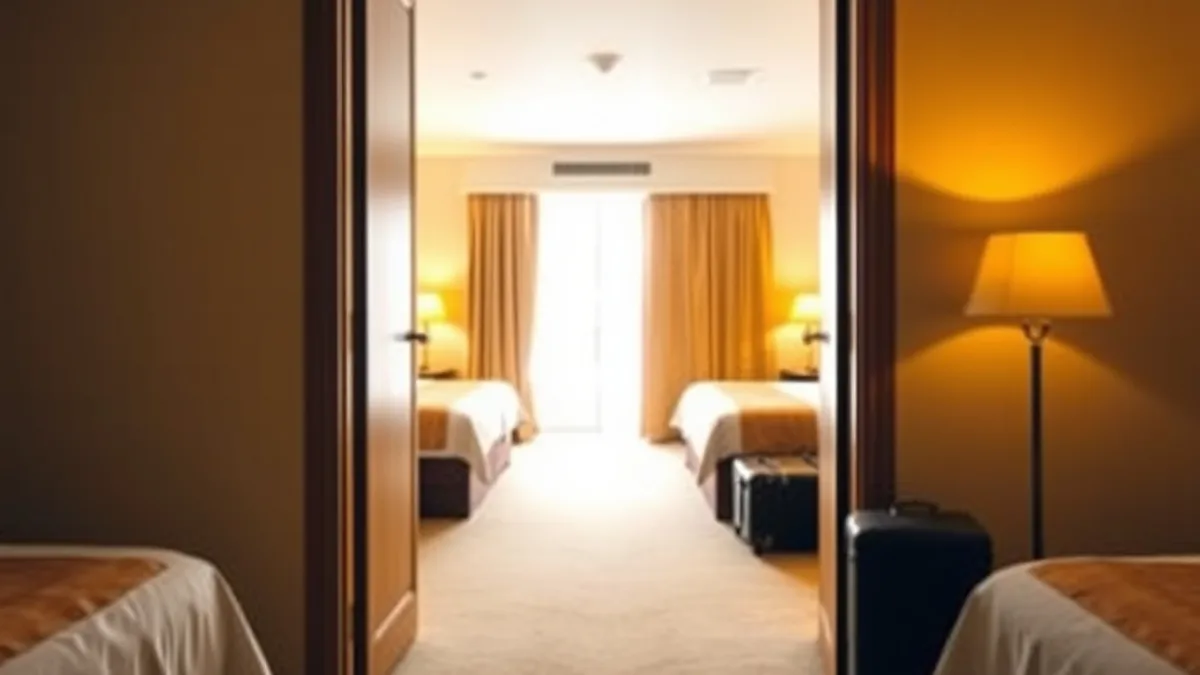
Connecting rooms share a private internal door, which means your group can move between the two rooms without ever stepping into the corridor. One room typically functions as the sleeping space for the kids, the other as the parents’ room, with the door between them kept open or closed as needed.
Adjoining rooms — sometimes called adjacent rooms — only sit next to each other. That can mean genuinely side by side with a shared wall, but it can also mean simply being on the same floor, or even across the hall from one another. There is no door between them. To visit each other, you use the hallway like any other guest.
The door that makes the difference
The internal door in a true connecting pair usually locks from both sides. That detail matters more than it sounds: parents can leave their own door secured while the kids’ side stays accessible, and adults can split off from children at night without anyone walking through a public corridor in pajamas.
Here is the catch: booking engines and front-desk staff often use the two terms loosely, and a confirmation that says “adjoining” or even “connecting” is not a guarantee of an internal door. The label on your reservation is a starting point for the conversation, not the finish line. That is why the wording of your request — and verifying the setup at check-in — matters so much.
Which setup fits your trip
The right choice depends less on the hotel’s layout and more on how your group actually travels. Think about who needs to reach whom during the night, and how much privacy each person wants during the day.
When a connecting door earns its keep
Families with young children get the most value from connecting rooms, since parents sleep just steps away from the kids. A toddler waking at 2 a.m. is a few paces away rather than a corridor crossing, and naps or early bedtimes don’t require an adult to sit in a hallway-adjacent room feeling cut off.
Travelers with a caregiver, or a group member who needs overnight assistance, should also prioritize a connecting door over simple proximity. Being next door is not the same as being reachable in seconds without dressing, finding a key card and opening two doors.
When nearby is good enough
Groups of friends, or families with teenagers, often do better with adjoining rooms. At that age, privacy matters more than a shared door, and nobody wants a sibling wandering through at 7 a.m. Rooms a few doors apart keep the group together without forcing everyone to share air.
Couples and solo travelers rarely need either setup. If you are considering two rooms just for extra space, one larger room or a suite is usually the better spend — you pay for square footage and comfort instead of a second bathroom you didn’t need.
What to ask for when booking
Getting a true connecting pair is mostly about how precisely you ask. Because these rooms typically make up under 5-10% of a hotel’s total inventory, vague requests get vague results, and the pairing you want may already be spoken for. Put the specifics in writing, then confirm them by phone, and treat every reply from staff as a clue about whether the hotel actually has what you need. Follow these steps:
- Use the exact phrase “connecting rooms with an internal door.” Put it in the reservation notes field and in any email you send the hotel. This wording leaves no room for interpretation — you are not asking for rooms that are near each other, you are asking for a door.
- Call the hotel directly after booking online. Online requests often sit in a notes field nobody reads. Speak to the front desk and ask them to add a connecting-room request to your folio, so it sits with the reservation itself rather than in a general inbox.
- Ask whether the rooms are “connecting” or “adjoining” — and make the staff member confirm a door exists. Don’t accept “they’re right next to each other” as an answer. Politely push until someone confirms, in their own words, that there is a lockable internal door between the two rooms.
- Ask where the connecting layouts are concentrated. Ground-floor and accessible-room floors often have the highest concentration of connecting pairs, so if you have a floor preference, mention it in the same call.
- Request that the room numbers be noted on your reservation. A “preference” can evaporate; an actual room pairing assigned in the system is much harder to lose. Then ask for the confirmation in writing — a short email reply is enough.
None of these steps takes more than a few minutes, and together they turn a hopeful note into a documented request. If a hotel cannot confirm an internal door exists, treat that as your answer and keep looking before you commit.
Timing, availability and price
Here is the part most travelers underestimate: connecting rooms are a tiny slice of any hotel’s inventory. They typically make up under 5-10% of total rooms, because not every floor plan allows an internal door between two units. That scarcity means they sell out first in peak season, long before standard doubles or twins do.
If your trip falls in the June-August school holidays or the mid-December to early January stretch, treat the request as urgent rather than optional. Ask when you book, not a few weeks before departure. In practice, 3-6 months ahead is a sensible lead time for those family-heavy dates, and the earlier you lock in the pairing, the better your odds of getting rooms on the floor you want.
Why a follow-up call matters
Some hotels only release their connecting rooms to general booking 30 days before arrival, often because they hold them back for guests with specific accessibility or family needs. That means a pairing can appear at the last minute even when the website shows nothing. A polite follow-up call about a month out, asking the front desk to check again, can genuinely pay off.
On price: expect to pay roughly 10-25% more for two connecting rooms than for two standard rooms booked separately. The pairing is in high demand among families, and hotels know it. If the quote seems far above that range, ask whether a suite or a two-bedroom unit works out cheaper — sometimes it does.
Alternatives when connecting rooms are gone
So the hotel has no connecting rooms left for your dates. That is disappointing, but it is far from the end of the road. Several other setups deliver much of the same comfort, and some actually give you more space than a connecting pair would. The trick is knowing what to ask for by name, because “family room” means wildly different things at different properties. One hotel’s family room is a cramped double with a cot; another’s is a genuine two-bedroom unit.
Start by asking about room categories you may not have seen on the booking site. Smaller hotels often keep suites and two-bedroom units off the main online inventory, and a direct call can uncover options that never appeared in your search results. Front desk staff can also tell you which floors have the most flexible layouts, so it pays to pick up the phone before you settle for whatever the website shows.
- A family suite or two-bedroom unit: these usually sleep 4-6 guests and give everyone shared living space without depending on a door between rooms. Parents get a separate bedroom, and the kids get beds or a sofa bed in the second — often the most practical layout of all.
- Two adjoining rooms on the same floor: a good fit for groups of friends or families with teens, who value privacy over internal access. Ask for rooms side by side rather than merely “near each other,” and confirm the floor when you call.
- A multi-bedroom villa or holiday home: the strongest fallback for bigger groups or longer stays. You get full shared living areas, several bedrooms, and usually a kitchen, which cuts food costs on a week-long trip.
- Rooms directly across the hall from each other: the last-resort compromise. It is not ideal with very young children, but for older kids it works, and it is far better than being parked on different floors.
Whichever option you choose, get the specific room type written on your confirmation. A vague “family accommodation” note protects you far less than a named category with a stated occupancy. If the hotel cannot guarantee it in writing, ask what alternatives they would offer if the category is unavailable on arrival.
Confirming your setup at check-in
Even a written confirmation can fall apart at the front desk, because room assignments shift overnight and staff change between shifts. The five minutes you spend verifying your setup at check-in are the cheapest insurance you will buy on the whole trip. Do it before you carry a single bag upstairs, while you still have full leverage to switch rooms without repacking suitcases or waking up the kids at bedtime.
- Ask to see the rooms or the floor plan before accepting the key. A front desk agent can pull up the layout on screen, or walk you to the door if the rooms are ready. Physically verify that the internal door exists and actually opens — a locked or painted-shut door is more common than you would think.
- Test the connecting door’s locks from both sides. You want everyone to be able to secure their own room at night, especially if adults plan to stay up after the kids are asleep. Check that the door latches properly and does not swing open on its own.
- If the pairing is wrong, ask the front desk immediately. Do not wait until bedtime to discover the problem. Say clearly that you have a connecting-room request in writing and ask what the hotel can do to fix it that day.
Arrival time plays a bigger role here than most people realize. An early afternoon check-in leaves the front desk the whole day to reassign rooms before the evening rush, while a late-night arrival often means accepting whatever is left. If your pairing matters, plan to arrive early — and if the hotel cannot resolve it, ask about a room move the following morning before you unpack anything.
One last tip: keep your written confirmation on your phone, not buried in email. When a shift change means you are talking to someone who never saw your request, a screenshot of the reservation notes ends the conversation fast and gets your family into the right rooms without an argument.
The bottom line for your next booking
The mix-up is easy to prevent once you know the words matter. Connecting rooms have an internal door; adjoining rooms are just nearby — never assume the terms mean the same thing. Put your request in writing, call the hotel to confirm, and book 3-6 months out for peak-season family trips. That way, the rooms you pictured are the rooms you actually get.
And if the pairing is unavailable, a suite, two adjoining rooms or a multi-bedroom villa can deliver the same comfort without the scramble at the front desk. If this saved you from a booking surprise, leave a comment or share the article with a fellow traveler.