You want a desert night under brilliant stars without giving up a real bed, hot water or good food — but where in the Negev do you start, and when is it actually pleasant? That’s the question this guide answers. Glamping in Israel’s Negev desert has grown into a real scene, with domes, luxury tents and upgraded Bedouin-style camps spread across several distinct areas, each with its own climate and character.
Below, you’ll find why the Negev works so well for this kind of stay, which seasons bring comfortable days and cool nights, and how the three main regions — the crater, the Arava Valley and the northern farmlands — differ. We’ll also walk through choosing between stay types, what a night typically costs and how to book smart, plus practical tips for making the most of your desert evenings. By the end, you’ll have a simple plan: the right area, the right month and the right style of camp for your trip.
Why the Negev Works for Glamping in Israel’s Desert
The Negev covers over 12,000 square km — more than half of Israel’s entire land area — yet it holds remarkably few permanent settlements. That combination of vast space and sparse population is exactly what makes it work for glamping. With so few towns and roads, light pollution stays low and silence becomes the default, not a luxury. On a clear night, the Milky Way is often visible to the naked eye, something most visitors from cities rarely experience.
The desert isn’t empty of places to stay, though. Over the past decade, established glamping hubs have clustered in a handful of spots: around Mitzpe Ramon and the Ramon Crater area in the central Negev, in the Arava Valley near Eilat in the south, and among the agricultural moshavim of the northern Negev, where farms and vineyards soften the landscape. Each hub has developed its own style of hospitality, from small family-run camps to more polished operations.
From canvas to geodesic domes
The range of stay types is wider than many travelers expect. Geodesic domes with panoramic windows have become the signature option near the crater, framing the landscape from your bed. Luxury safari tents deliver the classic canvas feel with real furniture and en-suite bathrooms. Bedouin-inspired camps add cultural character, often with communal fire pits and traditional desert meals, but upgraded with comfortable bedding and private facilities. Whatever your budget and comfort level, there’s a version of desert glamping that fits.
When to Go: Seasons and Weather Windows
Timing makes or breaks a desert trip. The sweet spots are March to April and October to November, when daytime highs sit comfortably between 20-28°C and evenings turn cool enough for a fire and a jacket. These windows give you warm days for hiking, pleasant nights for stargazing and none of the extremes that define the other seasons. It’s the same logic that draws travelers to shoulder seasons elsewhere, like those who plan their trips around lavender season in the Provençal countryside — the right weeks change everything.
Summer and winter: know what you’re signing up for
Summer is a different story. From June to August, temperatures regularly top 38°C, and canvas structures without cooling become genuinely uncomfortable, even unsafe, in the afternoon hours. If summer is your only option, book only air-conditioned units — solid-walled domes or tents with proper climate control — or consider skipping the desert entirely and saving it for a cooler month.
Winter, from December to February, brings its own challenge: nights can drop to 5-8°C. Days are often mild and lovely, but once the sun sets, the desert cools fast. Pack real layers, including a warm hat for evening stargazing, and confirm with your host that your unit has heating before you book. A heated dome with a blanket-stocked bed turns a cold desert night into a highlight; an unheated tent can ruin it.
One more tip: within those shoulder-season windows, aim for weekdays if you can. Midweek stays bring calmer crater overlooks, quieter camps and the clearest skies, since fewer visitors mean less ambient light and noise around the popular viewpoints.
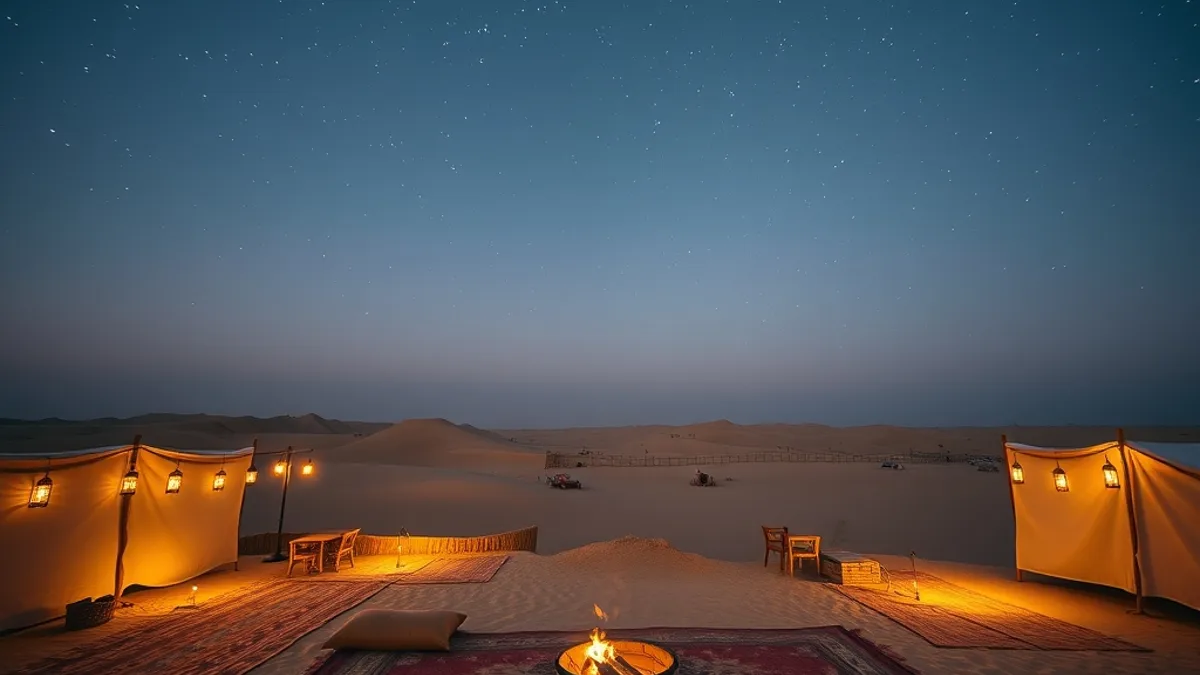
The Best Areas: Crater Views, Arava Warmth and Northern Oases
The Negev isn’t one uniform desert — it’s three distinct glamping zones, each suited to a different kind of trip. Choosing the right one first makes every other decision easier, from what you pack to how far you drive.
Mitzpe Ramon sits about 85 km south of Beer Sheva, roughly a 1-hour drive, perched directly on the edge of the Ramon Crater. This is the darkest-sky zone, where camps and domes are built to face the crater rim and the night skies are about as good as they get in Israel. The Arava, which stretches south toward Eilat along the Jordanian border, runs warmer year-round thanks to its lower elevation, which makes it the natural pick for winter trips when the crater nights turn cold. The northern Negev’s moshavim offer a softer landscape of vineyards, orchards and farm fields, with much shorter drives from Tel Aviv and the center of the country.
- Crater area for stargazers: The high elevation around Mitzpe Ramon and the lack of nearby towns mean the darkest skies in the country — some camps even set up telescopes for guests on clear nights.
- Arava Valley for winter warmth: Its desert-agricultural setting mixes date groves and open sand, and daytime temperatures stay pleasant enough for hiking and cycling even in the cooler months.
- Northern moshavim for easy weekends: Farm-stay glamping here pairs wine tastings and village walks with your desert nights, and you can arrive from Tel Aviv in time for a late-afternoon check-in.
Each zone also shapes your driving plan differently. From Mitzpe Ramon, most of your time is spent on the crater rim itself, so you can park once and walk. In the Arava, sites are spread out along the valley, so a car becomes essential for reaching trailheads and neighboring moshavim. Around the northern farm stays, distances are short enough that you can base yourself in one place and explore on foot or by bike.
The simplest way to decide: match the area to your main goal. Stargazing favors the crater, warmth favors the Arava, and easy access favors the north.
How to Choose the Right Stay Type
The Negev’s glamping scene splits into three main stay types, and the right choice depends less on budget than on the kind of desert experience you want. A couple chasing a romantic crater sunrise will want something very different from a family looking for campfire dinners and a bit of cultural flavor.
Geodesic domes have become the signature stay around Mitzpe Ramon, and it’s easy to see why. Their curved panoramic windows frame the crater and the night sky from the bed, so you get the desert view without stepping outside. Safari tents are the classic option: real canvas walls, a proper bed, an en-suite bathroom and a private deck where you can sit with coffee while the desert warms up. Bedouin-style camps, many run by local families, trade some privacy for atmosphere — think woven textiles, shared fire pits and home-cooked desert meals like lamb slow-cooked in an underground oven.
- Ask about the exact view orientation. Some domes face the crater rim directly, while others look inward toward the camp’s courtyard — worth confirming if the panorama is your main reason for booking.
- Check whether meals are served on-site or nearby. In remote crater-area camps, dinner may be a set menu ordered in advance, so plan your evenings around it.
- Look at the spacing between units. Well-designed camps stagger domes and tents so you hear the wind, not your neighbors’ conversations.
- Confirm what “en-suite” actually means. At a few Bedouin-style camps, bathrooms are in a separate facility building a short walk away rather than inside the unit.
Whatever style you pick, three features separate true glamping from basic camping with better marketing: a private bathroom, working climate control and shaded outdoor space of your own. Ask hosts directly about all three before you book, and you’ll avoid the most common disappointment in desert stays.
What a Night Typically Costs and How to Book Smart
Glamping in the Negev costs more than a campsite but far less than a desert resort, and prices are fairly predictable. For a couple, expect roughly ₪400-900 per night for a well-equipped dome, tent or upgraded Bedouin-style unit. Premium domes positioned right on the crater rim — the ones with floor-to-ceiling views — can reach ₪1,500 per night, especially on peak weekends.
Timing your booking
Demand concentrates hard in spring and autumn, particularly around weekends and Israeli holidays. For those dates, book 1-3 months ahead; the best-view units at popular camps fill first. If your schedule is flexible, shift to midweek: rates often drop 20-30%, and the camps themselves feel noticeably quieter, which matters when the whole point is silence and dark skies.
Booking smart with small hosts
Many Negev desert camps are small, family-run operations that handle reservations personally rather than through big booking platforms. That has real advantages — hosts will happily adjust a meal plan or suggest a crater hike — but it also means you should confirm the details directly. Ask clearly about cancellation terms, what’s included in the rate, and whether dinner and breakfast are available and at what cost. Get the confirmation in writing, even if it’s just a message, so there are no surprises when you arrive at the end of a desert road.
Making the Most of Your Desert Nights
A desert night in the Negev is the reason you booked, so treat the hours around it with a little planning. Aim to arrive in the hour before sunset: the crater walls shift through reds and purples, and the light changes by the minute. Settle in, pour a drink and watch it happen from your deck or the camp’s viewing point rather than from the car.
For stargazing, timing matters more than equipment. The skies over the crater and the Arava are dark enough to see the Milky Way clearly, but moonlight washes it out — so target the new-moon weeks for your trip. Many hosts around Mitzpe Ramon run telescope nights or can point you to local guides who do; ask when you book.
- Download a stargazing app before you lose signal. Coverage drops off quickly near the crater, and an offline star map makes the sky far easier to read.
- Give your eyes 20-30 minutes to adjust. Stay away from phone screens and unit lights during that time, or use a red-light mode.
- Book a sunrise jeep tour or hike into the crater. Early morning is when the terrain is cool and the light is at its best, and guides can explain the geology you’re looking at.
- Keep midday for the hammock or shaded deck. Desert sun is harsh even in pleasant months, so structure your day around early morning and evening activity.
Pack closed shoes and a warm layer no matter the season. Desert temperature swings are real — evenings can feel 10-15 degrees cooler than afternoons, and sandals plus a t-shirt that worked at sunset will not get you through a stargazing session at midnight.
Your Negev Glamping Plan at a Glance
The Negev proves you don’t have to choose between a real desert night and a comfortable one. It delivers genuine glamping across three distinct areas: the crater around Mitzpe Ramon for the darkest skies, the warm Arava Valley near Eilat, and the easy-to-reach moshavim of the north. Each suits a different goal, whether that’s stargazing, winter warmth or a short drive from Tel Aviv.
Timing matters too. Aim for March to April or October to November, when days are pleasant and evenings are cool, and book one to three months ahead for spring and autumn weekends. Expect ₪400-900 per night for a couple, more for premium domes with crater views. Match your dome, tent or camp style to the experience you want, then let the dark skies do the rest. If this helped you plan your trip, leave a comment or share the article.