You arrive at your hotel room exhausted after a long flight, slide the key card into the lock, and nothing happens. You try again, flip it over, insert it the other way up, and still the door refuses to budge. At that moment, most travelers start wondering how hotel room keys actually work, why they fail so often, and what the fastest fix is when they do.
This guide walks through the whole system, from the plastic card in your pocket to the bolt on the door. We will compare the three main key types you will encounter, explain what is happening inside the lock reader, and cover the common reasons cards stop working plus quick fixes. You will also learn how mobile keys behave differently, how deadbolts and security latches protect you at night, and what to do if you lose a key entirely. By the end, a silent door reader will feel a lot less mysterious.
The Three Main Hotel Room Key Types
Most hotels hand you one of three things at check-in: a magnetic stripe card, an RFID key card, or a mobile key on your phone. Each works on completely different technology, and each fails in its own characteristic way, so it helps to know which one you are holding.
Magnetic stripe cards are the oldest system still widely deployed. They carry a black stripe that must be swiped or inserted into the lock, and the stripe itself is fragile, which is why these cards fail more often than any other type. You will mostly encounter them at budget properties and older hotels that have not upgraded their locks.
RFID cards have largely taken over the mid-range and upscale market. Instead of swiping, you tap the card or fob against the reader, and the door opens within a second or two. Mobile keys go one step further by removing the plastic entirely and turning your smartphone into the key.
- Magnetic stripe cards store data on the stripe itself, so physical wear from rubbing against other cards in your wallet gradually corrupts the information and causes read failures even when the card looks fine.
- RFID key cards contain a tiny chip and antenna instead of a stripe, which makes them far more resistant to everyday damage, and they typically respond within 2-4 cm of the reader.
- Mobile keys are issued through the hotel’s app after digital check-in and communicate with the door lock over Bluetooth, so the quality of your phone’s battery and settings matters as much as the lock itself.
- Some properties issue fobs rather than cards for RFID systems, which are handy on a keyring but easy to lose if they are not attached to anything.
How Key Cards and Lock Readers Actually Work
Modern RFID locks work through a short, encrypted conversation between your card and the reader. When you tap the card, the two devices exchange an encrypted signal, and the lock checks two things before opening: whether the card is assigned to this specific room, and whether it is still within its valid time window. If either check fails, the reader typically flashes red or beeps instead of unlocking.
Why keys expire mid-stay
That time window is the detail that surprises most travelers. Key cards are programmed to expire at checkout time on your departure date, which is a security feature as much as a convenience. The catch is what happens when your plans change: if you extend your stay but the front desk does not update your card, it will suddenly stop working on what was originally your checkout morning, even though your reservation is fine. A quick stop at reception reprograms the expiry, so it is worth extending your key at the same time you extend your booking.
When the problem is the lock, not the card
Door readers run on batteries, and those batteries commonly last 1-2 years before they need replacing. When a reader’s battery dies, the lock cannot communicate with any card, no matter how new or perfectly programmed it is. This is why a card that works on the room next door but not on yours often points to a dead reader rather than a faulty key. If reception has just reissued your card and it still will not open the door, mention the possibility of a dead battery and ask them to test the lock directly.
Why Key Cards Stop Working and Quick Fixes
Key cards fail for a handful of predictable reasons, and most of them are fixable in minutes once you know what to look for. The three big culprits are demagnetization, expired programming, and hardware problems at the door itself.
Demagnetization is the classic killer of magnetic stripe cards. The stripe can be wiped by phones, magnets, or wallet clasps kept within a few centimetres of it, which is exactly how most people carry their room key. If your card lives in the same pocket as your smartphone or in a wallet with a magnetic clasp, you are slowly erasing it every day of your stay.
When a card fails, the fix is usually simple: take it back to the front desk and ask for a reprogram. Staff do this constantly, and it is typically done in under 5 minutes. If a freshly reprogrammed card still will not open your door, the card is probably fine and the lock is not, so ask staff to check the reader’s battery before you make another trip downstairs.
- Carry the card in a dedicated pocket or a sleeve, away from your phone, magnetic money clips, and the clasp of a bifold wallet, since even brief proximity can start degrading the stripe.
- Test the card right after reprogramming by having staff confirm which direction to swipe or insert, because many locks fail simply because the card is presented upside down or backwards.
- Note whether the reader beeps or flashes when your card fails; a red light with no response at all suggests a lock-side problem, while a repeated error tone points to the card itself.
- If you are traveling with a companion, ask for two separately programmed cards at check-in so one demagnetized card never leaves you both locked out.
Using Mobile Keys Without Getting Locked Out
Mobile keys turn your phone into the room key, and they work well as long as you set them up properly. The most common mistake is assuming the app will just work when you walk up to the door. It usually does, but only if you have prepared it in advance.
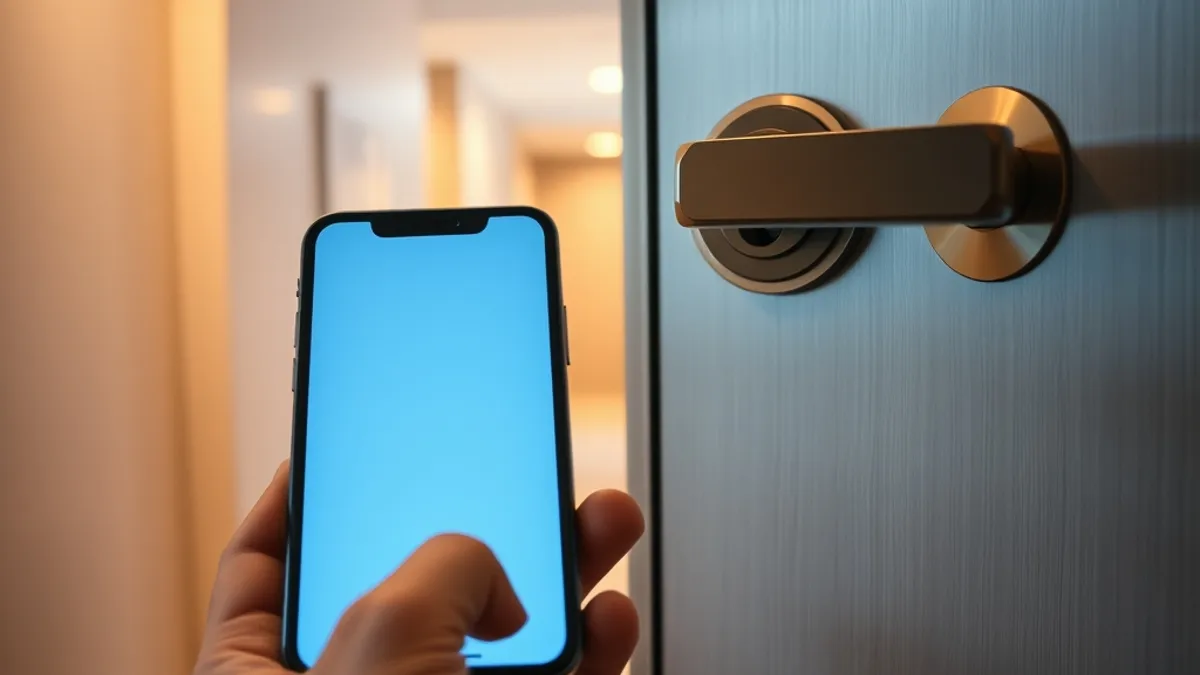
Start by making sure Bluetooth is enabled and the app is open as you approach the door. Readers typically detect a phone at roughly 1-2 meters, so you do not need to tap anything the way you would with a card. Hold the phone near the lock, wait for the confirmation light or sound, and enter.
Timing matters too. Download the key while you still have a signal, ideally before you leave reception, because some apps need connectivity to activate a new key. If you activate it in an elevator or a dead zone in the hallway, you may find yourself standing at the door with an app that will not load.
The biggest gotcha is a drained battery. If your phone dies before you return at night, you have no key and a walk to the front desk. On the plus side, mobile key check-in can save you 10-20 minutes of waiting at busy properties, so the trade-off is usually worth it.
- Set your phone to keep Bluetooth active in low-power mode. Some battery-saver settings quietly disable Bluetooth, which kills the key exactly when you are trying to conserve charge late at night.
- Check whether your hotel requires unlock confirmation in the app. A few systems ask you to tap an unlock button rather than simply holding the phone near the reader, and fumbling for that button in a dark hallway is frustrating.
- Add the key to a second device if the app allows it. A tablet or a travel companion’s phone can serve as a backup if your main phone is lost, dead, or left behind at the pool.
- Test the mobile key on your first return to the room. If it fails right after check-in, you can sort it out with staff in daylight instead of at midnight after a long day of travel.
Deadbolts, Security Latches and Night Locks
Even in hotels with modern electronic locks, the door itself usually has at least one extra layer of security, and it is worth knowing how each one works. These secondary locks are what keep you comfortable opening the door to housekeeping or an unexpected visitor, and they behave very differently from your key card.
Traditional deadbolts
On older doors, the traditional deadbolt is still the strongest barrier you have. It requires either a physical key or an interior thumb-turn to throw the bolt fully into the door frame, which means someone outside cannot retract it without the actual key. When you settle in for the night, give the thumb-turn a full rotation so the bolt is completely extended rather than half engaged.
Latches and electronic deadbolt buttons
Swing-bar and chain latches serve a different purpose. They let you open the door a few centimetres to verify who is on the other side without unlocking it fully, which is handy when room service arrives earlier than expected. The swing-bar type is generally more robust than a thin chain, but both are meant for peering, not for securing the room while you are out.
Electronic locks add their own twist: many have a dedicated deadbolt button on the inside panel. Pressing it engages a secondary bolt that a key card alone cannot override from outside. This is useful if you want the room locked while a partner is still inside, but it is also the mechanism that causes problems when someone leaves with the bolt engaged, which we will come back to later.
Lost Keys and Room Security Habits
Losing a hotel key card feels worse than it is. The moment you realize it is gone, call or walk to the front desk and report it. Most hotels deactivate lost keys immediately and issue a replacement free of charge, so there is no reason to spend an afternoon searching the beach for a plastic card. Quick reporting protects you: an unreported card could still open your room if someone finds it.
One scenario that genuinely causes trouble is leaving your card or phone inside the room with the deadbolt engaged from the inside. Many electronic deadbolts cannot be overridden from outside by a key card, so staff may have no choice but to call a locksmith to get you back in. Before stepping out, do a quick pocket check and make sure the deadbolt has not been thrown from the inside.
Where you keep your spare matters more than most travelers expect. Storing it in your main luggage works only if you never take the luggage with you, which is rarely the case on a multi-stop trip.
- Keep the spare in a zipped interior pocket of your day bag. Interior pockets are harder for pickpockets to reach than outer compartments, and the card stays with you even if you set the bag down at a café.
- Never store the spare in your wallet next to your phone. Even though RFID cards are not affected by magnets the way magnetic stripe cards are, a wallet left at a restaurant takes both your money and your room access with it.
- Consider a second spare for couples or families. If two of you are traveling and one person stays out late, a third card issued at check-in avoids late-night door negotiations with the front desk.
- Ask whether the replacement card affects your old one. At some properties, issuing a new card automatically deactivates the previous one, which is useful to know if you think the lost card might turn up in a jacket pocket later.
Wrapping Up Hotel Room Keys
So, back to that tired traveler standing in the hallway, swiping a card that refuses to cooperate. Hotel room keys are not mysterious, they are just small pieces of technology with specific limits. Key cards, mobile keys and deadbolts each work differently, and each fails for different reasons. A card can expire at checkout time, a reader battery can die, a phone can run out of charge, or a magnet in your wallet can wipe a stripe clean.
The good news is that most lockouts are preventable. Knowing expiry windows, Bluetooth range and demagnetization risks prevents most lockouts before they happen. And simple habits like reporting lost keys fast and engaging the deadbolt at night keep your stay smooth and secure. Next time your card fails twice at the door, you will know exactly why, and exactly what to ask for at the front desk. If this guide helped you out of a hallway jam, leave a comment or share it with a fellow traveler.