Every villa listing has that photo: a pool that seems to spill straight into the sea, with no wall, no edge, no separation at all. Then you arrive, squint across the terrace, and wonder whether what you booked actually counts as an infinity pool or just a regular pool pointed at a nice view. The difference matters more than you might think, both for the experience and for how the pool should be maintained.
This guide breaks down infinity pools at villas in plain terms: what the design really involves, why it costs more to run, and the safety and maintenance checks worth making before you pay a deposit. You’ll also find practical questions for your host, tips for getting the best photos, and the destinations where these pools genuinely shine. By the end, you’ll know exactly what to look for and what to ask.
What an Infinity Pool Actually Is
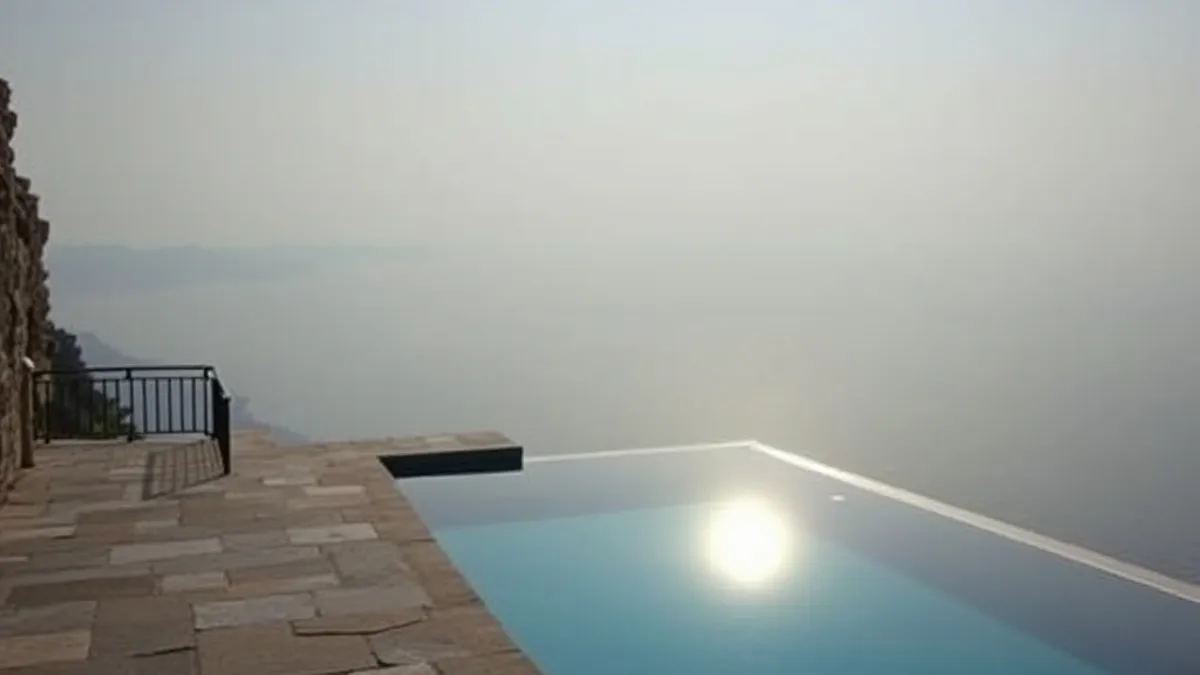
An infinity pool, sometimes called a vanishing-edge or negative-edge pool, is built so that water flows over one or more lowered walls into a hidden catch basin below. From the right angle, that overflowing edge disappears from view, creating the illusion that the water has no boundary at all and simply continues to the horizon.
The edge is the whole trick
The effect has nothing to do with being perched on a cliff or facing the ocean. It depends on two engineering details: a perfectly level edge wall, and a continuous overflow that keeps the water level sitting 10-15 mm above that edge. If the wall is even slightly out of level, or the pump stops feeding the overflow, the illusion collapses and the pool starts looking like what it is: a pool with a wall.
That hidden catch basin, or balance tank, collects the spilled water and recirculates it back into the pool. This extra system is what adds roughly 10-20% to build cost compared with a standard pool of the same size, and it’s also why these pools behave differently day to day.
True infinity edge vs. infinity view
Many villas market an “infinity-view” pool, which is simply an ordinary pool positioned so you look out toward the horizon while swimming. There’s no overflow, no catch basin and no vanishing edge, just a view. A true infinity edge changes the look of the pool itself, not just the backdrop. If the photos show water meeting the sky exactly at the pool line, ask the host directly whether the pool has an overflow edge and balance tank. Their answer will tell you quickly which kind you’re booking.
Why Infinity Pools at Villas Cost More to Run
Infinity pools look effortless, but the system behind that vanishing edge works harder than a standard pool ever does. That extra work shows up in water use, filtration hours and, ultimately, how well the villa keeps the pool looking like the listing photos.
Water loss is built into the design
Because the water level sits 10-15 mm above the edge and spills over continuously, infinity pools lose water constantly to evaporation and splash-out. Topping up isn’t an occasional chore; it’s routine maintenance. The balance tank below the edge collects what spills over and recirculates it, but whatever evaporates or gets splashed out still has to be replaced. A well-run villa tops up the pool regularly and asks guests to be reasonable about heavy splashing.
Longer filtration, bigger budget
The overflow and catch-basin system also means the pump and filtration run longer hours than in a standard pool, since spilled water has to be collected, filtered and returned around the clock. This is why well-run villas budget noticeably more for upkeep than neighbors with ordinary pools. If a host brags about low maintenance costs, treat that as a warning sign rather than a selling point.
That budget matters most when something goes wrong. A cloudy or green edge pool usually signals a filtration or chemical problem, not just a busy week of guests. Heavy use can cloud water within 24-48 hours, but a properly sized system should recover quickly. If the water stays murky, the villa’s upkeep budget or routine, not the guests, is the likely culprit.
Safety Checks Before You Book
A vanishing edge is beautiful precisely because it hides the boundary, and that’s exactly what makes it worth checking before you book rather than after you arrive. Most villa infinity pools run 1.2-1.5 m deep, with some shallow lounging shelves at 0.4-0.6 m, but the drop-off pattern near the edge varies from villa to villa. A pool that looks calm and inviting in listing photos can still have a sharp slope three steps from the edge, and that’s something no photo will show you. Get the details in writing so there’s no confusion when children or weaker swimmers are in the water.
Before paying a deposit, ask the host these safety questions directly:
- Edge protection: ask whether the vanishing edge itself is fenced, gated or alarmed. Unfenced edge pools are typically recommended for children aged 8 and above only, so this matters especially if your group includes younger kids.
- Depth profile in writing: request the exact depth map, including where drop-offs occur near the edge, so you know whether a swimmer can stand at every point or whether the floor slopes sharply.
- Night visibility: check whether the edge itself is walkable or visually confusing after dark, since a level water surface can look like solid terrace in low light.
- Terrace lighting: confirm whether the pool terrace has adequate lighting for evening use, not just decorative accent lights, so the edge line stays visible after sunset.
These questions take a few messages to resolve, and hosts with well-designed pools answer them easily and without hesitation. Vague or evasive replies are useful information too: they suggest the villa may not have thought through edge safety at all. Since water at the overflow edge can hide exactly where the pool ends, an unclear answer is worth taking seriously before children are anywhere near the water.
Questions to Ask the Villa Host
A good villa host will answer pool questions without hesitation, and the answers tell you a lot about how the property is actually run. Before you book, ask when the pool was last cleaned and when the water was last tested. A villa that logs these dates is usually one that takes maintenance seriously. Then go one step further and request a fresh clean and top-up the day before you arrive. Heavy guest use clouds water surprisingly quickly, so a pool that looked perfect for the previous visitors may not look that way on your first morning unless someone has been through it recently.
Infinity pools also have extra equipment that ordinary pools don’t, and that equipment needs regular attention. The balance tank and the overflow channel along the vanishing edge collect everything that spills over, including leaves, insects and dust. If these are neglected, the system recirculates debris straight back into the pool and the water quality drops fast.
- Ask who performs the maintenance: an in-house caretaker who visits daily is a better sign than a contractor who comes once a week, especially in leafy or coastal locations.
- Request the water-test readings, not just the date, so you can confirm chlorine and pH levels were actually within range rather than simply noted.
- If you’re traveling in a cooler season, confirm the pool is heated and ask for the target temperature in writing, since “heated” can mean anything from a properly warmed pool to a heater that’s rarely switched on.
- Ask whether the fresh clean includes skimming the overflow channel, because a spotless main pool with a clogged channel can still look poor at the edge.
Getting the Best Views and Photos
Timing matters more than camera gear when you’re photographing an infinity pool. Shoot early in the morning or between 4-6 pm, when the wind is at its lowest and the water surface stays mirror-flat. A flat surface is what makes the vanishing edge read as a clean, sharp line; even a light breeze turns it into a rippled, broken stripe that ruins the illusion.
Get the angle right
Stand so the camera sits at water level, either crouching at the pool’s edge or shooting from inside the water with a waterproof case. From this low position, the pool edge visually merges with the sea or valley horizon, and the boundary between pool and landscape almost disappears. Shoot from standing height and the illusion collapses, because you’ll see the drop and the catch basin below the edge.
If you’re heading to the tropics, plan your trip around the dry season, roughly November-April in Southeast Asia. It brings the calmest water and the clearest skies, which is exactly what an edge shot needs. Overwater villa settings take this effect to another level, as in the Maldives, where pools seem to float between water, sky, and privacy. There, the pool edge and the lagoon horizon blend so completely that the photo barely shows where one ends and the other begins.
One last practical tip: check the wind forecast for your shooting window rather than guessing. A calm 5 am beats a hazy sunset, and ten minutes of still air is all you need for the perfect frame.
Destinations Where Infinity Pools at Villas Shine
Not every infinity pool delivers the same payoff, and the setting makes all the difference. Cliffside and hillside villas gain the most from the design, because the vanishing edge reads as a natural continuation of the slope toward the sea. The eye follows the water over the edge and keeps going, so the pool feels like it pours straight into the ocean below.
Overwater and lagoon settings work differently. Here, the trick is blending rather than drama, and that’s why the best of these pools use shallow shelves of 0.4-0.6 m. A shallow shelf matches the tone and depth of the surrounding lagoon water, so the pool and the sea merge into one continuous surface instead of appearing as two separate blues.
Mountain and valley villas rely on atmosphere rather than water color. Their magic comes from elevation and morning mist drifting through the valley below, so the pool edge appears to float above clouds. For this effect, orientation matters: ask for an east-facing pool so you catch the sunrise as the mist burns off.
- In cliffside locations, look for villas where the edge sits perpendicular to your main view, since a side-on edge reads far more dramatically than one you see end-on.
- For lagoon villas, check whether the shelf faces the open water rather than the shore, because a shelf pointed inland blends with the beach instead of the horizon.
- In mountain settings, valleys with regular morning temperature swings produce mist more reliably than dry, high-altitude sites, so ask the host how often the valley fogs over.
- Consider the sun’s path in any destination: a pool that faces the sunset gives you golden-hour shots, while an east-facing one gives you mist and sunrise, and few villas offer both.
Wrapping Up Your Infinity Pool Villa Check
Every listing photo seems to show a pool spilling into the ocean, yet guests often arrive unsure what they are actually looking at. The answer is simple: an infinity pool is defined by its overflow edge and catch basin, not just the view. If water flows over a lowered wall into a hidden tank below, you have the real thing; if it is just a standard pool pointed at the horizon, that is a different product.
Get the practical questions sorted before you pay the deposit. Safety, depth and cleaning details are best resolved before booking, not on arrival, when there is little room to fix anything. Then time your trip well: staying in the dry season and shooting in the early morning or 4-6 pm low-wind window delivers the photos the listing promised. If this guide helped you plan your stay, leave a comment or share it with a fellow traveler.