You’ve landed at a stunning villa with an infinity pool and ocean views, only to discover your phone charger doesn’t fit the wall socket, and your hair dryer trips the power the moment you switch it on. It’s a frustratingly common scene, and one that’s easy to avoid with a little preparation.
Villa power sockets and voltage differ from country to country, and they don’t always match what you use at home. This guide walks you through why plugs and voltage vary around the world, how to check whether your devices are safe to use abroad, which adapter to pack, and how to plan charging when you’re traveling with several gadgets. We’ll also look at power limits in remote villas and finish with a quick pre-trip checklist, so you can plug in and power up with confidence from the moment you arrive.
Why Villa Power Sockets and Voltage Vary Around the World
It’s easy to assume a plug is just a plug, but socket shapes change from country to country. There are around fifteen standard socket types in use worldwide, labeled A through N, and they vary in pin shape, size and arrangement. That’s why a plug that works perfectly at home can be useless the moment you arrive at your villa in Bali, Zanzibar or the Maldives.
Voltage varies by region too
Shape is only half the story. Most of Europe, Asia and Africa, including popular villa destinations like Bali, Zanzibar and the Maldives, run on 220-240V power. The US, Canada and most of Central America, on the other hand, run on 100-127V. Plug a device built for one system into the other without checking, and you may end up with a fried charger or a tripped breaker.
Remote villas add another layer. Properties far from the grid often rely on generators or solar power, which can come with limited outlet capacity. So before you pack, it pays to know both what fits in the wall and how much power the villa can actually deliver.
Check the Voltage Before You Pack Your Devices
Before anything goes into your suitcase, flip each charger over and read the small print. Somewhere on the plug or the power brick you’ll find the voltage rating, and this single line of text tells you whether the device will survive your trip. Phone and laptop chargers are usually dual-voltage, rated 100-240V, which means they handle both the 100-127V system at home and the 220-240V system found across most of Asia, Africa and Europe. If your charger shows that range, all you need is an adapter for the socket shape.
When a device can’t cope
Not everything is so flexible. Hair dryers and curling irons are often single-voltage, built for 120V or 230V only. Plug a single-voltage tool into the wrong system and it can burn out, or worse, trip the villa’s breakers and plunge the whole place into darkness. Heat tools are the most common culprits, so check their labels carefully before you pack them.
If you’re unsure about a device, the simplest solution is often to leave it behind. Many villas provide a hair dryer as standard, so ask your host or check the amenities list before you travel. Using the villa’s own appliance, which is built for the local voltage, removes the risk entirely and frees up space in your bag.
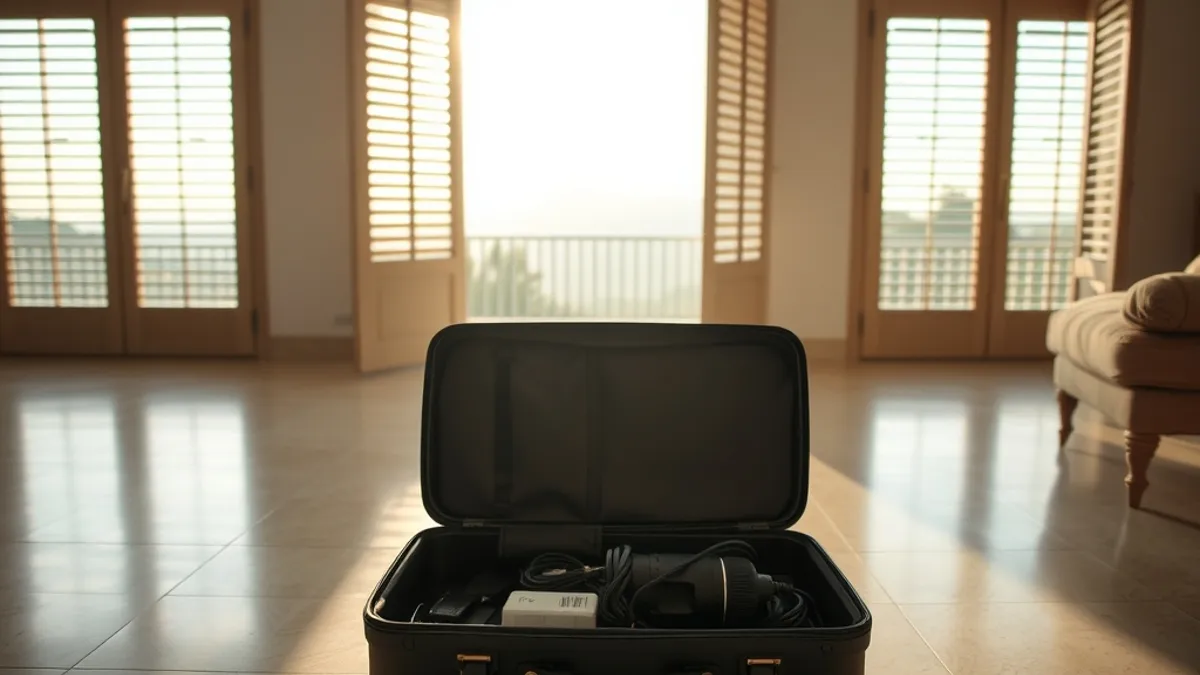
Match the Right Adapter to Your Destination
Once you know your destination’s voltage, the next step is matching an adapter to the socket on the villa wall. The good news is that a couple of socket types cover most popular villa destinations. Type C/F sockets, which fit most two-pin European plugs, are standard across Europe, Bali and the Maldives, so travelers from Europe often need nothing more than their usual plugs. Type G sockets, found in the UK, Zanzibar, the UAE and Singapore, are the chunky three-pin variety and require a three-pin adapter.
It helps to think about your own plug before you shop. A US two-pin plug will not fit either type without an adapter, while European travelers can often plug straight into a villa in Bali or the Maldives. If you’re planning a beach escape in East Africa, it’s worth knowing that villas there typically use Type G sockets, so pack accordingly before you set off for white sand quiet and palm-shadow ease in Zanzibar. And if your travel plans hop between continents, a single purchase can cover you for years.
A universal travel adapter typically costs $10-25, making it one of the cheapest pieces of travel gear you’ll ever buy. Most universal adapters combine several plug patterns in one folding unit, so the same adapter works in Bali, Zanzibar and a London hotel without swapping anything. Many models also include USB or USB-C ports built into the adapter body, letting you charge a phone directly without packing the original wall plug. Look for a version with surge protection if you plan to plug in laptops or cameras, since power quality can vary in older villa buildings. One small warning: a universal adapter changes the shape of your plug, not the voltage, so it only works safely with devices that can handle the local supply.
Plan Charging for Multiple Devices
Most travelers pack more electronics than they realize, and villa bedrooms rarely have as many wall sockets as a hotel room does. A quick count usually reveals the problem: a phone, a laptop, a camera, an e-reader and a power bank add up to five devices competing for perhaps two outlets. In some villas, especially older properties or rooms styled with lamps and bedside tables in every corner, the available sockets may sit behind furniture or in awkward spots near the door. Planning your charging setup before you leave saves you from rotating plugs all week, and it takes less than ten minutes to sort out.
- Count every device you will bring. Lay them out on the table, including the power bank, and note which ones need charging daily and which can go several days. This tells you how many charging points you actually need, not how many you think you might use.
- Bring one compact multi-port USB or USB-C charger. A single block with four ports turns one scarce wall socket into four charging points at once. It costs little, weighs less than several separate plugs, and works with the dual-voltage ratings that phone and laptop chargers typically carry.
- Pack at least one long charging cable. Villa beds and sofas are often placed far from the wall sockets, and a short cable leaves you charging on the floor. A cable of around two meters or more lets you scroll from bed or work from the couch comfortably.
With this small kit, one socket does the work of four, and nobody in your group waits their turn to charge. It is one of the cheapest ways to make a villa stay feel effortless, and it frees you up to enjoy the pool, the terrace and the sunset instead of hunting for a free outlet after dark.
Prepare for Power Limits in Remote Villas
Remote villas offer the quietest, most beautiful settings, but they often come with a power setup that behaves differently from a city apartment. Properties far from the grid may run on solar panels, a generator, or a combination of both, which means the electricity supply has real limits. Destinations like the coast of Madagascar, where places such as Ifaty offer remote escapes for exotic coastlines and barefoot slowness, show exactly why this matters: the more isolated the villa, the more thoughtful you need to be about power use.
Why high-wattage appliances cause trouble
Hair dryers, kettles and air conditioning units draw a lot of power at once. On a solar or generator system, running several of these simultaneously can trip a breaker or drain stored power quickly. Some off-grid villas simply restrict these appliances, or provide only low-power outlets in guest rooms.
Ask before you go
Message your host before arrival and ask a simple question: can the outlets handle a hair dryer, a kettle and the air conditioning at the same time? Most hosts answer honestly and will happily point you to the villa’s provided hair dryer instead. This one exchange prevents tripped breakers and awkward moments mid-vacation.
Finally, pack a small power bank. Outages happen more often in isolated destinations, and a charged power bank keeps your phone alive for maps, messages and photos until the lights come back on. It weighs almost nothing and earns its place in your bag every single trip.
Quick Pre-Trip Power Checklist
A five-minute power check before you zip your suitcase saves you from dead batteries, tripped breakers and a frantic search for an adapter on day one. The good news is that everything on this list can be done from your couch the night before departure. Here is how to run through it quickly.
Start by confirming two facts about your destination: the socket type and the voltage range. Much of Europe, Bali, Zanzibar and the Maldives use 220-240V power, while the US, Canada and most of Central America sit at 100-127V. Then check your own gear, because the devices matter as much as the destination. A phone charger that handles both ranges will breeze through a stay in any of these places, but a heat tool bought for a US bathroom outlet may not. The checklist below covers the three things that matter most, and none of them takes more than a few minutes to sort out.
- Confirm socket type and voltage. Look up whether your destination uses two-pin Type C/F sockets, as in Europe, Bali and the Maldives, or three-pin Type G sockets, as in the UK, Zanzibar, the UAE and Singapore. Note the voltage range too, so you know what your devices must tolerate.
- Verify each device’s voltage rating. Read the fine print on every charger: dual-voltage items rated 100-240V work anywhere, while single-voltage heat tools like hair dryers and curling irons, often rated 120V or 230V only, can burn out on the wrong supply. Leave the heat tools at home if they do not match.
- Pack the three essentials. A universal travel adapter covers nearly every socket type in one purchase. Add a multi-port charger for shared outlets and a power bank for outages or long travel days.
Run through this list the evening before you fly and you will board with every charging scenario covered. It is a small habit that pays off at every villa you stay in, from a beach bungalow to a hillside retreat.
Power Up With Confidence
A little preparation turns the dreaded dead-charger moment into a non-issue. Villa power sockets and voltage differ by region, but the fix is simple: check the voltage before you pack, then bring the right adapter for your destination. Most chargers are dual-voltage anyway, so a quick glance at the small print tells you exactly what you can bring with confidence.
For almost every villa stay, three items cover you completely. Dual-voltage devices handle any outlet, one universal adapter fits the local sockets, and a multi-port charger keeps every device topped up from a single plug. Pack those, and you will never think twice about the wall again. If this guide saved your next trip, share it with a fellow traveler or drop a comment below.