You found a glamping tent listed at triple the price of the standard options nearby, and the photos look similar: a canvas structure, a bed, a view. So what are you actually paying for? Many travelers struggle to tell whether luxury glamping amenities genuinely deliver more comfort, or whether the higher rate is mostly clever marketing and a well-styled photo shoot.
This guide breaks down exactly what separates a true luxury tent from a dressed-up campsite. We’ll cover the physical comforts that form the baseline, the outdoor features that command the biggest premiums, the service levels you should expect at the top end, and how location and exclusivity quietly shape the price. Then we’ll show you how to verify whether a rate is worth it, where this value shows up best in the world, and how to decide when paying more makes sense.
What Separates Luxury Glamping Amenities From Standard Camp Comforts
The first thing that separates luxury glamping amenities from standard camp comforts is what you touch in the first five minutes: the bed. Standard tents typically run $80 to $150 per night and often mean a camp cot, a thin foam pad or a mattress that bottoms out by morning. Luxury tents, which typically range from $250 to $800 per night, start with a real frame bed and a hotel-grade mattress, then layer it with proper linens, a duvet and multiple pillows so sleeping feels like a hotel room, not a survival exercise.
The second marker is plumbing. Above roughly $300 per night, ensuite bathrooms with hot running water and flush toilets are the baseline, appearing in roughly the majority of stays in that bracket, along with quality toiletries rather than a shared ablution block down the path.
Finally, the structure itself matters more than most listings admit. Look for these physical details before you book:
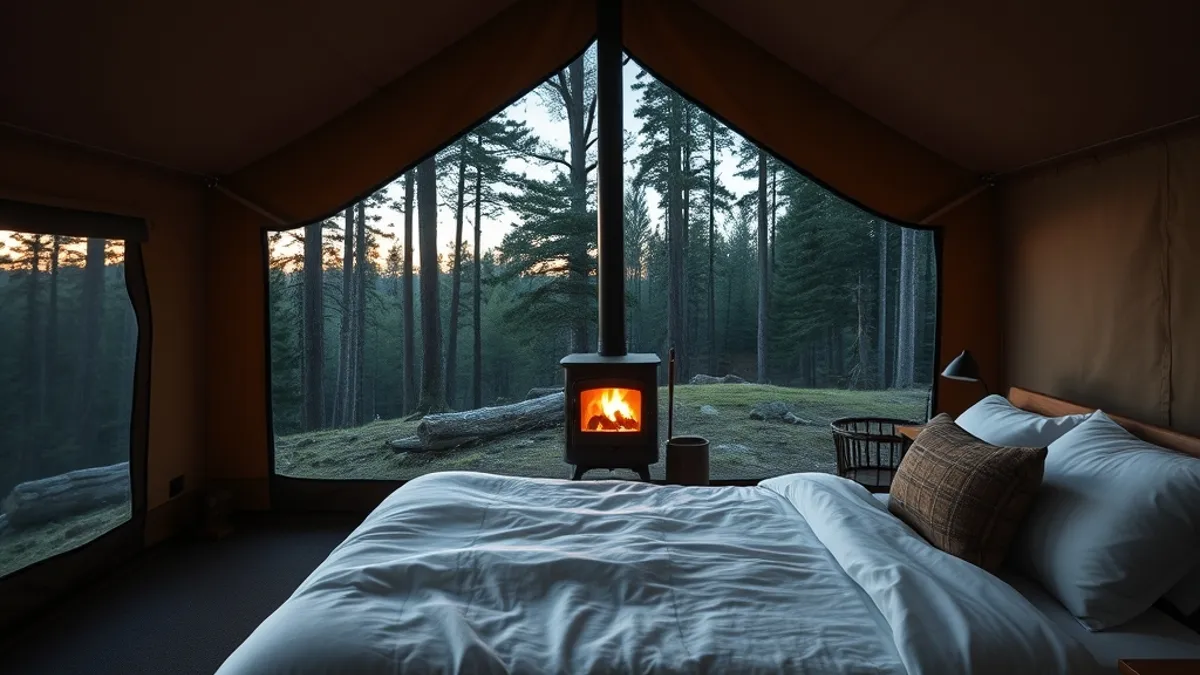
- Climate control: a wood stove, underfloor heating or air conditioning keeps the tent usable at night and in cold months, something absent from most budget tents, where a hot water bottle is the entire heating plan.
- Solid flooring: a proper deck or hard floor blocks the dust, cold and damp that seep straight through groundsheet-style floors, and it means no midnight wobble on uneven ground.
- Insulated canvas and framing: quality materials dampen wind noise, keep rain from drumming directly over your head, and hold warmth long after the stove goes out.
If a listing is vague on all four of these points, the premium price is buying styling, not comfort.
Outdoor Features That Justify the Premium
Outdoor features are where luxury glamping stops imitating a hotel and starts justifying its own category. The single most cited feature in stays above $400 per night is a private wood-fired hot tub or plunge pool, and it’s easy to see why: soaking under open sky, steam rising, no one else in sight, is the experience standard tents simply cannot offer. Wood-fired hot tubs and private decks are the most commonly cited premium features across high-end listings, so their presence is a fair signal that a property has invested where it counts.
The second pillar is private outdoor space that belongs to one tent only. Think expansive decks with loungers, an outdoor shower and a fire pit reserved for your stay, rather than a shared deck where you negotiate sightlines with neighboring guests. Positioning plays a role too: top-end operators angle each tent and fit floor-to-ceiling windows so the view is curated for one unit, instead of offering a communal sightline everyone shares.
Food is the third lever, and the price of it is fairly predictable. When meals are included, all-inclusive plans typically add $50 to $120 per person per day. Here’s what that tier usually buys:
- Outdoor kitchens or covered cooking areas: a proper prep space with a grill or stove on your own deck, so you can cook with a view instead of walking to a communal camp kitchen.
- Private chef service: a chef who cooks and plates meals for your tent alone, often using local ingredients, which is what pushes meal plans toward the upper end of that price range.
- Fire pit dining setups: pre-stacked wood, cooking grates and seating arranged at your pit, so an evening by the fire becomes a dinner venue rather than a place to burn marshmallows.
One private deck and a working hot tub can turn a simple tent into a full resort experience, which is exactly what these features are priced to deliver.
Service Levels You Should Expect at the Top End
Service is the least visible luxury glamping amenity and the one that most often exposes a property pretending to be upscale. At the top end, you should have a dedicated host or on-site staff who respond within minutes, not a self-check-in lockbox and a phone number that goes to voicemail. If something breaks, if the stove won’t light, if you need a dinner recommendation, someone is there. That human presence costs money to maintain, and it’s a legitimate part of a higher nightly rate.
Housekeeping and daily upkeep
On multi-night stays, housekeeping should be standard, just as it is in hotels: beds refreshed, floors swept, towels replaced, the wood stove restocked. This is rare below the luxury tier of glamping, where you’re often expected to manage your own bedding and firewood for the entire stay. If a listing charges premium rates but only offers a mid-stay towel swap on request, that’s a gap between marketing and operation.
Concierge extras and dining
The best operations go further with concierge-style extras: pre-arranged airport or trailhead transfers, guided excursions booked before you arrive, and a stocked pantry waiting in your tent so you don’t need to drive out for basics. Dining is another clear marker of a true upscale operation. All-inclusive meal plans add a meaningful per-person daily cost on top of the room rate, and breakfast delivered to your tent or a full hosted dinner shows the property has a real kitchen team, not just a kettle. Check exactly which meals are included before you book, because “breakfast included” and “fully catered” are very different price tiers.
Before booking, it’s fair to ask directly: who is on site, during which hours, and what happens if something goes wrong late at night? The answer tells you more about the service level than any photo gallery.
Location and Exclusivity as Hidden Value
Some of the highest glamping rates you will see have very little to do with the tent itself. The location does the heavy lifting. Properties inside private reserves or along national park boundaries often pay for permits, conservation contributions and strict land-use rules, and those costs show up in the nightly price. The permit system also caps how many operators can exist in these areas at all, so supply stays tight no matter how strong demand gets.
Density matters just as much. A property with one to five units gives you silence, dark skies and wildlife that has not learned to avoid people, while a resort-style camp with 20-plus tents inevitably shares trails, fire pits and views. The trade-off is distance: the most exclusive sites typically sit 30 to 90 minutes from the nearest town, which means longer transfers, higher logistics costs and fewer last-minute dinner options. That isolation is not a flaw in the product — it is the product.
Seasonality adds another layer. Peak windows in popular regions commonly run 30 to 50 percent above shoulder season prices, simply because the best weeks sell out first. If you want a sense of what true remoteness feels like in practice, this piece on remote hideaways on Mongolia’s Khuvsgul lake region shows how far operators go to reach settings where nobody else is competing for the view.
- Permit-limited supply: operators on protected land often cannot expand or add units without new approvals, so even a fully booked season cannot be met with more inventory — scarcity is built into the system, not manufactured by marketing.
- Staffing economics of remoteness: keeping cooks, guides and housekeepers on-site far from town means housing them and sourcing supplies at a distance, which is a real cost baked into rates at isolated properties.
- Wildlife access on your doorstep: low-density sites in private reserves often allow guided walks or night drives on the property itself, something a 20-tent camp usually cannot offer without crowding the same ground.
- Transfer logistics: at sites 30 to 90 minutes out, ask whether the rate includes a pickup or shuttle — if it does not, budget for that separately before comparing prices with a town-adjacent option.
How to Check Whether the Rate Is Actually Worth It
A high nightly rate is a claim, not a guarantee. The good news is that luxury glamping claims are unusually easy to test, because the amenities that justify the price — bathrooms, heating, service — are exactly the things past guests write about in detail. A listing can promise anything, but a guest who shivered through a cold night or queued for a shared shower has no reason to be polite about it. That makes review-reading and direct questions surprisingly powerful tools. Work through the checks below before you commit, and most overpriced listings will sort themselves out in under an hour.
- Compare amenity lists line by line. Pull up two or three cheaper options in the same region and put their lists next to the expensive one. If the $700 tent offers the same hot tub, ensuite and wood stove as a $350 competitor nearby, the premium is location or branding, not comfort — and you can decide which of those you actually want to pay for.
- Read recent reviews with three keywords in mind. Search guest feedback specifically for mentions of the bathroom, the heating and the service. These are the three areas where luxury claims most often fall short in practice: a “spa bathroom” with weak water pressure or a “cozy tent” that turns cold at 2 a.m. will show up in reviews long before it shows up in the listing photos. Prioritize reviews from the last season, since older feedback may describe a tent that has since been renovated — or let slide.
- Ask the host direct questions before booking. Message them about water pressure, how warm the tent stays overnight and whether staff are on-site around the clock. Vague or evasive answers are themselves useful information — a genuinely upscale operation will answer specifics without hesitation.
- Time your booking to the calendar. For summer dates, booking 3 to 6 months ahead locks better rates and first pick of units. If your dates are flexible, targeting shoulder season gets you the same amenities at noticeably lower prices with fewer neighbors.
None of this takes more than an hour, and it is the difference between paying for a genuinely premium stay and paying a markup. The travelers who get the best value from luxury glamping are almost never the ones who found a “deal” — they are the ones who verified the details first, asked the awkward questions early and booked with a clear picture of exactly what their money was buying.
Where Luxury Glamping Delivers This Value Best
Not every landscape makes a luxury tent worth $500 a night. The settings where the premium holds up best share one trait: the environment itself would be genuinely uncomfortable without the engineering around you, so the comfort being sold is real, not decorative.
Wild, remote landscapes
Icelandic volcanic plains and the lake regions of Mongolia are the clearest examples. In both, a heated, insulated tent with running water is not a nice-to-have — it is the difference between a memorable night and a miserable one. Building and supplying structures in these environments carries real cost, from hauling water to generating power off-grid, and that cost is exactly what the rate reflects. When the wind picks up outside and you are warm under layered linens with a view of open tundra, the price makes sense in a way it never would in a mild valley.
Coast, countryside and heritage settings
In gentler landscapes, the value formula shifts from survival to experience. Along coastlines and in rolling countryside, a private deck with a wood-fired hot tub turns a simple canvas structure into something close to a full resort — your own sauna-like soak, your own sunset, no shared facilities in sight. In heritage regions, the premium comes from design: tents styled with local character, from riad-inspired detailing to handwoven textiles, that blend regional craft with hotel-grade bedding and bathrooms. Here you are paying partly for a sense of place that a generic chain hotel in the same town cannot replicate at any price.
The common thread is that the money goes into something you can point at — heating against real cold, privacy against real crowds, or design rooted in a real culture. That is the kind of premium worth checking carefully, and usually worth paying.
The Bottom Line on Paying More for Glamping
A higher nightly rate is usually earned, not invented. When a tent costs two or three times a standard option, look for the tangible upgrades: an ensuite bathroom, climate control for cold nights, a private deck or hot tub, and staff who actually answer when something goes wrong. If those appear on the amenity list and show up in recent reviews, the price reflects real comfort rather than clever branding.
The fastest way to check is simple: compare amenity lists side by side and read reviews that mention bathrooms, heating and service specifically. Then use timing to your advantage. Booking 3 to 6 months ahead for summer dates, or choosing shoulder season instead, often secures the same premium setup at a noticeably lower price. If you have stayed somewhere that justified its rate, or one that did not, share your experience in the comments.