Every villa listing has that photo: a wide terrace, two loungers, an infinity edge, golden light. What the photo cannot show you is where the sun sits at two in the afternoon, whether the breeze turns into a wind tunnel, or whether the neighbor’s balcony looks straight down onto your dining table. That gap between the hero shot and daily reality is exactly where outdoor living at villas succeeds or fails.
This guide walks through what actually makes outdoor space livable: how to judge a terrace beyond its photo, why mature gardens are worth more than they appear, which shade setups hold up through the day, when to book around the outdoor season, and how to match the layout to the way you travel. By the end, you will read villa listings with a sharper eye and know which questions to ask before you commit.
Why outdoor living at villas depends on more than a good photo
A single wide-angle shot of a terrace can hide almost everything that matters. Wide-angle lenses push walls and rooflines out of frame, so you may never see that the space has no shade after ten in the morning, that it catches the full force of the afternoon wind, or that the villa next door overlooks it completely. Photos are taken at the most flattering hour of the most flattering day, which is rarely the hour you will actually be sitting there.
Real outdoor living means the space works across the whole day, not just at sunset. You want a spot for morning coffee in the light, a shaded corner at midday when the sun is directly overhead, and a comfortable table for dinner once it cools down. If the only usable zone is a strip by the pool between four and six in the evening, you do not have outdoor living. You have a photo opportunity.
What a genuinely livable villa gives you
The villas where guests end up spending most of their stay share a pattern: a covered veranda deep enough to block the high sun, a garden with real planting rather than a token lawn, and a pool or plunge area that anchors the afternoon. Together, these let you stay outside for eight to ten hours a day instead of retreating indoors every time the heat peaks. That is the difference between renting a villa and simply renting a bigger hotel room.
When you browse listings, train yourself to look past the hero shot and count the outdoor zones instead. One good photo tells you nothing; three distinct, sheltered spaces tell you the owner has actually thought about how people live there.
The fastest test of a terrace is how much of it is shaded. As a rule of thumb, look for at least 40-50% of the total surface covered by a pergola, awning, or deep roof overhang. Below that, the space becomes a part-time feature: fine for a quick breakfast, abandoned by late morning.
The reason is simple physics. Pergolas and deep verandas keep surfaces 10-15°C cooler than unshaded decking at midday, and that difference decides whether you actually use the space. Stone and timber that would burn your feet in direct sun stay comfortable under cover, and the air above them stays sit-down-and-stay-a-while cool instead of radiating heat back at you.
Orientation matters just as much. Check the listing photos for shadows and sun position: a west-facing terrace peaks in heat between three and six in the afternoon, which is precisely when you want to sit out with an aperitif. East-facing spaces shine at breakfast and fade by dinner, so the ideal villa often gives you both.
- Power outlets: you will want them for a fan, a laptop, phone chargers, or string lights once the sun goes down, and retrofitted terraces often lack them entirely.
- Lighting: look for wall sconces or covered fixtures rather than a single bare bulb, since good evening lighting is what turns the terrace into your main room after dark.
- Table size: confirm the dining table actually seats your whole group, because a romantic two-seater on a six-person villa forces half the party indoors at mealtimes.
- Furniture quality: cushions that are stored wet, wobbly plastic chairs, and a lone lounger for a four-guest villa are all signs the terrace was styled for photos, not use.
Terraces: what separates a usable one from a decorative one
Many villa listings show a beautiful terrace that nobody actually sits on by noon. The difference between decorative and usable usually comes down to one thing: shade. A comfortable shaded terrace needs at least 40-50% coverage of its total surface, whether that comes from a pergola, a retractable awning, or a deep roof overhang. Under a solid structure, surfaces stay 10-15°C cooler than exposed decking at midday, and that gap decides whether you eat lunch outside or retreat to the sofa.
Orientation matters just as much. Study the listing photos for shadows and compass clues: a west-facing terrace peaks in heat between 3 and 6pm, exactly when you want to sit out with an aperitif. If the only shaded corner faces east, you will get lovely breakfast light and an unbearably hot evening. Ask the host directly which hours the terrace is comfortable in the season you plan to travel.
Then look at the practical fittings, which separate a real outdoor room from a slab with chairs:
- Power outlets on the terrace itself. You need them for a fan, a speaker, a blender, or a laptop; if none exist, check whether an extension cord can safely reach from indoors.
- Layered lighting. Overhead lights for dining, plus low-level or warm accent lights so the space stays inviting after dark rather than switching to a single harsh bulb.
- A table that actually fits your group. Count the chairs in the photos, not the table size; a six-seater with four chairs is a common listing trick.
- Wind exposure. A terrace that catches constant trade winds can render even a sturdy umbrella useless, so look for a sheltered corner or a windbreak wall in the photos.
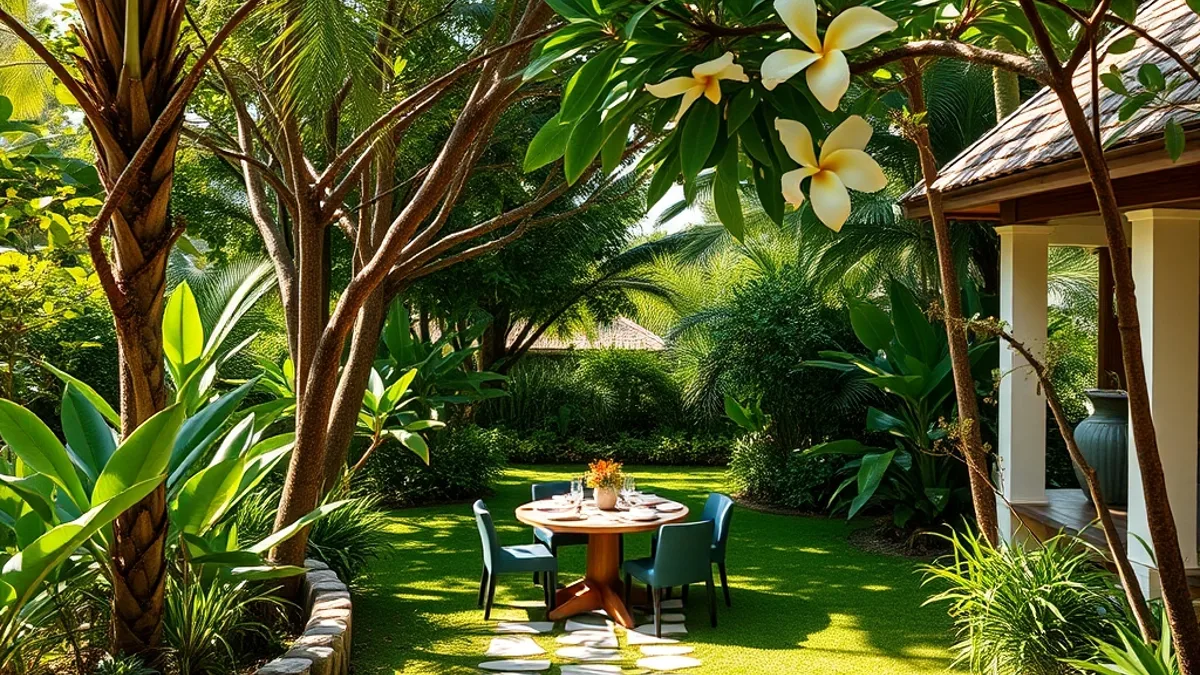
Gardens as the quiet luxury that photos rarely capture
Gardens are the feature that villa photos handle worst, and the one that quietly separates memorable stays from ordinary ones. The biggest advantage is shade: mature trees provide the best natural cover of any outdoor feature, and there is no shortcut, because a tree needs 5-10 years of growth to cast a proper canopy. That is why older properties usually win here. A newly built villa can install a pool in weeks, but it cannot install twenty years of frangipani.
Privacy is the second quiet luxury. A walled or densely planted garden creates a sense of enclosure that an open-lawn villa cannot match, no matter how big the lawn is. When you can swim, read, and eat dinner without a single sightline from a neighboring property, you use the garden completely differently.
In tropical destinations, the planting itself changes the climate. Gardens layered with frangipani, palms, and ferns cool the surrounding air by several degrees compared with bare ground or paving, so a well-planted villa feels calmer before you have even turned on a fan.
- Maintenance visits: ask whether gardeners come during your stay, since poolside trimming at eight in the morning is not the holiday soundtrack you paid for.
- Where they work: good properties schedule maintenance away from the pool and terrace zones, or skip non-essential work entirely for short bookings.
- What the planting attracts: flowering tropical gardens bring birds and butterflies, but also the occasional insect, so check whether the villa treats the terrace area and provides repellent.
- Edible extras: some villas have lime, mango, or herb beds that guests are welcome to pick from, which is a small detail that tends to come up only if you ask.
Shade strategies from pergolas to palm canopies
Umbrellas look great in listing photos, but they are the weakest form of shade at a villa. A single gust knocks them over, they cast a small circle of cover, and you spend half your afternoon shifting them across the deck as the sun moves. Fixed structures like pergolas and deep verandas solve both problems at once: they stay put in the wind and they shade a much larger area for the whole day, which is exactly why shaded surfaces stay so much cooler than bare decking at midday.
Movable shade is the second layer worth checking for. Louvered roofs let you angle the slats to block the low evening sun while still letting air through, and retractable awnings let you chase shade or invite it depending on the hour. On a west-facing terrace, that flexibility turns the hot late-afternoon window into usable time instead of a reason to go inside.
Natural shade is the most pleasant of all. Palm fronds and broadleaf canopies filter light softly, cool the air around them, and never clank in the wind. The catch is that their coverage depends on the sun’s angle during your travel season, so a garden that is shaded in one month may be fully exposed in another. On islands where palm shadow is part of the appeal, such as the settings described in Zanzibar’s quiet palm-shaded retreats, it is worth asking the host how the light falls in your specific month.
- Check the structure’s footprint, not just its existence. A slim pergola over one corner of a huge deck covers only a fraction of the surface, far short of the share needed for a genuinely comfortable terrace.
- Ask whether louvers are manual or motorized. Motorized systems get adjusted daily; manual crank versions often stay frozen in one position because guests cannot be bothered.
- Look at what is planted above and around the terrace. A canopy positioned to the west of the terrace blocks the harsh afternoon sun far more effectively than one directly overhead.
- Watch for shade that disappears at mealtime. Some verandas are perfectly shaded at lunch but fully exposed by dinner, which matters if outdoor dining is your priority.
Timing your stay around the outdoor season
When you travel matters as much as which villa you pick. In tropical destinations, the dry season delivers the longest stretch of usable terrace hours, which is exactly why rates run 30-60% above shoulder-season prices. You are paying a premium for predictability: day after day of clear mornings and evenings you can spend outdoors without checking the sky.
Shoulder months trade some of that certainty for better value and a different rhythm. Expect warm days punctuated by brief afternoon showers, usually short enough that you barely leave the veranda. For shaded outdoor living, this pattern is arguably ideal: you get dramatic skies, cooler air after the rain, and a terrace that stays comfortable all day under a good roof.
How far ahead to book
Timing your reservation matters most for villas whose main selling point is outdoor space, because there are fewer of them and they sell first. Book 3-6 months ahead for high season, especially if a private pool plus a large covered terrace is on your must-have list. For shoulder season, 4-8 weeks ahead is typically enough, though popular areas fill faster. Speaking of which, budget an extra $150-400 per night for villas that combine a private pool with substantial covered outdoor space; that combination is the single biggest price driver.
Destination choice shapes the equation too. In places like the rice-field enclaves around Ubud, the green season brings brief downpours and misty mornings that suit veranda living beautifully, while inland positions stay cooler than coastal spots. Check rainfall patterns for your specific month rather than relying on generic “dry season” labels, since microclimates vary widely within a single island.
Matching outdoor space to how you actually travel
The right outdoor space depends on how you actually spend your days, and villas that look identical in photos can suit completely different trips. A remote worker needs a shaded, desk-height table with Wi-Fi that genuinely reaches the terrace, not just the living room. A group of eight needs zones, because one shared deck means diners and loungers fight for the same space all week. Deciding your travel style first makes the listing search far easier.
Wellness-focused trips flip the usual priorities. A private pool is nice, but morning light in a mature garden does far more for a restful stay. If that sounds like your kind of trip, it’s worth browsing some wellness retreats built around quiet gardens and restorative design to see how the best properties arrange their outdoor spaces. Orientation toward the east, surrounded by planting, gives you quiet, birdsong, and soft early light for yoga or coffee, while the pool becomes secondary.
- Test the Wi-Fi claim before you book. Ask the host for a speed test taken on the terrace itself, and confirm there is a shaded, desk-height surface rather than a low coffee table that wrecks your posture by day three.
- Look for level changes, not just square meters. Split-level outdoor zones, with dining on one tier and lounging on another, let a family spread out without anyone moving furniture twice a day.
- Check where the morning sun lands. East-facing gardens catch gentle early light, while west-facing decks stay blazing until early evening, which changes how you use every hour of the day.
- Plan meals around the good light. The best conditions for outdoor dining fall roughly 90 minutes after sunrise and in the two hours before sunset, so a villa with an east-facing breakfast table and a west-facing aperitif spot covers both.
One practical habit ties it together: before booking, sketch your ideal day hour by hour and match each block to a specific spot in the villa’s photos. If no photo answers for, say, the 3pm nap slot or the sunset drink hour, ask the host directly. Good villas have an answer for every hour; the rest just have a hero shot.
Bringing it together
That single wide-angle terrace photo can’t tell you how the space behaves at 3pm in full heat, or whether the garden gives you privacy and cooling. The answers lie in three things you can actually check: how much of the terrace is covered by shade, whether the trees and planting are mature, and which way the space faces. A pergola or deep veranda keeping surfaces 10-15°C cooler at midday matters far more than stylish furniture.
Once you’ve found a villa that scores well on all three, move quickly. For high season, book standout terraces 3-6 months ahead, and expect an extra $150-400 per night when a private pool comes with a large covered outdoor space. Match the layout to how you actually travel, whether that’s remote work, family meals, or quiet garden mornings, and the outdoor space will do the rest. If this helped you plan, leave a comment or share the article.