You land after a long flight, drag your suitcase to the front desk, and finally open your hotel room door. Then comes the moment every international traveler dreads: your plug doesn’t fit the wall. Even worse, you’re not sure whether your charger is actually safe to use with the local electricity. This guide on hotel power outlets and voltage walks you through everything you need to know before that moment ever happens.
We’ll explain why outlets and voltage differ around the world, which plug types you’ll actually encounter in hotel rooms, and how to tell whether you need a simple adapter or a voltage converter. You’ll also find practical tips for charging phones, laptops, and cameras safely, solutions for common hotel outlet problems, and a pre-trip checklist so you never get stranded with a dead battery on arrival night. A short takeaway at the end pulls it all together.
Why Hotel Power Outlets and Voltage Differ Around the World
Mains electricity is not the same everywhere. The world basically runs on two voltage systems: most of the Americas and Japan use 100-127V, while Europe, Asia, Africa, and Australia run on 220-240V. If your device expects one and receives the other, the results range from a charger that refuses to work to electronics that overheat and fail permanently.
Frequency adds another layer. Some countries supply power at 50Hz and others at 60Hz, and this difference matters mainly for devices with motors or analog timing components. An analog clock brought from a 60Hz country may run noticeably off time on a 50Hz line, and some small motors can behave oddly. Phone chargers, laptop bricks, and other modern electronics are largely indifferent to frequency, so this is rarely a dealbreaker for typical travel gear.
Why a fitting plug is not a safe plug
Here is the mistake that catches the most travelers: plug shape and voltage are completely separate issues. A plug can physically slide into an outlet and still receive the wrong voltage. Some older or multi-standard outlets accept several pin styles, which creates a false sense of security. Before you plug in anything beyond a dual-voltage charger, confirm what the local supply actually is, not just whether the pins line up.
The Plug Types You Will Actually Meet in Hotels
Hotel rooms around the world use a handful of familiar socket styles, and once you can recognize them, packing the right adapter becomes simple. The good news is that four plug families cover the overwhelming majority of destinations travelers actually visit. A single universal adapter covering types A, C, G, and I handles the vast majority of hotel stays worldwide, which is why it is the one accessory most frequent travelers never leave home without.
- Type A and B use flat pins, with Type B adding a round grounding pin. These dominate hotel rooms in North America, Mexico, and Japan, so travelers from those regions often need no adapter at all for each other’s outlets.
- Type C, E, and F are round-pin outlets covering most of continental Europe, including destinations like Portugal and Croatia. The two-pin Type C Europlug alone fits outlets in more than 50 countries across Europe, Asia, and South America.
- Type G is the three rectangular-pin socket used in the UK, Ireland, Singapore, Hong Kong, and the UAE. It has a built-in switch on the wall plate, so flip it on before assuming the outlet is dead.
- Type I has two angled flat pins plus an optional vertical grounding pin, and it is standard in Australia, New Zealand, China, and Argentina.
When shopping for a universal adapter, check that it physically supports all four of these styles rather than just claiming to be universal in bold print on the box. Expect to spend somewhere in the $15-30 range for a solid model, and look for one with a fuse or surge protection as an extra layer of safety. Around 15 plug types exist worldwide, labeled A through N, but the long tail beyond these four families is small enough that most travelers never encounter it. If you do visit a country with an unusual socket, a local shop or airport kiosk will usually have a compatible adapter. A quick photo of your adapter’s face next to a photo of your destination’s outlet type will tell you instantly whether they match before you fly.
Adapter or Converter: Matching Your Gear to the Voltage
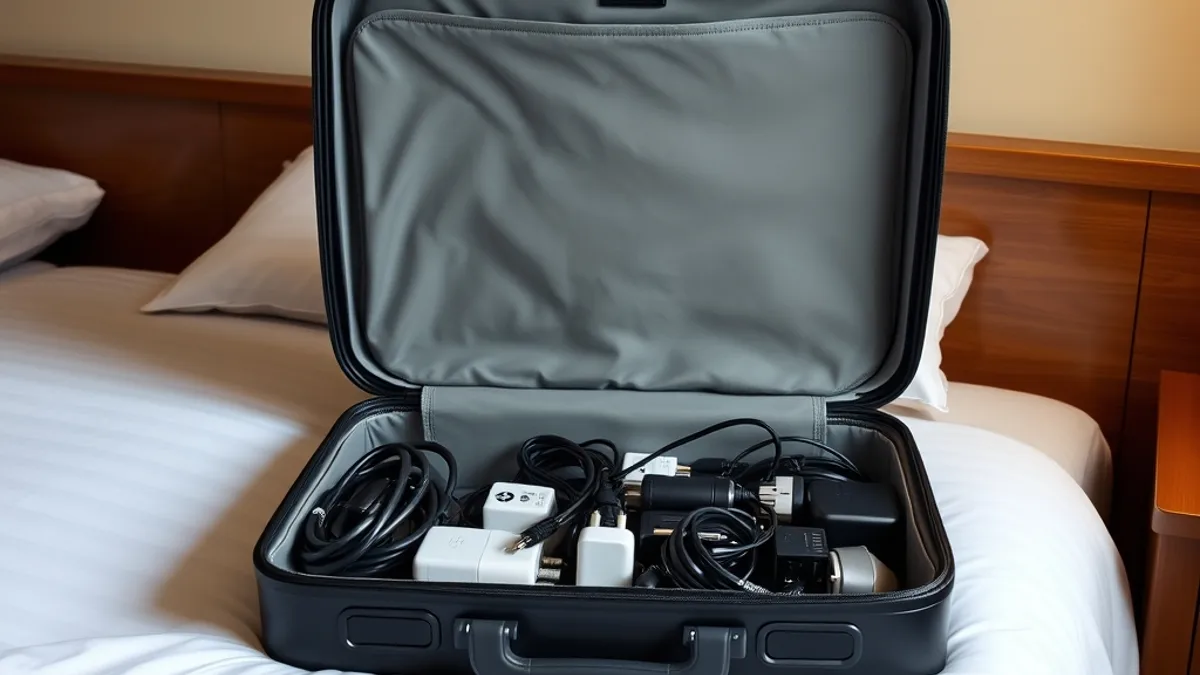
Before you pack anything, flip the charger over and read the fine print. If the label says “Input 100-240V, 50/60Hz,” you’re holding a dual-voltage device. It automatically handles both the 100-127V system used in the Americas and Japan and the 220-240V system used nearly everywhere else. All it needs is a plug adapter to fit the local outlet shape, nothing more.
When you actually need a converter
Single-voltage devices are the problem children of international travel. Some hair dryers, curling irons, and irons draw serious power, and high-wattage devices over roughly 50W usually need a voltage converter rather than a simple plug adapter. Feed a 120V-only appliance 220-240V and you risk burning out the device or tripping the room’s circuit, sometimes with a burning smell thrown in.
Even then, converters come with real limitations. They’re heavier than adapters, and most are rated for short-term use only, not the twenty minutes a hair dryer actually needs. That’s why many experienced travelers skip converters entirely and simply buy dual-voltage styling tools, or use the hair dryer already provided in the hotel bathroom. It’s lighter luggage and one less thing that can fail.
Charging Phones, Laptops and Cameras Safely in Your Room
Here’s the good news: the gear you charge every day is already built for world travel. Phone, tablet and laptop chargers are almost always dual-voltage, meaning they accept 100-240V input at 50-60Hz. That means a single universal travel adapter, typically costing $15-30, is all you need to plug in anywhere your hotel happens to be.
If you want to simplify even further, look at USB-C Power Delivery chargers. These work worldwide with nothing more than a plug adapter, so one compact brick can handle your phone, tablet and laptop in any country. For many travelers, that becomes the simplest single-charger setup possible: one charger, one adapter, done.
Newer hotels are also making things easier. Many modern rooms include built-in USB-A or USB-C ports on bedside panels or wall outlets, so you can charge small devices directly with your own cable and skip the adapter entirely. Check the panel by the bed when you check in before digging through your bag.
A few cautions before you pack. If you’re considering a power strip, keep these points in mind:
- Voltage rating matters: only bring a power strip that is itself dual-voltage; a 120V-only strip plugged into a 240V line can overheat or trip the room’s breaker.
- Grounding: choose a strip that is ungrounded-safe, since many hotel outlets around the world lack the grounding pin your home outlets have.
- Skip the adapter stack: daisy-chaining one adapter into another, or stacking a strip on top of an adapter, can loosen connections and spark, so plug your charger directly into a single adapter whenever possible.
Common Hotel Outlet Problems and How to Handle Them
Even with the right adapter, hotel outlets can surprise you. Older European buildings in particular were wired long before modern travel gadgets existed, and the sockets reflect that age. Knowing the common problems helps you work around them without a late-night panic.
Loose fits and low-power sockets
In older European hotels, outlets are sometimes recessed or set deep into the wall. Thick, bulky adapter bodies can sit loosely in these sockets, wobbling or losing contact with the pins. A slim, low-profile adapter fits these deep sockets far better, so it’s worth owning one as a backup even if your main adapter is chunkier.
Bathrooms bring a different trap. Many European bathrooms have special shaver-only sockets, clearly marked as such, that are rated for low wattage only. They’re designed for electric shavers and toothbrushes, not laptops or camera batteries. Plugging a laptop charger into one can trip the circuit or worse, so charge your electronics at the desk or bedside outlets instead.
When outlets are scarce or something goes wrong
Older rooms often offer limited outlets, sometimes just one or two behind the desk or bed. Rather than juggling multiple single adapters, bring a compact dual-USB wall charger: one adapter, one outlet, two devices charging at once. It frees up the scarce wall socket for your laptop or a lamp.
Finally, trust your senses. If an adapter or plug feels hot to the touch or smells of burning plastic, unplug it immediately. Then ask the front desk for a room with modern outlets. Hotels deal with this regularly, and a room change is a far better outcome than a fried charger or a scorched wall.
A Pre-Trip Checklist for Hotel Power Outlets and Voltage
A few minutes of checking before you fly saves you from dead batteries and fried devices at your destination. Hotel power problems are almost entirely preventable, and the prep work costs nothing but time. Run through this checklist about a week before departure so you have room to order anything you’re missing instead of paying inflated airport prices.
- Research your destination’s plug type and voltage. Look up which of the roughly 15 plug types your destination uses and whether it runs on 100-127V or 220-240V power. Note that neighboring countries can differ, so a trip with multiple stops may need more than one adapter or a multi-region model.
- Check every charger’s input label. Pick up each charger you plan to pack and confirm the fine print says it accepts 100-240V input at 50-60Hz. Most phone and laptop chargers meet this standard, but anything marked with a single voltage needs a converter or should stay home.
- Pack one universal adapter plus a spare cable. A single universal adapter typically costs $15-30 and covers most hotel stays worldwide. A spare charging cable costs even less and rescues you when the first one frays mid-trip. If your destination runs on 220-240V, leave single-voltage styling tools like hair dryers and curling irons at home rather than gambling on a converter.
- Charge everything fully before the flight. Top off your phone, laptop and camera batteries before you leave. If your adapter turns out to be missing or incompatible on arrival night, a full battery keeps you connected until you can buy a replacement in the morning.
Make this checklist part of your regular packing routine and it becomes automatic. The same five minutes of checking works for every trip, whether you’re heading to a neighboring country or across an ocean. Your devices will thank you, and so will your schedule.
Plugged In and Ready: The Takeaway
So you arrive at your hotel after a long flight, wheel your bag through the door, and the wall sockets laugh at your plugs. The good news is that this problem is smaller than it looks. Voltage systems and plug shapes vary by region, but around 15 plug types and just two voltage bands cover the entire world, so a little preparation goes a long way.
The practical formula is simple: dual-voltage chargers plus one universal adapter solve most hotel power needs. Before you fly, check the input label on every device you pack, because that quick glance is what prevents fried devices and dead batteries abroad. Get that right, and the only surprise waiting at your hotel will be the view. If this helped you pack smarter, leave a comment or share the article with a fellow traveler.