Booking a villa with a private pool feels like winning the family holiday lottery until a quiet worry creeps in: unsupervised water is the biggest risk on an otherwise perfect trip. Drowning is a leading cause of accidental death for children aged 1-4 worldwide, and a villa pool, unlike a resort pool with lifeguards, has no one watching it but you.
The good news is that villa pool safety is manageable when you treat it as a series of layers. This guide walks you through vetting a villa before you book, checking fences and barriers on arrival, adding alarms and covers, setting supervision rules that actually hold up, teaching kids the pool rules in a new environment, and packing a simple family pool safety kit. Do these things and you can enjoy the holiday you actually booked.
Why Villa Pool Safety for Kids Starts Before You Book
The most important villa pool safety decisions happen weeks before you pack a suitcase. Start by filtering your villa searches for “family-friendly” listings, then go a step further: message hosts 2-4 weeks before arrival and ask directly for photos of the pool fencing, any safety covers, and the pool steps or entry. A host who answers quickly with clear photos is telling you something useful. Vague answers or “the pool is very safe, don’t worry” are reasons to keep looking.
Choose the pool design with safety in mind
Prioritize villas with four-sided isolation fencing or a gated pool over properties with infinity edges or shared, unsecured pools. Four-sided fencing means the barrier surrounds the pool itself and separates it from the house, so a child cannot wander from a bedroom straight into the water. Infinity edges and shared pools can be beautiful, but they remove the physical barrier that does most of the protective work.
Also check whether the pool has a shallow zone and a gradual entry, such as beach-style steps or a wide shelf, before you confirm your stay. Young swimmers need somewhere they can stand comfortably, and a gradual entry makes getting in and out far less dramatic. If the listing photos only show a deep, uniformly sloped pool, ask about it in writing so you have the answer before you commit.
Checking Fences and Barriers on Arrival
However thorough you were before booking, verify everything in person. Walk the pool perimeter on day one and confirm the fencing is at least 1.2 meters tall with a self-closing, self-latching gate. This matters because four-sided pool fencing with self-closing, self-latching gates reduces child drowning risk by more than 80 percent, but only if the barrier is actually intact and functioning.
Test the latches yourself at child height. If a latch is stiff but workable by a determined five-year-old, or if the gate doesn’t swing fully shut on its own, flag it right away. Then look at the fence line from a toddler’s perspective and move anything climbable.
- Loungers and chairs: Shift any furniture leaning against the fence, since a child can use it as a step to the top rail.
- Planters and pots: Large decorative planters near the fence line work just as well as a stool, so relocate them out of reach.
- Storage and equipment boxes: Pool toy chests or maintenance boxes left against the barrier create the same climbing problem, so ask for them to be moved.
If you spot gaps under or between fence panels, or a gate propped open with a rock for staff convenience, ask for repairs immediately and politely insist the prop disappears for the duration of your stay. Most villa staff will act quickly once they understand you mean it.
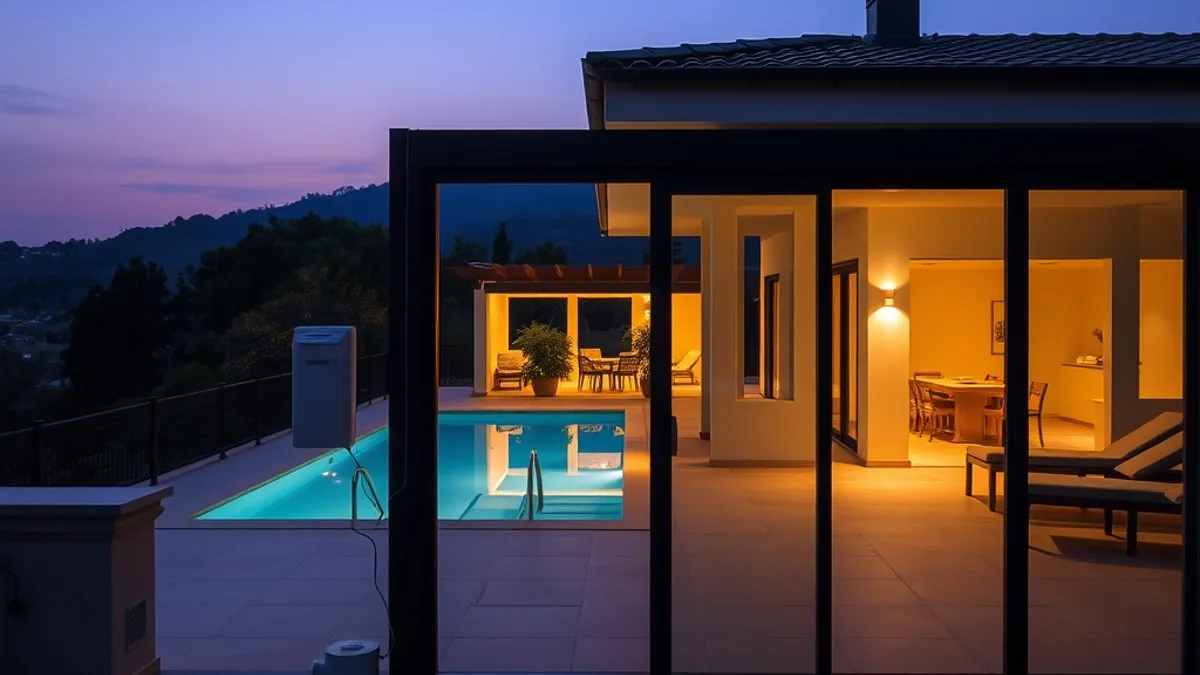
Adding Alarms and Extra Layers of Protection
Fences are your first layer, but no barrier is perfect, which is why alarms and covers matter. One of the most useful things you can pack is a wearable wristband alarm for toddlers, which costs roughly $50-250 depending on the model and sounds a loud receiver alarm the moment it gets wet. Alternatively, ask the host before arrival whether the villa already has floating pool alarms or door alarms installed, and request a demonstration on day one so you know how to arm and test them.
Secure the doors that lead to the water
Many villa accidents start indoors, with a sliding door that opens directly onto the pool deck while parents sleep or cook. Fit sliding-door alarms on any villa rooms that open straight onto the pool area, especially bedrooms where children sleep. These are inexpensive, battery-powered, and loud enough to wake the household if a door slides open at night or during an early morning solo adventure.
Covers: rigid beats flimsy every time
At night, use a rigid safety cover or a properly tensioned pool net rather than a flimsy solar cover. Solar covers are designed to warm water, not to hold weight, and a child can slip beneath one and become trapped out of sight. If the villa only offers a solar cover, ask whether a safety cover or net can be fitted, or make sure the pool area is fully locked and alarmed overnight instead.
Supervision Rules That Actually Hold Up
On holiday, everyone wants to relax, and that is exactly when supervision slips. The fix is simple: make water watching an official role, not a vague group effort. Before each swim, one adult takes the watch, and everyone knows who it is. That person stays sober, stays put, and stays focused on the water.
The watch works best with clear ground rules. Agree as a family that no child enters the pool area without an adult present, even for a minute. This covers the tempting moments: a quick retrieve of a forgotten toy, a dare between cousins, a toddler wandering out while lunch is being prepared. A closed gate plus a named watcher is what stops those moments from becoming emergencies.
It helps to remember how fast things go wrong. Children can drown silently in under 2 minutes, and in as little as 5 cm of water. There is usually no shouting or splashing to alert you, which is why phones stay away during watch duty. A watcher scrolling on a lounger is not watching.
- Swap the watch every 15-20 minutes so no adult’s attention fades, and hand over verbally: “You have the watch now” leaves no room for confusion about who is responsible.
- Keep a phone nearby but face-down and silent, reserved only for calling emergency services, so the watcher is reachable without being distracted.
- Count children out loud when the session starts and ends, so you always know exactly how many kids are in or around the water.
- Position the watcher inside the fence at pool level, not on a balcony or upstairs terrace, where railings and distance make it harder to see a child at the water’s edge.
Teaching Kids Pool Rules in a New Environment
A private villa pool is unfamiliar territory: different depths, different deck surfaces, different entry points. Treat it like a new playground and give kids a proper tour before anyone swims. On arrival day, walk the whole pool area together and point out the shallow end, any depth markers and the no-go zones, such as the deep end, the pool equipment corner or a steep drop-off near an infinity edge.
Set the villa rules on day one
Villa pools come with hazards hotel pools often do not, so set house rules immediately. Wet stone decks around villas are frequently slippery, so running is off-limits from the start. Diving is banned unless you have personally confirmed the depth, because unfamiliar water can be shallower than it looks. Keep the rules short, repeat them at the start of each swim, and apply them to visiting friends and cousins too, so no child feels singled out.
Swim aids stay on at the edge
Non-swimmers should wear armbands or swim vests even when they are only playing at the pool edge, not just when they are in the water. Falls happen at the edge, and a child who slips in without flotation has seconds, not minutes. Make it a fixed routine: armbands go on before the gate opens and come off only when you leave the pool area. It removes the daily negotiation and keeps protection constant.
Packing a Family Pool Safety Kit
A small bag of safety gear takes up little suitcase space and covers the gaps many villa pools have. Private rentals rarely provide rescue equipment or child-specific alarms, so assume you need to bring your own. Pack a compact kit: a wearable wristband alarm for toddlers, a door alarm for rooms that open onto the deck, high-visibility swim vests for non-swimmers, and a basic first-aid kit with waterproof plasters and antiseptic.
Spend an hour on logistics on your first day. Save the local emergency numbers in every adult’s phone, including the local equivalent of 911, and locate the nearest clinic or hospital to the villa on a map. Note the route and rough travel time, because you do not want to be searching for it under pressure. If the villa has no reaching pole or ring buoy poolside, improvise one: a long brush handle, a pool net pole or a sturdy plastic ring kept by the gate is far better than nothing.
- Test the wristband and door alarms before the first swim, and pack spare batteries, since a flat battery on day three silently cancels your protection.
- Choose swim vests in bright colors like orange or yellow, so non-swimmers are easy to spot instantly across a crowded pool deck.
- Store the first-aid kit in a known, dry spot near the pool, and make sure every adult and older child knows where it is.
- Write the villa’s address on a card in your wallet, because telling emergency services exactly where you are is harder than it sounds on holiday.
Relaxed Holidays Come From Layers of Protection
That hidden worry about unsupervised water doesn’t have to follow you on holiday. Vetting the villa before you book, checking fences on arrival, adding alarms and setting clear supervision rules all work together as one system. No single layer is perfect, but each one buys time, and time is exactly what prevents accidents when children are near water.
Families who plan pool safety in advance are the ones who actually get to enjoy the private-pool holiday they booked: slow mornings, sunset swims and kids worn out by dinner. Do the prep, relax properly. If this helped you plan your trip, share it with another traveling family or leave a comment below.