The booking photos look perfect: a private pool, a wraparound terrace, not another soul in frame. Then you arrive and discover the neighbors are three meters away, sipping coffee with a direct view of your lounger. Villa privacy is one of the most misunderstood parts of resort travel, and most travelers have no idea what to check before they reserve.
This guide breaks the problem down into parts you can actually verify. We start with what villa privacy really means, then look at how to read barriers like walls, screens, and hedges, and the sightline geometry that no photo ever shows. We also compare shared walls with fully detached units, explain how to confirm privacy before you book, and point to destinations where seclusion comes naturally. A short checklist at the end pulls it all together.
What Villa Privacy Actually Means
Villa privacy is not one thing. It is four separate layers, and a property can score well on one while failing completely on another. Visual screening means you cannot be seen from neighboring units. Sound separation means you cannot hear them, and they cannot hear you. Access control covers who can physically reach your terrace or plunge pool. And sightline geometry describes the angles between your outdoor space and everyone else’s.
This is why a villa can be beautifully screened with planting on three sides yet still share a party wall with the unit next door. If you are a light sleeper, that shared wall matters far more than a hedge. Before comparing options, decide which layer matters most to you, because few villas deliver all four equally.
The view-versus-seclusion trade-off
Ocean and jungle views often trade directly against seclusion. The more open the frontage, the more exposed the terrace becomes, since an uninterrupted view toward the horizon usually means an uninterrupted view back toward you from somewhere else. Villas with wide, open layouts tend to rely on distance or orientation for privacy rather than barriers. If a listing shows a sweeping panorama and a low, open deck, assume that anyone on a neighboring property with a similar vantage point can see across it, and ask specific questions before booking.
Screens, Walls and Hedges: Reading the Barrier
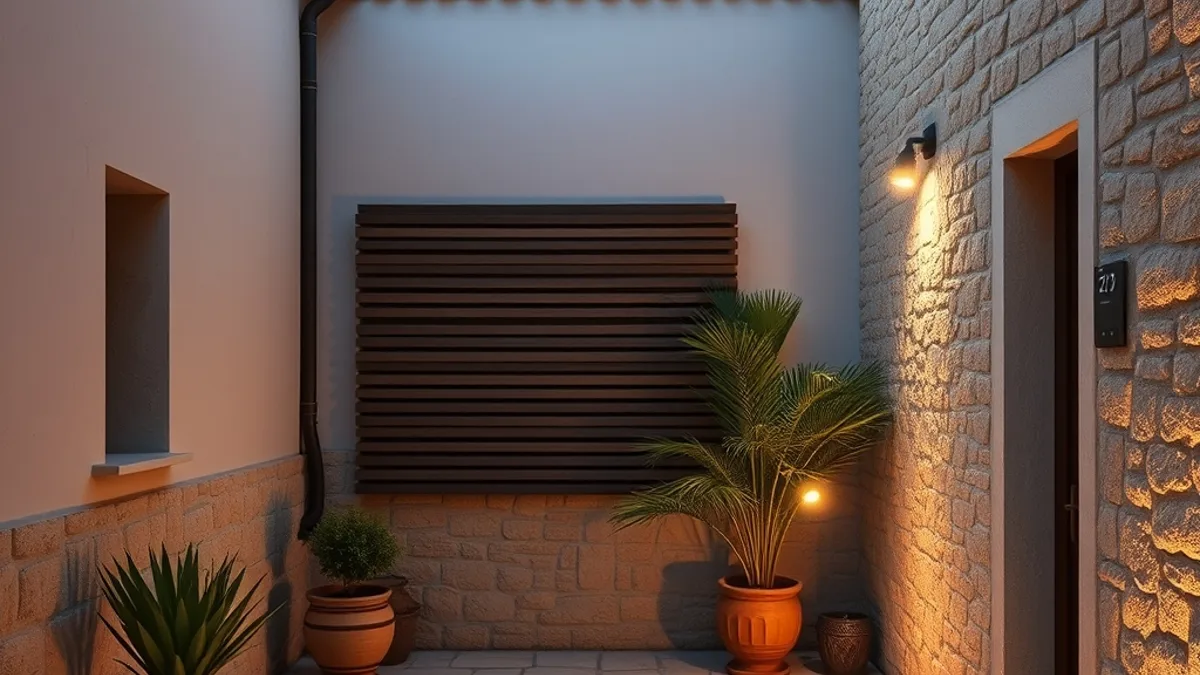
Barriers are the most visible layer of privacy, and they come in three main types. Solid walls over 2 m give the strongest screening available, blocking both sightlines and some wind, but a tall wall on every side can feel cage-like, especially in a compact courtyard plan. Slatted timber screens are the middle ground: they filter views while keeping airflow, which matters in hot climates where a solid enclosure turns a terrace into an oven.
Hedges work differently. Ficus, bamboo, and bougainvillea soften sightlines naturally and add greenery, but they only block a seated view if they reach roughly 1.5-2.5 m in height with dense planting. A sparse hedge with gaps at eye level provides atmosphere, not privacy.
- Check the maturity of the planting, not just the species: a newly planted hedge may need a full growing season or more before it actually blocks anything, so ask when it was installed.
- Look at where the barrier sits relative to your furniture: a 2 m wall protects a standing view, but if your daybed sits on a raised deck, the effective screening height drops.
- Bougainvillea and ficus drop leaves and flowers daily, so a hedge that doubles as a pool fence means more skimming and staining on the water surface.
Low planting under 1 m is decorative, not private. If the listing photos show waist-high frangipani beds and clipped shrubs, treat it as a signal that the villa relies on distance or orientation instead of barriers. That can work perfectly well, but only if the neighboring units are far enough away or angled differently, which is a geometry question rather than a planting one.
Sightlines: The Geometry Nobody Photographs
Sightlines are the part of villa privacy that no photograph captures, because a camera shoots from one fixed point while your terrace lives in three dimensions. Two villas can sit 20 m apart and still have total privacy, while two others 40 m apart stare straight into each other’s pools. Distance alone tells you almost nothing; the angle between units matters far more. The fix is to work through the geometry step by step before you commit, using the site plan as your main tool rather than relying on marketing photos or drone shots that flatter the layout.
- Study the direction neighboring terraces and pools face. A 30-60 degree offset between pools usually removes direct views, since no one lounging by either pool looks straight across at the other. Diagonal placement also means people see foliage and sky in the background, not a stranger’s sunbeds.
- Ask what sits higher on the slope. Elevated villas look wonderfully private in photos, but hillside layouts mean units above and behind can overlook your deck, so request details on everything at a higher level. A villa that screens beautifully from the path can still be read like a stage from the ridge above.
- Request a site plan or unit placement map before booking. Most resorts send one within 48 hours, and it lets you trace the actual angles between your villa and its neighbors instead of guessing from a resort map designed to look tidy.
Once you have the map, trace a line from your lounger and your pool to the nearest occupied terraces. If those lines cross open space at an angle rather than head-on, you are likely fine. Pay special attention to the view from inside the pool, where a seated position drops your sightline below hedges and railings that block standing views. For a masterclass in privacy achieved through layout rather than walls, it is hard to beat overwater villas separated by open lagoon, where the water itself does the screening work and no barrier is needed at all.
Shared Walls vs Fully Detached Villas
The biggest price gap in any villa resort usually comes down to one thing: whether your walls touch someone else’s. Semi-detached and row villas typically cost 15-30% less than fully detached units in the same resort, and for many travelers that discount is worth serious consideration. The trade-off is sound. A party wall shared with a neighbor can carry conversation, music and even furniture scraping across a floor, especially at night when ambient noise drops away.
That said, not all shared walls behave the same way. Construction matters enormously. Thick masonry or double-wall construction dampens noise far better than thin timber partitions, which are common in lighter, eco-styled builds. When comparing options, ask the resort directly what the dividing walls are made of. A masonry party wall can be close to silent; a single-layer timber partition rarely is.
The smart compromise: end-of-row and corner units
If you want most of the detached experience without the detached price tag, look at end-of-row and corner units. These share a wall on one side only, leaving three sides open to garden, pool or view. In practice, they capture most of the private feel of a standalone villa while sitting comfortably in the mid-range price band. The main thing to verify is what sits along the open sides, since a corner unit facing a walkway or a neighboring pool can feel less secluded than the floor plan suggests. Ask about orientation and check guest photos before committing.
How to Verify Privacy Before You Book
Listing photos and floor plans tell you almost nothing about privacy. What actually matters is the position of your villa relative to everything around it, and the only way to judge that is to ask specific questions and look at the right evidence. Treat it as a short investigation, and do it before you pay the deposit. The good news is that it takes little more than a few emails and twenty minutes with guest photos, and the effort pays off for the entire length of your stay. A villa that looks secluded from the front can back directly onto a service path, and no amount of clever photography will show you that.
- Ask what is beside each side of the villa. Get a straight answer for all four sides: another villa, a service path, staff quarters, a restaurant, or open garden. A villa flanked by green space on three sides is a very different proposition from one with a neighboring terrace two steps away.
- Ask what is above it. Elevated villas often look completely private in photos but can be overlooked from hillside units higher up the slope. If the resort is built on terraced terrain, find out whether any unit sits above and behind yours.
- Ask how far the nearest occupied terrace is. Distance is the simplest form of privacy. A vague answer like “close but separate” is a signal to push for specifics or move on.
- Ask the resort to send a map of the grounds. Most will email one, typically within 48 hours. Study the direction neighboring pools and terraces face, not just how close they are.
- Cross-check guest photos rather than official renders. Renders show the villa at its most flattering angle. Guest photos show what you actually see from the deck, including neighboring rooftops and walkways.
- Read recent reviews with privacy in mind. Guests who were overlooked or kept awake by noise usually mention it specifically, and recent reviews reflect the current state of planting and construction, not the resort five years ago.
One last timing note: end-of-row, upper-floor and detached units sell out 3-6 months ahead in high season. If you have a clear preference, flag it early in the booking notes rather than hoping it survives the reservation process. It also helps to confirm your request in writing once the booking is made, so there is a record of exactly which unit and position you agreed on. If the resort cannot guarantee a specific villa, ask them to note the preference anyway, since front desk teams often have some flexibility at check-in. And if privacy is your top priority, be prepared to walk away from a resort that dodges these questions, because hesitation usually means the answer is not the one you want to hear.
Destinations Where Villa Privacy Comes Naturally
Some destinations make privacy almost effortless, because the landscape itself does the screening work. In rice-field enclaves and green-hill settings, vegetation and terrain act as natural barriers: tall palms, terraced paddies and dense tropical planting block sightlines the way a built wall would, but look far better doing it. Resorts in these settings often need minimal artificial screening, and the views you trade for seclusion are green rather than built-up. If that appeals, it is worth reading about Ubud enclaves surrounded by rice fields and quiet tropical serenity, where this kind of natural screening is the default rather than an upgrade.
Water as the barrier
Overwater and island layouts take a different approach: they rely on distance instead of barriers. Your neighbor is not behind a planted fence but across meters of open water, which removes direct sightlines entirely. The same logic applies on small private islands, where villas are spaced along a shoreline rather than clustered around a shared lawn. The privacy here comes from the layout, so it rarely degrades over time the way hedges can.
Turning inward in the desert
Desert courtyard designs solve the opposite problem: how to stay private in dense settings. Instead of opening outward, these villas turn inward, using high walls and enclosed patios to create a sealed private core. You give up wide views from the terrace, but you gain a completely enclosed outdoor space, often with a plunge pool or shaded seating that no neighbor can see into. Each of these destination types delivers a different flavor of seclusion, so match the style to what you actually want from the trip.
The Privacy Checklist in Short
That booking photo promised seclusion, yet you arrive to find a neighbor’s terrace just a few meters away. The good news: this is avoidable if you know what to look for. Villa privacy comes down to four layers — barriers, sightline geometry, wall construction and surrounding terrain. Work out which of these is your priority, then match it to the destination: vegetation and terrain do in rice fields what distance does overwater.
Before you pay, verify rather than trust: request a site plan, cross-check recent guest photos, and book detached or corner units early, since they sell out months ahead in high season. If your dates are flexible, shoulder-season travel in May-June or September-October widens your choice of genuinely secluded units. If this helped you compare villas more confidently, leave a comment or share the article with a fellow traveler.