Many lodges label rooms “accessible” without meeting any real standard, so travelers with mobility needs can arrive to find steps at the entrance, doorways too narrow for a wheelchair, or a bathroom that cannot actually be used. The word appears on booking sites constantly, but behind it there may be nothing more than a ground-floor location and good intentions. For a traveler who depends on a roll-in shower or a bed at transfer height, that gap between the label and reality can undo an entire trip.
This guide walks through exactly what to verify before you pay for accessible rooms at a lodge. We cover why the label alone proves nothing, which room measurements to confirm, the bathroom and shower details that matter most, how to check step-free routes around shared areas, and a booking strategy built on written confirmation. You will also get a ready-to-send list of questions, so you can turn a vague promise into a booking you trust.
Why ‘Accessible’ on a Lodge Website Is Not a Guarantee
The word “accessible” carries no legal definition on most lodge websites. In practice, it often means nothing more than a room on the ground floor, or one you can technically reach by a ramp somewhere on the property. Few lodges have had their rooms assessed against a formal accessibility standard, and fewer still publish the results. That leaves the definition to whoever wrote the listing, and they may genuinely believe a ramp at the main entrance makes the whole property accessible.
Safari and wilderness lodges are especially prone to this partial access. It is common to find a step-free entrance that leads to a deck reached only by two or three steps, or a wide bathroom door that opens onto a shower with a raised tray you cannot roll over. Remote locations make it worse: many properties were built with local materials on uneven ground, and retrofits happen piecemeal rather than as a planned project.
Read the label as a claim, not a certification
The practical approach is simple: treat “accessible” as a starting claim that you verify, the same way you would treat “sea view” or “sleeps four.” The rest of this article gives you the specific measurements, bathroom details and routes to confirm before any money changes hands. None of the checks require specialist knowledge, just a short list of questions and a willingness to ask for photos.
Room Measurements to Verify: Doorways, Bed Height and Turning Space
Accessible rooms vary enormously in size and layout, so the numbers matter more than the description. Start with the doorways. Ask for the clear width measured in centimetres, with the door fully open and any frame or lip accounted for. Many standard interior doorways measure around 70-75 cm, which rules out most wheelchairs; wheelchair users typically need 80-90 cm of clear width to pass through comfortably. A vague answer like “plenty wide” is not an answer.
Bed height is the second number that decides whether the room works. Ask for the distance from the floor to the top of the mattress, and whether there is clear space on at least one side of the bed for a transfer or a hoist. Then move to the floor area itself: a room can have all the right features and still be too cramped to maneuver in. A checklist covers the rest:
- Turning space: request the room’s total floor area and confirm at least a 150 cm turning circle that stays clear of furniture, including under any desk or luggage bench.
- Thresholds: ask whether the transitions between veranda, bedroom and bathroom are level, or whether there are raised strips, sliding door tracks or small steps at each boundary.
- Furniture placement: check whether the bed can be repositioned and whether low furniture, rugs or dangling cords sit in the usual path from door to bathroom.
Ask for these measurements in writing rather than over the phone. Written answers create a record you can point to, and lodges tend to check with housekeeping before putting numbers on paper.
Bathroom and Shower Checks That Make or Break the Stay
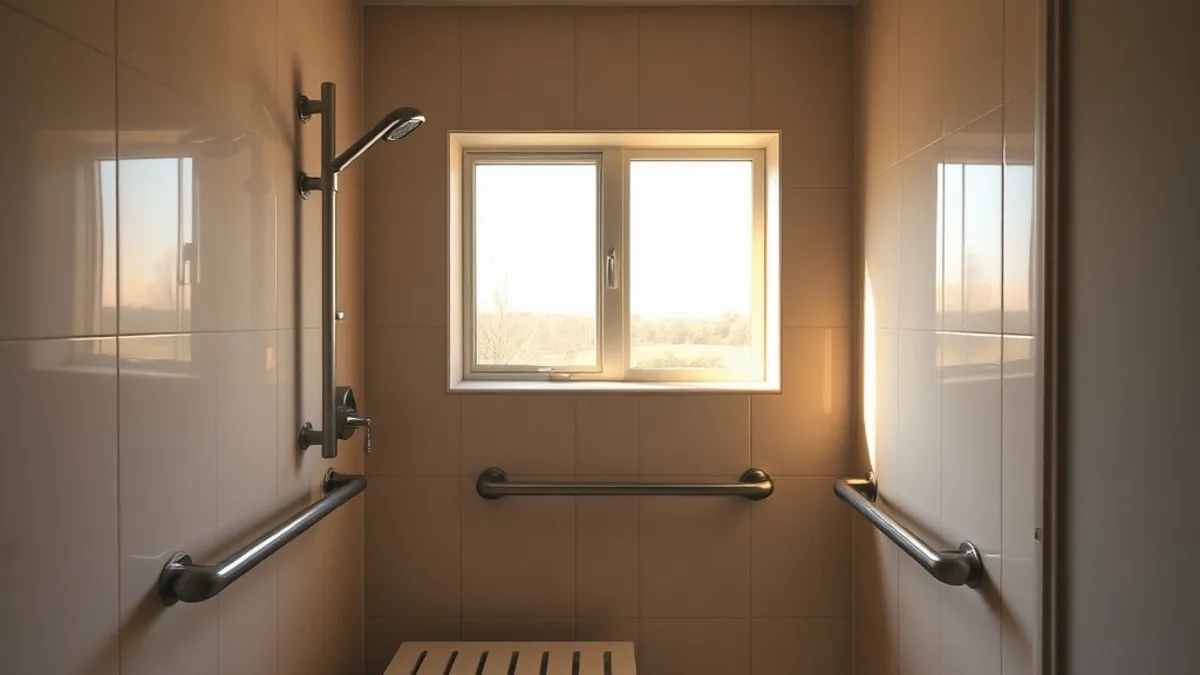
The bathroom is where most accessible room bookings fail, so verify it in more detail than any other space. Confirm there is a true roll-in shower with roughly 90 x 150 cm of clear floor space and no step-up tray at all. A shallow lip or a raised edge that looks minor in photos can make the shower completely unusable from a chair. Ask directly whether the shower floor is flush with the bathroom floor.
Grab bars deserve equal scrutiny. Confirm there are bars positioned beside the toilet and inside the shower, not just somewhere in the bathroom, and that they are fixed to the wall rather than attached to fixtures that cannot bear weight. A fold-down shower bench is another feature to name explicitly, since a freestanding stool is not a substitute. On top of the big features, work through the details:
- Basin height and clearance: check whether the basin has open space underneath so a wheelchair user can roll up close to it, and whether the taps are lever-style rather than twist knobs.
- Reachable fixtures: confirm that towel rails, mirrors, light switches and the hairdryer or kettle can all be reached from a seated position without stretching or standing.
- Toilet height: ask whether the toilet is at a raised height suitable for transfers, and whether there is space on one side to position a chair alongside it.
Photos answer faster than words. Request recent photos of the exact bathroom, or a short video call walkthrough, about 2-4 weeks before arrival. A live video is especially useful because you can ask staff to open the shower door and show the tray edge in real time.
Getting Around the Lodge: Ramps, Paths and Shared Facilities
The route from your car to your room matters as much as the room itself. Ask the lodge to confirm in writing that at least one truly step-free path runs from the parking area or drop-off point all the way to your door. A verbal “yes, it’s all flat” over the phone is easy to give and easy to get wrong, so a written answer gives you something concrete to hold onto if you arrive to find a single step blocking the way.
Shared spaces are the next thing to pin down. A lodge can have a perfectly accessible room and still leave you stranded if the dining area is up three steps or the pool sits across a steep gravel slope. Game-drive vehicles deserve special attention: ask how you board them, whether there is a ramp or lift, and whether staff routinely help travelers transfer into a seat. Some lodges handle this daily and have a system; others have simply never been asked.
Terrain is the detail most travelers overlook until they arrive. Many safari lodges, including some of the spacious homestead-style stays near safari country, sit on ground that standard wheelchairs simply cannot cross. Before you book, ask specifically about:
- Surface underfoot: sand, loose gravel, mown grass and even smooth boardwalks with gaps at the joints can stop a standard chair, so ask which surfaces connect your room to the main areas.
- Slope of any ramp or path: a ramp that exists on paper may still be too steep or too narrow for an independent chair, so ask for its approximate gradient and width.
- Support on offer: confirm whether the lodge provides a golf cart shuttle, dedicated staff assistance between areas, or an all-terrain or beach-style chair you can borrow, and whether these need to be reserved in advance.
- Weather effects: rain can turn gravel paths into mud and make boardwalks slick, so ask what the ground is typically like during your travel dates.
Booking Strategy: Lead Times, Written Confirmation and Direct Contact
Accessible rooms are in a different scarcity category from ordinary rooms. Many lodges have only one or two, and the same handful of dates competes for them every high season. That scarcity changes how you should approach the whole booking process: earlier planning, direct contact with the lodge and a paper trail at every step. The extra effort is modest, but it is the difference between a room that works and a room that merely fits the label.
- Book 3-6 months ahead for high-season dates. With so few accessible rooms per lodge, waiting until a few weeks out usually means choosing between a different lodge and a different room type, neither of which may meet your needs. If your travel dates are fixed around a safari or a family gathering, start the conversation even earlier.
- Contact the lodge directly. Booking-platform filters often mark a room “accessible” based on a single feature, such as being on the ground floor, without any real assessment behind it. A phone call or email to the lodge itself lets you ask the specific questions a filter never will, and you can judge how confident the answers sound.
- Get every promise in writing. After your call, send a follow-up email summarizing what was confirmed and ask the lodge to reply confirming it. If a detail changes or is forgotten at check-in, that exchange is your reference point, and it is far harder for a front desk to argue with than a memory.
- Reconfirm before arrival. Ask for your specific room number and restate the key features you were promised. Lodges occasionally reshuffle room assignments, and a swap to a “similar” room can quietly undo months of planning. A short email close to your arrival date catches most of these problems in time to fix them.
- Ask about the backup plan. Find out what the lodge does if the accessible room has a maintenance problem or is out of service on your arrival day. A vague answer is a warning sign; a clear one, with a named contact and a concrete alternative, tells you a lot about how seriously they take accessibility.
None of these steps takes more than a few minutes, but together they protect you from the most common failure mode: arriving to discover that the room you booked and the room you actually need are not the same thing.
Questions to Send Before You Pay for Accessible Rooms
Once you have shortlisted a lodge, put everything in one email rather than spreading your questions across several messages. A single, organized checklist is far easier for lodge staff to forward to the right person and answer completely, and it creates a tidy written record you can refer back to. Cover the essentials in one pass: doorway widths, bed height, whether the shower is a true roll-in design, grab bars in the right positions rather than just somewhere in the bathroom, step-free routes around the property, and what staff assistance is available day to day.
Photos and accountability matter just as much as the answers themselves. Marketing galleries tend to show the most photogenic suite, which is often not the accessible one, so be specific about what you want to see. And ask who is actually answering you, because generic reservations replies may come from someone who has never set foot on the property. Before you pay, request:
- Dated photos of the exact accessible room, including the bathroom, the doorway and the route from the parking area, so you can see the current state of that specific room rather than a different room type.
- A short video call walkthrough if photos leave gaps, since a live pan across the bathroom and veranda reveals steps, thresholds and clearances that still images can hide.
- The name and direct contact of the staff member handling accessibility, so your follow-up questions go to someone who has seen the room and can answer from experience rather than a brochure.
- Written confirmation of each answer, so that what was promised at booking time is documented and easy to reference if anything changes before you arrive.
Wrapping Up Your Accessible Room Checklist
So how do you avoid arriving at a lodge that calls itself accessible but has steps at the door? The answer comes down to one habit: verify everything in writing before you pay. Ask for the specific measurements, the bathroom features and a confirmed step-free route, and treat a vague “yes, we’re accessible” as a reason to keep asking questions, not a reason to book.
Timing matters just as much as the questions themselves. Because accessible rooms are often limited to just one or two per lodge, booking 3 to 6 months ahead gives you the best chance of securing one, and reconfirming the room and its features 2 to 4 weeks before arrival protects you from a last-minute swap. A short checklist email and a video walkthrough turn an uncertain label into a confident booking. If this helped you plan a trip, leave a comment with your own experience or share the article with a fellow traveler.